
Oil Palms
The tree and its fruits
Oil Palms in Sabah > Oil Palm Tree and Its Fruits
Oil Palms
The tree and its fruits


Development of a FEMALE Inflorescence into a Fresh Fruit Bunch
7th Week to 12th Week
Suggest fertilizer schedule considered satisfactory for oil palm as
following.
N:P2O5:K2O
g/per palm annually
First year
400:200:400
Second year
800:400:800
Third year and onwards
1200:600:1200
Mg application if deficiency symptoms are noticed. Fertilizers are preferably
applied in two equal split doses (May and September), within 2 m diameter around
the palm.
Supply of sufficient quantities of green leaf or compost is advantageous,
especially where the soil is poor in organic matter.


An oil palm fruit bunch contains several
hundred fruits which do not ripen all at the same time. The period between the
first ripen fruit and the time at which all fruits of a bunch are ripen is 18 to
20days.
The manager of an oil palm plantation can control ripeness in two ways:
1) ensure that the frequency of harvesting in any one area is kept sufficiently
high to eliminate over-ripening and the resulting high FFA
2) by setting a standard number of detached ripe fruit per bunch below which
bunches are not harvested, this ensure that under-ripe bunches, which would
reduce oil yield, are not cut.
Harvesting is carried out using either a chisel or a sickle, depending on the
height of the palms. The FFB is harvested by cutting through the bunch stalk and
carried manually to the roadside for transportation to palm oil mill.

Sabah Oil Palm Plantations
The palm oil plantations covering more than 700,000 hectares in East Sabah where
suitable agricultural land are available . Sabah's agriculture land has the
highest yield of oil palm fresh fruit bunch per hectare.
Sabah's Oil Palm Sector is mainly confined to the primary processing of oil
palm. Presently, there are 58 palm oil mills in Sabah producing crude palm oil ,
palm kernel oil and palm kernel cake. Only a small number of refineries
producing higher value added oil palm products.
The Oil Palm Sector is an important sector the economy. In terms of export
earning, oil palm contributes more than 30 per cent of the total income from
exports. In 1998, exports of palm oil reached a record of RM5 billion. Sabah is
the largest producer of crude palm oil in Malaysia contributing 25% of the total
production of crude palm oil in Malaysia.
What is oil palm used for, where is oil palm planted & produced, where is the
oil consumed?
West African have traditionally used Oil palm (Elaeis guineensis Jacq.) to make
foodstuffs, medicines, woven material and wine. Now the palm is planted in
large-scale plantations throughout the tropics countries because it is used in
commercial products like cooking oil, soap, cosmetics and margarine.
Oil from oil palm plant is edible and has now surpassed soybean oil as the most
produced vegetable oil in the world.
Palm Oil also processed into soaps, washing powders and skin care products,
medicines and the future biofuel.
The palm fruit provided two source of oil :
1) Palm oil (from palm fruit) - This Crude Palm Oil (CPO) is the primary product
derived from the red seeds of the oil palm
2) Palm Kernel oil (from the fruit seeds) - Palm Kernel Oil (PKO) from the
fruit’s nut/seed is considered to be a secondary product and the Palm Kernel
Meal (PKM) is used for animal feed mainly.
Palm oil is high in saturated fats and thus semi-solid at room temperature.
Oil palm plantations have primarily expanded in the top two palm oil producing
countries : Malaysia and Indonesia.
Malaysia produced almost 50% of world palm oil production, while Indonesia
produced 30%.
World demand for palm oil has been increasing dramatically. Most of this palm
oil was consumed in Asia.
POIC Palm Oil Industrial Cluster
POIC Sabah Sdn Bhd is a wholly owned company of the State Government of Sabah.
It has a 15-year plan to develop a 7,500 acres of land in Lahad Datu into a
cluster of palm oil-related factories . POIC Lahad Datu is Malaysia's first
dedicated large-scale palm oil downstream industrial cluster. The first phase of
the POIC encompassing over 500 acres is in late stage of completion. Inquiries
to inquiry@poic.com.my Tel : 088-272261
The oil palm (Elaeis guineensis) produces palm oil and palm kernel oil. It is
a native of tropical Africa that is extensively planted commercially in many
other tropical countries.
Palm oil is produced from the pulp of the fruit. The oil is light yellow to red
in color and is rich in carotenes (the precursor of vitamin A) and Vitamin E.
Palm kernel oil is produced from the seed. The oil is almost colorless and is
used in making margarine, ice-cream and in the baking industry.
Oil palm is Sabah's largest agricultural crop with over 1 million ha planted,
almost all In the east coast. The Tawau and Sandakan Residencies have about
436,000 ha and 592,000 ha respectively.
Malaysia produces about 50% of the world's palm oil. The value of palm oil
exports In 2003 was RM 26.15 billion.
There is roughly 1 oil palm mill for every 10,000 ha of oil palm planted.
Pure palm oil is the best vegetable oil to use for frying food.

Antigonon leptopus (mexican creeper)
Common known as mexican creeper, coral vine or bee bush. This pink flowering
plant commonly used within oil palm plantations to attract natural predators of
oil palm pests.
More about Pest and Diseases Control in Oil Palm Plantation

Palm oil plantations and deforestation/reforestation.
reafforestation.files.wordpress.com
More about the Destruction of natural rainforest to grow oil palm in Borneo

Oil palm trees are cultivated for the production of palm oil.
The oil palms (Elaeis) comprise two species of the Arecaceae palm family.
1) African Oil Palm Elaeis guineensis is
originated from west Africa between Angola and Gambia;
2) American Oil Palm Elaeis oleifera is native to tropical Central and South
America.
Old Oil Palm Trees
Mature trees are single-stemmed, and grow to 20 m tall. The leaves are pinnate, and reach between 3-5 m long. A young tree produces about 30 leaves a year. Established trees over 10 years produce about 20 leaves a year.
EFB - Natural Solid Wastes : EFB (Empty Fruit Bunch) is solid waste generated in oil palm planted throughout Malaysia over 4 million hectares land, which remains unutilized commercially.
Two methods of composting empty fruit bunches (EFB) of oil palm :
Ingredients used for composting in The OPEN and CLOSED methods
| Open Method | Closed Method |
| 1)Mixtures of EFB, 2)fermentation liquid waste and 3)chicken manure in open method | 1)EFB, 2)palm oil mill effluent and 3)chicken manure in closed method |
| Natural aeration was carried out in the open system | Vontrolled aeration in the closed system. |
| Windrow piles of 1mt for the open system | Windrow piles of 80 mt for the closed system |
| For the open system, the EFB were cut into pieces. | For the closed system, the EFB were reduced in size by a hammer mill. |
| The composting process progressed at a reasonable rate, being faster for the open than the closed system. | The distribution of moisture during composting was uneven in the closed system. This resulted in uneven biological activity. |
| A C/N ratio of 16 was achieved in 50 days in open method | A C/N ratio of 16 was achieved in 85 days in closed method |

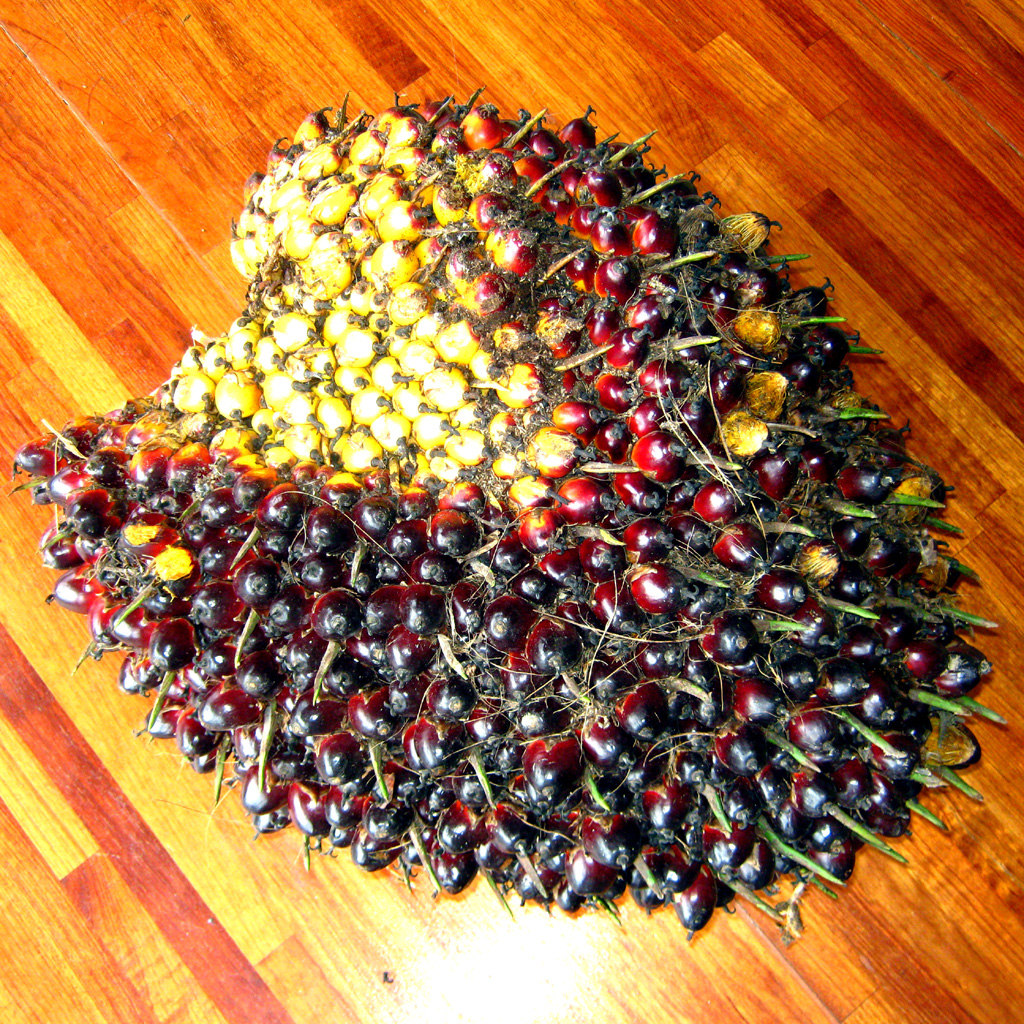


FFB - Fresh Fruit Bunch
FFB Fresh Fruit Bunch - Oil palms are grown for their clusters of fruit, which
can weigh 40-50 kg. Upon harvest, the drupe, pericarp and seeds are used for
production of soap and edible vegetable oil.
Oil Palm fruits are harvested for their oil-rich mesocarp (pulp). Like coconuts,
the seeds are rich in saturated fatty palmitic acid.
Palmitic acid has all single bonds between the carbon atoms and is similar to
animal fat (stearic acid), except it has 16 rather than 18 carbons.
Palm oils are used for cooking oil, soaps, candles, margarines and candy.
Health-conscious people who are concerned about atherosclerosis tend to stay
away from foods rich in saturated fats.
The fruit takes six months to mature from
pollination to maturity; it comprises an oily, fleshy outer layer (the pericarp),
with a single seed (kernel), also rich in oil. Unlike its relative, the Coconut
Palm, the oil palm does not produce offshoots; propagation is by sowing the
seeds.

How big is a Fresh Fruit Bunch FFB ?
A fresh Fruit Bunch is about the size of four human heads combined. While a seed
from the bunch is as big as your thumb.

Emerging Inflorescences of Male and Female flowers of an oil palm tree
Oil palm is a monoecious crop as it bears both male and female flowers on the
same tree. In Malaysia, the oil palm trees planted are mainly the tenera
variety, a hybrid between the dura and pisifera.
More about flowers of oil palm trees

Development of Oil Palm Fruits
More about the Fruits of Oil Palm
Trees in Sabah
Different grades of oil quality are obtained from the pericarp and the
kernel, with the pericarp oil used mainly for cooking oil, and the kernel oil
used in processed foods.
For each hectare of oil palm, which is harvested year-round, the annual
production averages 10 tones of fruit, which yields 3,000 kg of pericarp oil,
and 750 kg of seed kernels, which yield 250 kg of high quality palm kernel oil
as well as 500 kg of kernel meal. The meal is used to feed livestock. Some
varieties have even higher productivities which has led to their consideration
for producing the vegetable oil needed for biodiesel.
The African Oil Palm was introduced to Sumatra and the Malay area in the early
1900s; many of the largest plantations of oil palms are now in this area, with
Malaysia growing over 20,000 square kilometers. Malaysia claims that in 1995 it
was the world's largest producer with 51% of world production. In this area, the
destruction of natural rainforest to grow oil palm plantations is an issue of
major environmental concern.
West African oil palm today has become an international oil crop from its
commercial plantation center in Malaysia and Indonesia.

Empty fruit bunch from an palm oil mill in Malaysia
More about Empty Fruit Bunch of oil palm trees
in Sabah
RELATED TOPICS

The Oil Palm Industries
Federal
Land Development Authority
Palm Oil Refiners
POIC Palm
Oil Industrial Cluster
Oil Palm
Pulp Mill
The
Supply Chain in Malaysia
Oilpalm Scheme
PALM OIL SUPPLIERS IN SINGAPORE
Palm Oil Refiners of Malaysia
Malaysian Palm Oil Suppliers
Indonesia Palm Oil Suppliers
International Palm Oil Suppliers

The Oil Palm Plantations
HOUSES IN OIL PALM PLANTATION
Plantation Workers
The Palm
Oil Palm Environment
Oil Palm Plantation
Oil
Palm
Fertilizer
Oil
Palm Photo Gallery
TSH Biotech
Harvesting
Elaeis guineensis
EFB - Fiber
Oil Palm Products
Destruction of Rain Forest

The Oil
Palm Oil Statistics
Palm Oil & Products
Palm Oil Nutrition
Palm Oil Industry
Palm Oil Nutrition
Palm Oil Bio Fuel
Palm Oil
Business Link
|
|
Oil Palm in Malaysia |

