Saturday, 20 October, 2018 03:33:56 PM
AGRICULTURE
> FRUITS >
The Wild Mangos of Borneo
Richard J. Campbell, Ph.D., Senior Curator of Tropical Fruit
“We drove along the rocky north coast of Sarawak in search of the
mangga aer (Mangifera laurina),
kuini (Mangifera odorata),
bembangan (Mangifera pajang) and
bachang (Mangifera foetida).
These wild mangos dominate both remnant forests and home gardens, casting their
shade upon the South China Sea. From a distance, these Goliath beings have a
spectacular appearance. I will never forget the way they jut out of the rocky
soil within sight of the sea, forming picturesque lollipops, ablaze with red,
white or purple flower spikes-the result of a three-week dry spell preceding our
arrival. At first we found it difficult to distinguish among the various
species, but after visiting home gardens in the area, we learned how to locate
and identify distinct species and were able to gather bud-wood. As usual, the
local people were curious and amused by our appear ance and activities. They
were happy to provide us with pieces of their trees. ” (excerpt from Borneo
Expedition Report, September, 2001)
Wild mangos were brought to the attention of the scientific community a decade
ago in The Mangos: Their Botany, Nomenclature, Horticulture and Utilization, a
book written by botanists A. J. G. H. Kostermans and J. M. Bompard. The wild
mangos they described are purportedly gold mines of genetic potential for the
modern mango industry, which is based solely on the species Mangifera indica.
From salt tolerance to disease resistance, these wild mangos could hold the
genetic key to the mango's future. Unfortunately, because of our ignorance of
the horticultural traits of these lesser-known species, there is a huge gulf
between potential and actual use.
We set out to enhance the Mangifera genetic collections at Fairchild Tropical
Botanic Garden by the addition of wild mangos, and to investigate, in some small
way, their potential. Once we had our scions of wild mangos, we had to determine
their graft compatibility with the Mangifera indica rootstocks available in
Florida. Graft compatibility is crucial to success because the wild mangos are
not well adapted to our soils. Further, we are interested in superior selections
— ones that will allow for precocious fruiting and a top quality product.
Seedlings require years to reach bearing age, with no guarantee of quality.
Our initial efforts met with some notable failures, but also provided some
modest successes. We identified, collected and grafted superior clones of 12
Mangifera species, and have now established Mangifera casturi, M.foetida, M.
griffithii, M. laurina, M. odorata, M. pajang, and M. pentandra on 'Turpentine'
rootstocks (M. indica). Among these wild mangos may be genes for mangos with new
spice flavors, mangos ideal for use green, mangos well-flavored for chutneys and
pickles, and mangos ideal for fresh fruit for tropical America. Further, we hope
to create hybrids with greater resistance to pests, diseases and environmental
stresses.
Yet, I still found myself concerned as to their value. For all we knew, the
superior genes contained within these species had already found their way off
Borneo and into modern mangos. However, in early September of 2001, in the heat
and humidity of northern Borneo, their potential became abundantly clear as we
observed their profuse bloom, and heavy crops of developing and ripe fruit — all
surprisingly free of disease. Almost all cultivars of M. indica would fail
miserably under these same conditions. Herein lies their potential, not only for
Borneo, but also for the humid tropical regions all over the world.
The challenge ahead is to grow these trees successfully, characterize them
genetically and begin to determine their potential. In the far distant future is
the hope for hybridization with the commercial mango, a union that could yield
superior disease resistance, and adaptability to sub-optimal conditions.
Meanwhile we continue to study and display to the public, the newest addition to
the world of the mango at Fairchild Tropical Botanic Garden — the wild mangos of
Borneo.

A type of wild mangoes that is not very common.
It is like mini Asam Kumbang with purplish red skin when it is ripened.
The fruit measures 3 cm x 2.5 cm .
The thin, fibrous and attractive orange flesh is thin but juicy and sourish
sweet.
To relish the juicy fruit, just peel the skin and suck the juice.
Its skin turns from green to different shades of red and finally on ripening,
becomes purplish red.
The green and immature raba are used in preparation of pickles, just like the
mempelam/empelam.

Buah mempelam (Mangifera indica L.) is a small green mango which is widely used
for making mango pickle known as Jeruk mangga in Malaysia.
Its fruit is about 8 cm long and 5 cm wide with bright green colour skin.The
skin turns from dark green to yellowish green on ripening.
The fruit is extremely sour and the baby fruit is crunchy.This make the baby
fruits a perfect choice for making jeruk mangga,the mango pickle.
Cut 500 g of immature buah mempelam into slices or thin wedges without the
skin.Soaked in 500 ml of brine (500 g bottled water plus 1-2 tbs of rock salt)
for 36 hours.
Pour away the water after 1 1/2 -2 days.Add 5 tbs of ground rock sugar followed
by just enough bottled water to cover the mango slices.
The pickles are ready in two days.

Buah lamantan has light green skin with dark spots on it and looks very much
like buah bacang except that it is smaller and rounder.
It is also much less odorous than Kuini but stronger than that of bacang.
It is quite rare.
Most often mistakened for small bacang.
Buah kemantan is not very popular because of its sour flesh of coarse texture
plus the strong odor.

Kuini (Mangifera odorata Griff.) is cultivated everywhere in Malaysia.
The medium size fruit develops a distinctive odor as it ripens which is unique
of Kuini.
Its fruit remains green even on ripening. The flesh is yellow, sweet and not as
fibrous as the three species of mangoes mentioned above.
It presence can be felt by its aromatic smell which penetrate every inch of the
area where it is found.
The peels from kuini can be irritating to our lips and cause itchy tongue.
The problem of this mango is its fruits may look fresh green outside but once
cut, very often reveal ‘bad apple’ inside. You can safely say that it is always
50 % chance to get fruits with rotten seeds inside.Unlike buah mawang and other
wild mangoes, it does not have tough skin to protect it from pests.

Semi wild asam bacang (mangifera foetida jack) which is quite common in West
malaysia also.
Asam bacang is oval shaped and is less aromatic.
Green asam bacang are made into pickles. Most natives and the malays here eat
asam with ikan belis and chillies.
The peels from these mangoes do not irritate our lips like the kuini and the
fruits do not have strong smell.
Asam bacang is not as juicy and tasty as buah mawang and asam kumbang. Its flesh
tastes sour and not as sweet as kuini fruit.

Asam kumbang(Mangifera quadrifida Jack)
Hakka people call it 黑皮酸-Heipisuan which means black skin mango.
It is juicy and pleasantly sour.
The fruits are oval in shape and have diameter of around 5-6 cm. The immature
fruits are green and on ripening, turn reddish purple in colour. Peel the dark
purple skin to reveal the inner pinkish purple skin attached to the flesh.
The flesh is light yellow in colour and is juicy, not sweet,not very sour and
fibrous. All these features make it a good fruit for quenching thirst.
It is not possible to cut slices out of the fruit because of its fibrous flesh.
To enjoy its juicy flesh to the fullest, just peel the skin and suck the juice.
Buah mawang and asam kumbang are very good fruits for diabetic people because
they are a bit sweet but pleasantly sour.

The buah mawang( Mangifera panjang Kosterm.) Is a big brown fruit weighing
800g-2kg with length measuring up to 18 cm and width 15 cm.
Hakka people call it 人头酸 (Human head mango) or Mou.
A single fruit can weigh up to 1 kg or more and one variety has fruits as big as
human head.
There are 2 varieties : The Big and the Small
The smaller variety is less fibrous and is sweeter than the other type.
A kind of aroma uniquely belongs to this mango family exudes from this fruit.
Its flesh is fibrous and yellowish orange in color .This is great for making
juice and mango jam,
The tree is usually of height 30-60m. Its juice is really a super drink, creamy
and fragrant.
Buah mawang has great potential to be commercialized because of its juicy and
heavenly sour flesh. A powerful blender is needed to blend its fibrous flesh.

MANGO
Source from Wikipedia, the free encyclopedia.
The mango (Mangifera spp.; plural mangos or mangoes) is a genus of about 35
species of tropical fruiting trees in the flowering plant family Anacardiaceae,
native to India and Indo-China, of which the Indian Mango M. indica is by far
the most important commercially. Reference to mangos as the "food of the gods"
can be found in the Hindu Vedas. The name of the fruit comes from the Tamil word
man-kay, which was corrupted to manga by the Portuguese when they explored
western India.
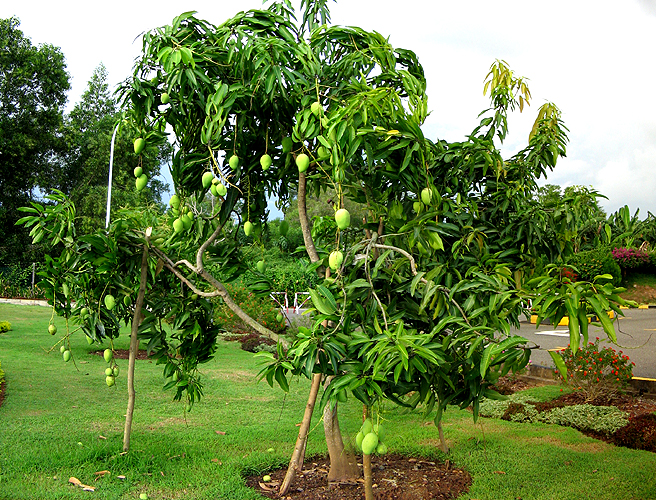
Mangos are large trees, reaching 35-40 m in height, with a crown radius of 10 m.
The mango is a fleshy stone fruit belonging to the genus
Mangifera, consisting of numerous tropical fruiting trees in the flowering plant
family Anacardiaceae. The mango is native to India from where it spread all over
the world.
It is also the most cultivated fruit of the tropical world. While other
Mangifera species (e.g. horse mango, M. foetida) are also grown on a more
localized basis, Mangifera indica – the common mango or Indian mango – is the
only mango tree commonly cultivated in many tropical and subtropical regions,
and its fruit is distributed essentially worldwide.
In several cultures, its fruit and leaves are ritually used as floral
decorations at weddings, public celebrations and religious ceremonies[citation
needed].
The leaves are evergreen, alternate, simple, 15-35 cm long and 6-16 cm broad;
when young they are orange-pink, rapidly changing to a dark glossy red, then
dark green as they mature.
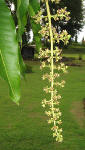
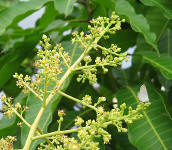
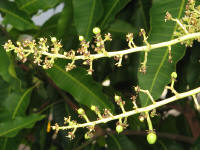
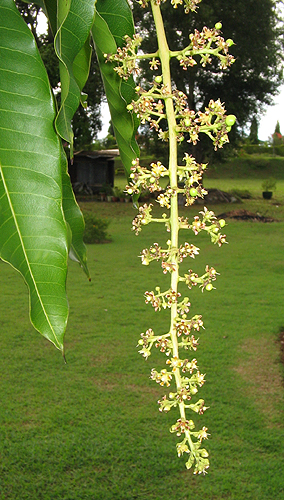
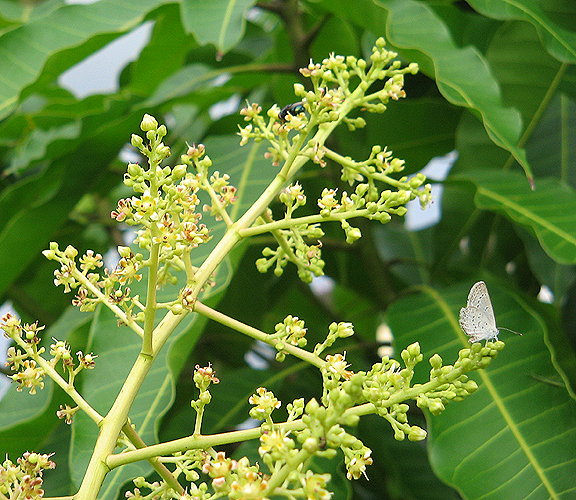
Mango Flower : The flowers are produced in terminal panicles
10-40 cm long; each flower is small and white with five petals 5-10 mm long,
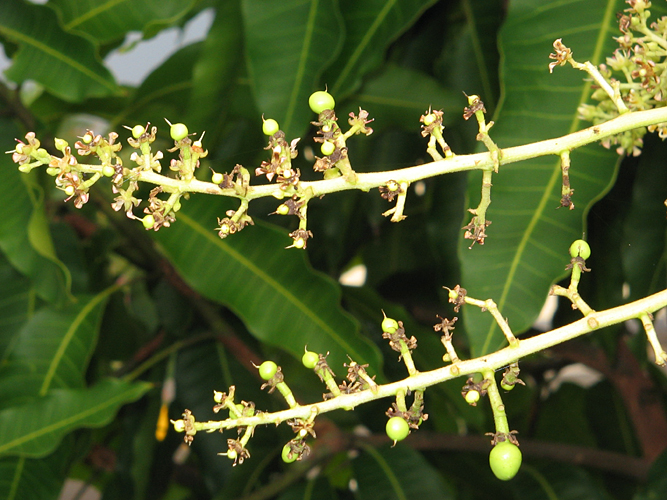
with a mild sweet odour suggestive of lily of the valley. After the flowers
finish, the fruit takes from three to six months to ripen.
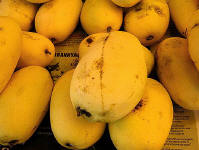
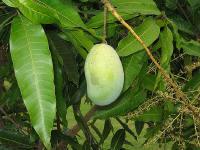
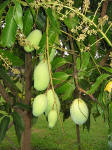
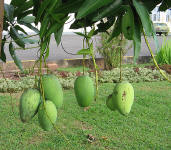
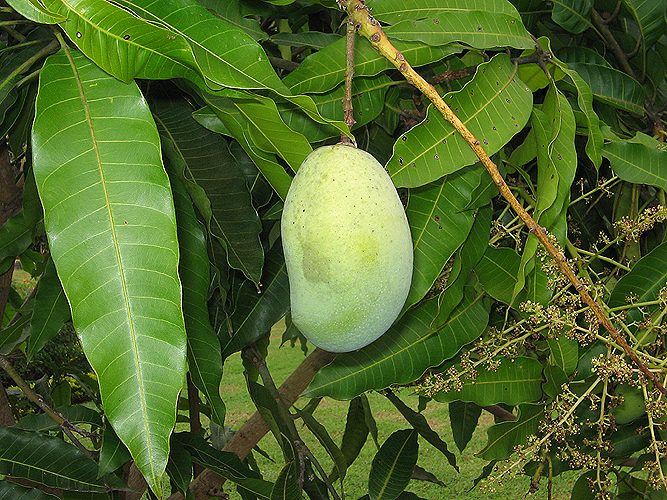
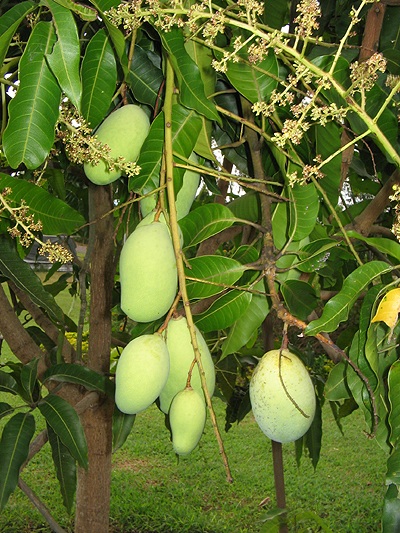
Mango Fruit : The mango fruit is a drupe; when mature, it
hangs from the tree on long stems. They are variable in size, from 10-25 cm long
and 7-12 cm diameter, and may weigh up to 2.5 kg. The ripe fruit is variably
coloured yellow, orange and red, reddest on the side facing the sun and yellow
where shaded; any green is an indication the fruit is not yet ripe. When ripe,
the unpeeled fruit gives off a distinctive resinous slightly sweet smell. In the
center of the fruit is a single flat, oblong stone that can be fibrous or
hairless on the surface, depending on cultivar. Inside the shell, which is
1-2 mm thick, is a paper-thin lining covering a single seed, 4-7 cm long, 3-4 cm
wide, 1 cm thick.
Consumption
Generally, once ripe, they are quite juicy and can be very
messy to eat. However, those exported to temperate regions are, like most
tropical fruit, picked under-ripe. Although they are ethylene producers and
ripen in transit, they do not have the same juiciness or flavour as the fresh
fruit. A ripe mango will have an orange-yellow or reddish skin. To allow a mango
to continue to ripen after purchase, store in a cool, dark place, but not your
refigerator. Refrigeration will slow the ripening process.
The small-fruited cultivars, usually somewhat yellow in colour, can be rolled on
a flat surface in the same way a lemon is rolled before extracting the juice. It
is ready for eating when the big stone can be rotated without breaking the skin.
With your teeth, rip off a piece of skin at the top of the mango and place your
mouth over the hole. Squeeze the fruit from the bottom up, as if squeezing
toothpaste from the bottom of the tube.
With any of the large-fruited cultivars of mango, the operation is less
hazardous: place the fruit lengthwise on a table and feel for the rather flat
stone (containing the seed), which should lie horizontally inside the skin about
midway through the fruit. Slice the mango so that the knife just passes over the
flat surface of the stone. Turn the mango over and repeat the process, cutting
across the other flat surface.
With each big slice that has been removed, cut hatch marks through the flesh
just down to the skin. Then, holding the portion flesh-side-up, press the thumb
on the skin side underneath as if turning the piece inside out. Many bite-sized
pieces of flesh will pop up and can be cut out to put into a fruit salad or
other preparation. This technique is sometimes called the hedgehog method
because of the appearance of the prepared fruit. An alternative to the hedgehog
method is to use a spoon to scoop out pieces of the fruit from the exposed
"cheeks".
A simple way to eat a large mango 'as is' involves using a knife. Start by
removing part of the skin and then slice out bite-sized pieces with the knife.
Remove more skin to expose more flesh. Expect to get juicy hands when eating the
last part, when there is no skin to hold with your hand.
Another way to eat a mango is to simply use a sharp knife to peel the skin
completely. Then make horizontal and vertical cuts on each side till the flat
stone is reached. Slice off the flesh from each side of the stone and then slice
the remaining flesh left on the side of the stone. This method works best on
mangoes that are ripe and which have firm flesh.
Ripe mangoes are extremely popular throughout Latin America. In Mexico, sliced
mango is eaten with chili powder and/or salt. In Guatemala, Ecuador and
Honduras, small, green mangoes are popular; they have a sharp, brisk flavor like
a Granny Smith apple. Vendors sell slices of peeled green mango on the streets
of these countries, often served with salt. In Hawai'i it is common to pickle
green mango slices.
Mangoes are widely used in chutney, which in the West is often very sweet, but
in the Indian subcontinent is usually sharpened with hot chilis or limes. In
India, mango is often made into a pulp and sold as bars like chocolate, and
unripe mango is eaten with chili powder and/or salt. In the Philippines, unripe
mango is eaten with bagoong, a salty paste made from fermented fish or shrimp.
Mango is also used to make juices, both in ripe and unripe form. Pieces of fruit
can be mashed and used in ice cream; they can be substituted for peaches in a
peach (now mango) pie; or put in a blender with milk, a little sugar, and
crushed ice for a refreshing beverage. A more traditional Indian drink is mango
lassi, which is similar, but uses a mixture of yoghurt and milk as the base, and
is sometimes flavoured with salt or cardamom.
Dried unripe mango used as a spice in south and southeast Asia is known as
amchur (sometimes spelled amchoor).
Cultivation and uses
The mango is now widely cultivated as a fruit tree in
frost-free tropical and subtropical climates throughout southern Asia, North,
South and Central America, the Caribbean, south and central Africa and
Australia. It is easily cultivated and there are now more than 1,000 cultivars,
ranging from the turpentine mango (from the strong turpentine taste) to the
huevos de toro ("bull's balls", from the shape and size). The mango is reputed
to be the most commonly eaten fresh fruit worldwide. Mangos also readily
naturalize in tropical climates. Some lowland forests in the Hawaiian Islands
are dominated by introduced mangos.
The mango is a popular fruit with people around the world. However, many mango
farmers receive a low price for their produce. This has led to mangoes being
available as a 'fair trade' item in some countries.
The fruit flesh of a ripe mango contains about 15% sugar, up to 1% protein, and
significant amounts of vitamins A, B and C. The taste of the fruit is very
sweet, with some cultivars having a slight acidic tang. The texture of the flesh
varies markedly between different cultivars; some have quite a soft and pulpy
texture similar to an over-ripe plum, while others have a firmer flesh much like
that of a cantaloupe or avocado, and in some cultivars the flesh can contain
fibrous material. Mangoes are very juicy; the sweet taste and high water content
make them refreshing to eat, though somewhat messy.
The mango is in the same family as poison ivy and contains urushiol, though much
less than poison ivy. Some people get dermatitis from touching mango peel or
sap. Persons showing an allergic reaction after handling a mango can usually
enjoy the fruit if someone else first removes the skin. The leaves are toxic to
cattle.
It is reputed that mangos soothe the intestines, which makes them easy to
digest. In India, where mangoes are the national fruit, they are thought to help
stop bleeding, to strengthen the heart, and to benefit the brain.
The mango also features as a common motif in Indian textiles, known as the
paisley design.
Cultivars
Many hundred named mango cultivars exist. In mango
orchards, several cultivars are always grown intermixed to improve
cross-pollination. In India, the commonest cultivar is 'Alphonso', known as the
King of Mangoes due to the popular opinion that they are the best cultivar
available. The best 'Alphonso' mangos are reputed to come from the town of
Ratnagiri in Maharashtra. About 80% of mangos in UK supermarkets are of the
single cultivar 'Tommy Atkins', which dominates the world export trade. It
travels well and has a good shelf-life, but does not have the same flavour as
some less common cultivars obtained from Asian shops.