Oligoaeschna foliacea
Last Updated on Friday, 16 June, 2023 11:19:13 PM
INDEX > Dragonflies of Borneo > Family Aeshnidae > Genus Oligoaeschna
Family of Aeshnidae
Genus Oligoaeschna
Oligoaeschna foliacea
Male 63mm 2008-06-03 SRI AMAN
Female 66mm 2008-06-02 SRI AMAN
There are 7 Borneo species in this Genus. 4 are endemic of Borneo
1- Oligoaeschna amata (Forster, 1903)
2- Oligoaeschna huehri (Forster, 1903)
3- Oligoaeschna elacatura (Needham, 1907) Endemic of Borneo
4- Oligoaeschna foliacea
Lieftinck, 1968
5- Oligoaeschna mutata Lieftinck, 1940 Endemic of Borneo
6- Oligoaeschna platrura Lieftinck, 1940 Endemic of Borneo
7- Oligoaeschna venusta Lieftinck, 1968 Endemic of Borneo
Genus : Oligoaeschna
Oligoaeschna species are medium to moderately large and rather heavily built.


Top : Male, Bottom : Female
In color they range from dark reddish-brown to black, marked darkly with green.
| Genus Oligoaeschna | Genus Indaeschna | Genus Gynacantha |
 |
 |
 |
| Oligoaeschna foliacea ♂ Body length 59+4=63mm |
Indaeschna grubaueri ♂Body length 95mm |
Gynacantha dohrni ♂ Body length 62+6=68mm |
They are among the smallest of the Bornean aeshnids. Apart from their
distinctive form, they may generally be separated from most other members of the
family by the presence of fewer crossveins in the discoidal triangle, which is
usually divided into only three cells in both wings, uncommonly four, whereas in
most other genera it is usually divided into five or more, and never fewer than
four cells.
Male
O. foliacea wings have fewer cross veins in the discoidal triangle, which is
usually divided into only three cells in both wings. Whereas in most other
genera it is usually divided into five or more cells.
In most species the male wings are lightly and uniformly coloured, generally a
pale amber, but females often have extensive semi-hyaline reddish-brown patches.
The male superior appendages are only moderately long and are robust, in many
cases flattened and expanded.
Female appendages normally break off with mating, but when intact they are long
and very broadly paddle-shaped with a thin stalk. The function of these long
racquet like appendage curious structures is unknown.
Males are generally separated by the structure of their anal appendages although
species also differ in their markings and wing venation.
Females show a good deal of interspecific variation in wing venation, wing
marking and the shape of the abdomen.
Oligoaeschna is one of the more taxonomically difficult genera of the Anisoptera.
Seven species, four endemic, are recorded from Borneo to which may be added a
probable further four, known only from females, which were described but not
named by Lieftinck in his 1968 revision and key (Tijdschrift voor Entomologie
111: 137-186). To this should be added that some specimens recently collected in
Brunei do not fit well with any forms discussed by Lieftinck and may either
represent undescribed females of known males or undescribed species.
The 3 families of dragonflies found in Borneo Island:
1 Family of Aeshnidae
RELATED TOPICS

INTRODUCTION TO THE DAMSELFLIES OF SABAH, BORNEO ISLAND
Insects are diverse and dominant inhabitants of the tropical rainforests in Borneo Island. New species are discovered too often. Entomologists are still struggling to cope with the documentation of tropical insect diversity.
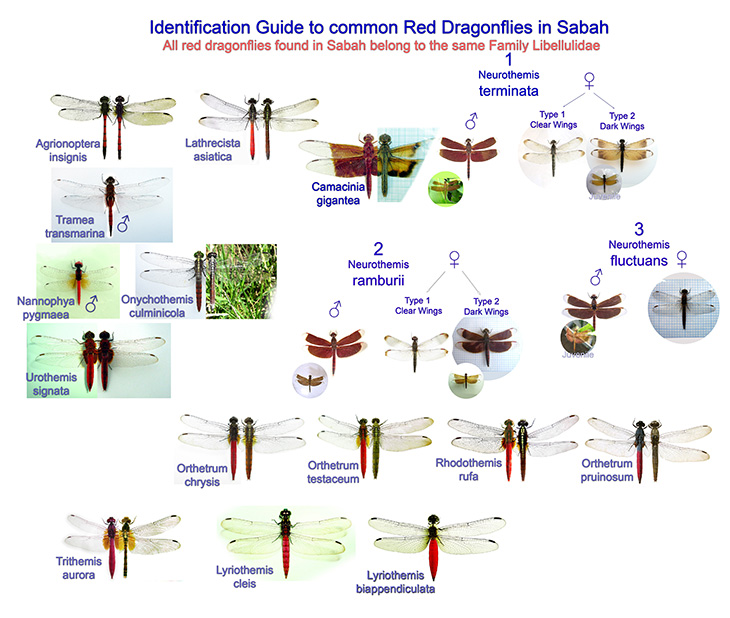
Most of the common dragonflies in Sabah are red coloured, especially from the family Libellulidae. Some red pecies are even confused as same species, for example the three species of Genus Neurothemis.
The compound eyes of dragonflies
Dragonflies and damselflies have large compound eyes that can see in all directions. When the compound eye is magnified several hundred times, each individual facet (ommatidium) is shown to be hexagonal in shape.
Ovipositor (Vulvar Lamina)
of Female Dragonflies and Damselflies
Female dragonflies have either one of the two method of depositing eggs from
the abdomen:
1- using Ovipositor Structure
2- using Vulvar Lamina
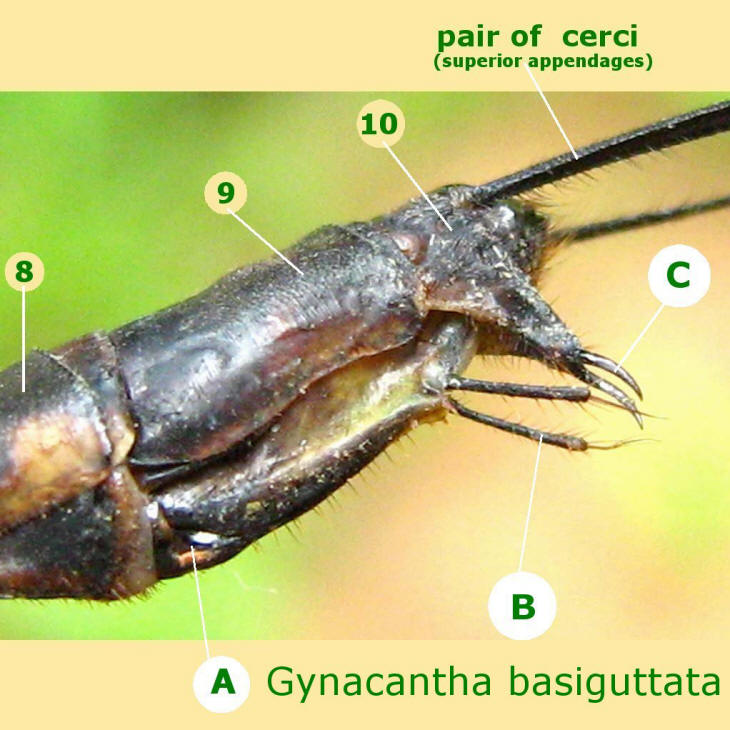
Male do not have an ovipositor. Instead male dragonfly and damselfly have appendages.
|
GO FURTHER FLORA Borneo has 150 species of wild fig trees. Most of them are found in forests of Sabah. FISHERIES Prawn farming is a main commercial activities in Tawau. Spawners from Tawau are graded the best in Malaysia. For decades, Tawau has been exporting high-grade tiger prawns to several countries such as Korea, Japan, Taiwan, China, Vietnam, Singapore, Egypt and Australia. |
|
|
Damselflies of Borneo |