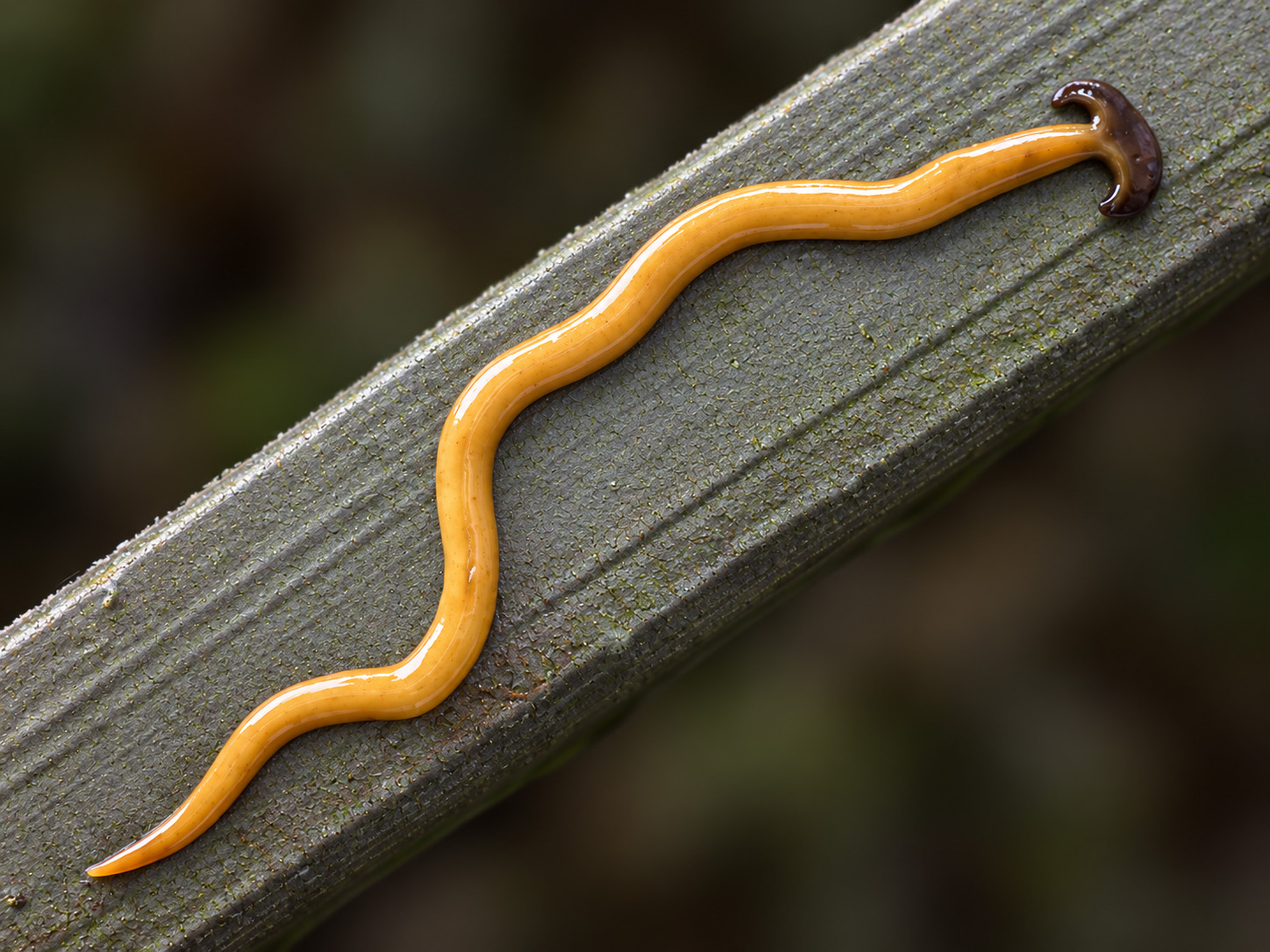
Provisional record. This page records an observation that has not been identified below subfamily. It will be revised when a determination is available.
Phylum Platyhelminthes, class Rhabditophora, order Tricladida, subfamily Bipaliinae — the hammerhead worms. Genus not determined.
Photographed by Wong Fook Yee at 09:06 on 31 August 2011, at Kundasang, Ranau district, Sabah, at approximately 1,500 m above sea level — on a hilltop overlooking Mount Kinabalu, at what was then the BCCM Retreat Centre and is now the Jabez Kinabalu Inn.
The animal was about 10 cm long, orange-yellow, smooth and glossy, with a fine pale line down the back and a dark brown crescent-shaped head. It was moving very slowly — at about the pace of a snail. The morning was cold, with wind off the mountain.
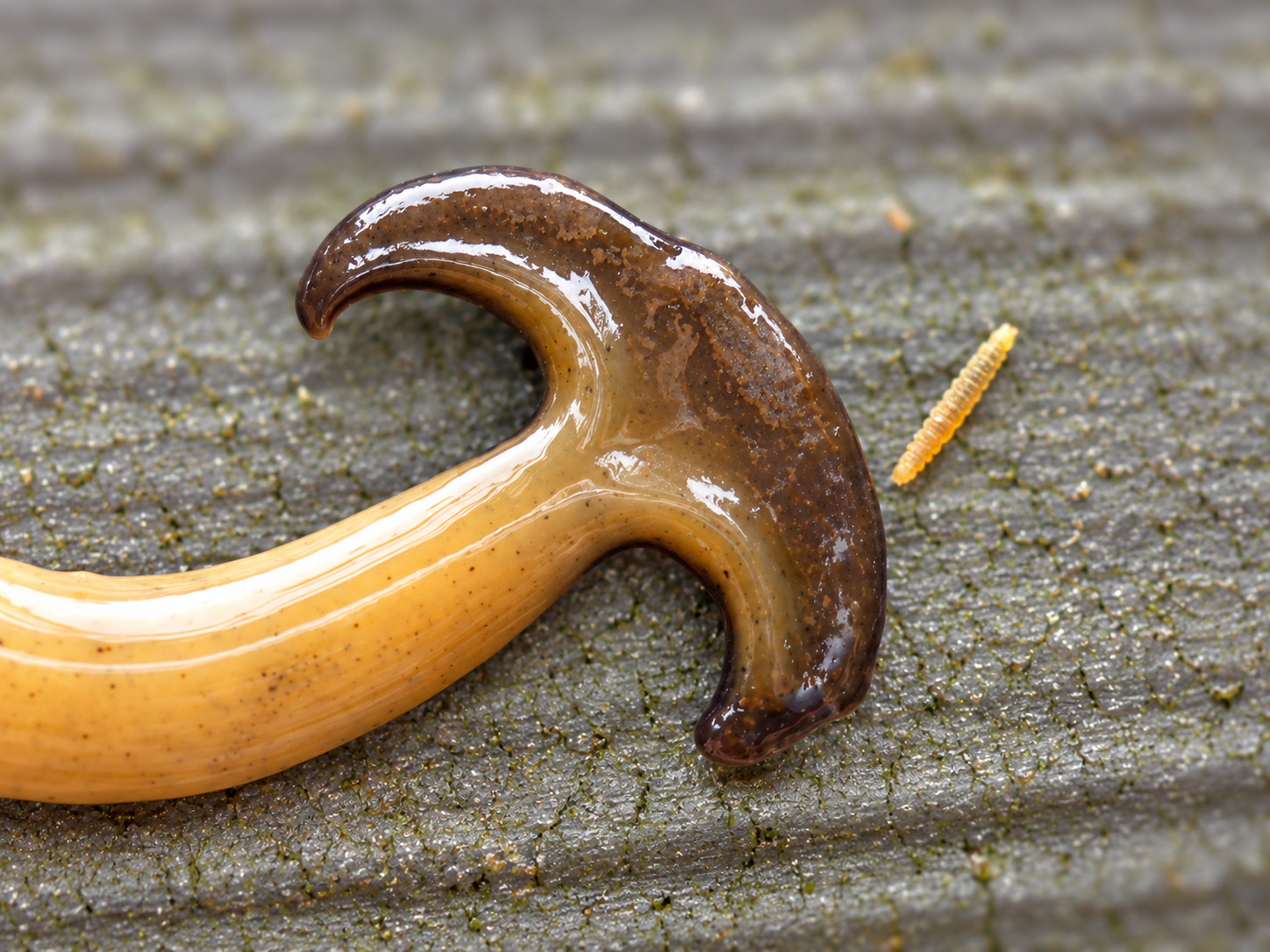
The close view shows the flared head plate that gives these animals their name. A small pale yellow larva, a few millimetres long, lay on the same leaf a short distance in front of the worm. Nothing in the photographs shows the two interacting, and no relationship between them is claimed here.
What is established: the animal is a land planarian — a free-living flatworm, phylum Platyhelminthes, class Rhabditophora, order Tricladida — and it belongs to the subfamily Bipaliinae, the hammerhead worms. Unlike most of the identifications on this site, the group here is not in doubt: the broad, flattened, crescent- shaped head plate is the character the subfamily is named for and is not shared by any other land flatworm.
What is not established: the genus and species. Bipaliinae contains several genera — Bipalium, Humbertium, Novibipalium and Diversibipalium among them — and they are separated on internal anatomy rather than on external appearance. Body colour, stripe pattern and head shape vary within species and overlap between them. No genus is claimed here.
What would settle it: examination by a specialist in land planarians, and in most cases dissection or molecular work rather than photographs alone. A photographic record of this group is often determinable no further than subfamily, and that is a legitimate outcome rather than a failure.
This observation is on iNaturalist, where it is open to identification by specialists in land planarians: observation 397152083. Any determination made there will be brought back to this page, and the record above revised to match. Until then the animal stands as Bipaliinae, genus undetermined.
Hammerhead worms are predators. They are generalist carnivores of the soil and leaf litter, taking earthworms, slugs, snails, woodlice, insect larvae and springtails. They do not feed on plants and they are not parasites.
They hunt by smell. Chemoreceptors along the margin of the flared head let the worm pick up an earthworm's mucus trail and follow it. Having overtaken its prey, the worm wraps around it and everts its pharynx — the muscular feeding tube, which opens on the underside of the body rather than at the head — pressing it against the earthworm and digesting it from the outside before absorbing it. Prey up to roughly a hundred times the worm's own mass has been recorded.
That last figure raises an obvious question, and the answer turned out to be a surprising one. In 2014 a team at Utah State University confirmed tetrodotoxin — the same potent neurotoxin found in pufferfish and blue-ringed octopus — in two Bipalium species. It was the first time tetrodotoxin had been found in any land invertebrate. The toxin was concentrated in the head, and the egg capsules carried about three times the whole-animal average. The authors proposed a double role: subduing prey far larger than the worm, since attacked earthworms became partly paralysed, and defence, since salamanders offered the worms showed the avoidance behaviour typical of tetrodotoxin.
A caution about how far that carries. Those tests were run on Bipalium adventitium and Bipalium kewense. The Kundasang animal has not been identified to genus, so nothing is established about what it does or does not contain. The sensible conclusion is not alarm but ordinary care: look, photograph, and don't handle it bare-handed — and if you do, wash your hands.
The Bipaliinae are native to Madagascar, the Indian subcontinent and Southeast Asia, across tropical and subtropical latitudes. Borneo lies inside that native range. The animal on this page is at home.
This is worth saying plainly, because almost everything written about hammerhead worms in English is written from somewhere they do not belong. Carried around the world in the soil of potted plants, several species have established far outside Asia — Bipalium kewense is now recorded from every continent except Antarctica — and in those places they are studied as an invasive threat to earthworm populations and to soil structure. A 2022 modelling study projected that suitable climate for bipaliin flatworms extends across parts of Australia, New Zealand, South America, eastern North America, western Europe and central Africa.
None of that is the story in Sabah. Here the hammerhead worm is a native predator in a native soil community, doing what it has always done. A photograph of one on a leaf at Kundasang is a record of local wildlife, not a biosecurity alert.
None. No hammerhead worm has been assessed. There is no IUCN Red List entry for any species of Bipaliinae, and land planarians as a whole are effectively unassessed.
This is not a judgement that they are secure. It reflects how little conservation attention soil animals receive. For scale, of roughly 23,000 described earthworm species — a far better-studied group than land planarians — only about 224 have ever been evaluated for the Red List, fewer than one in a hundred, and 28 of those came out as threatened. Nobody has looked at the hammerhead worms at all.
There is a real gap here, and it is one an amateur record can help fill. The taxonomy of the group is still moving — a recent molecular revision described twelve new species and two new genera in a single paper — and observations from inside the native range are much scarcer than observations from the countries these animals have been carried to. A dated, located, altitude-stamped photograph from a Sabah hillside is therefore worth more than its modest appearance suggests.
Page reviewed: 4 September 2026.