BATU CAVES  | Sri Maha Mariamman Temple  | Lord  Murugan  statue  |

Sri Maha Mariamman Temple
163, Jalan Tun H.S Lee, near the Chinatown, Kuala Lumpur


Open daily: 6am-9pm


...intriguing designs and decorative carvings of Hindu deities, gold embellishments, precious stones and hand-painted motifs depicting stories from early Hinduism.

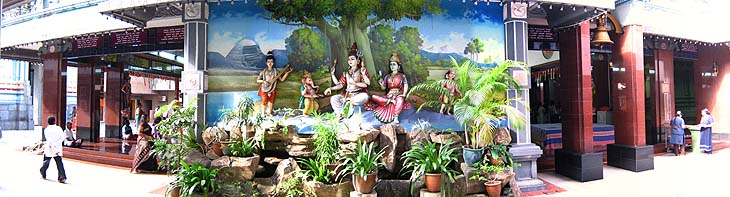
Just walking down from Petaling Street is this South Indian Sri Maha Mariamman Temple situated at Jalan Tun H.S.Lee. This is one of the most ornate and elaborate Hindu temple in Malaysia. The design and decorative features include intricate carvings of Hindu deities, gold embellishments, precious stones and hand-painted motifs. Exquisite Italian and Spanish tiles provide further ornamentation.


Thambusamy Pillai Family
The Sri Maha Mariamman Temple is founded by Thambusamy Pillai in 1873.  At was a private shrine of the Pillai family before the family open the temple door to the public in 1920s and eventually handed the management of the temple over to a board of trustees.

The Oldest Indian Temple
This oldest functioning Indian temple in Malaysia is also reputed to be the richest in the country. The Temple was originally sited near the KL Railway Station. In 1885 it shifted to its present location along Jalan Tun H S Lee next to Kuala Lumpur's Chinatown. The initial attap structure was demolished in 1887 and a brick building was erected in its place. That structure was demolished to make way for the current temple buildings which were completed in 1968. The impressive gateway to the Temple (gopuram) was completed in 1972. This new Temple was consecrated in 1973.

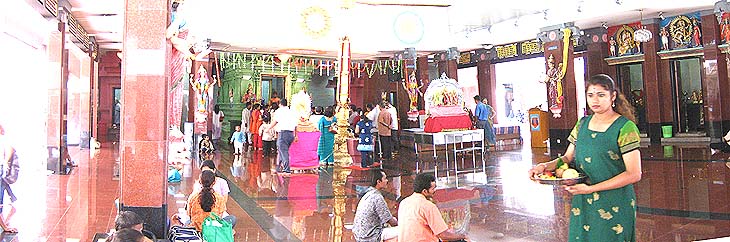
At the rear is the garbagraham, which corresponds to the head. It is a freestanding structure with its own roof and walls and has one entrance that faces east. This is the inner sanctum where the chief deity Sri Maha Mariamman is installed. The priest stands in front of the garbagraham when performing the puja (prayers).

Ganesh is in the shrine on the left and Subramaniam, his brother, is on the right. Ganesh is also found at the entrance as he is the remover of obstacles. The eight female figures inside the Temple are of Lakshmi (Goddess of Wealth).

Hinduism in Malaysia

Hinduism reached Malaysia in the 7th century by early Hindu traders from India. Relics and remains from this period have been found in Kedah (Bujang Valley). But the Hinduism practiced in Malaysia today is the Hinduism of the settlers who came into this country in the 19th and early 20th century. http://en.wikipedia.org/wiki/Hinduism_in_Malaysia.  Majority of the Indian in  Malaysia are Tamil Indians. 90 percent of these Tamil are practicing Hindus.

Hinduism has an important impact in Malaysian culture. Hinduism spread to Malaysia before Islam arrived in the 15th century. Hinduism culture are found Malay language, literature and art.

Tamil Nadu Indians came to Malaysia  in the late 19th and early 20th centuries as  laborers to work on rubber plantations. Among the early settlers were some well English-educated Indians whom today formed the  professional middle class.

Like in India, Hinduism is diverse in Malaysia, with large urban temples dedicated to specific deities, and small individual established  temples in plantation estates. Many people worship Shiva,  a deities of Southern India.

Second World War brought destruction to Malaysia  and caused cultural revival after the War.  Chinese religious believes, Christianity and Hinduism began to gain new spirit and new horizon. Second World War revive  Hinduism among Malaysian Indian  with the new foundation of organizations and administration  to bring unity and reform.

Hindus believe in God ( a supreme deity).  Hinduism believe in  reincarnation. There is an increase of Chinese adapting Hindu ceremonies in their religious life.


Gopuram (tower)
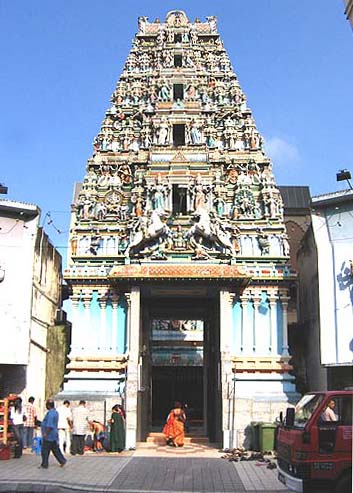
The tallest structure, the 5 tiered gopuram (tower), is the threshold between the material and spiritual world. This dramatic 23m-high pyramid-shaped gate tower is decorated with depictions of Hindu gods sculptured by artisans from southern India.

The chief sculptor was the late S. T. Muniappa from Tamil Nadu, South India and is credited for creating the 228 idols on the Gopuram.


The Silver Chariot - The Tallest in Malaysia
The silver chariot is kept in a vault in the temple and brought out only once a year during the annual Thaipusam festival. It is used during this occasion for transporting the statuettes of Lord Murugan through the city streets to Batu Caves. Built in 1983 at a cost of RM350,000 using 350 kilograms of silver. Made in India and shipped in 12 parts to be assembled. It is 6.5 meters tall and has 240 bells and a pair of horses on it.

Before the silver chariot, a wooden one was used which was made in 1930 by Indian craftsmen at a cost of RM50,000.

Sri Maha Mariamman
Mariamman is a manifestation of the goddess - Parwatee, an incarnation embodying Mother Earth with all her terrifying force. Mariamman is popularly worshipped by oversea Indians, especially Tamils because she is looked upon as their protector during their sojourn to foreign lands. She is associated with disease and fever and protects her devotees from unholy or demonic events.

The Sri Maha Mariamman Temple is where the Silver Chariot bearing the statue of Lord Murugan begins its journey at midnight every year to  Batu Caves, 13 kilometers away from Kuala Lumpur City.

A huge wooden gate leading into the temple, and above that is a 5-tiered pyramid at least 25 feet high covered, from top to bottom, with hundreds of Hindu statues. Lord Maruga on peacock. All statues had numerous meanings, lessons and symbols hidden inside them.


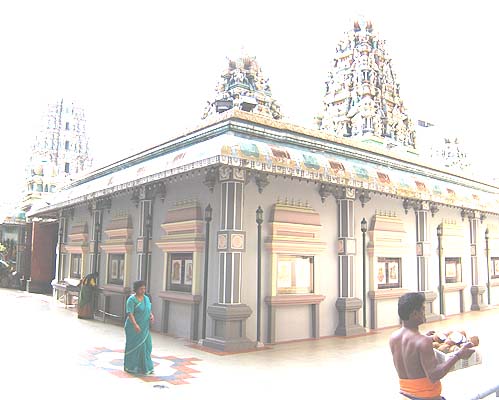
Main Temple Building : The temple was made up of main building and three other open buildings containing shrines. Inside the main building there was one large shrine painted a light green and flanked by two female statues. To the side were three shrines made of dark marble with brightly colored statues above each doorway. Devotees go to each one with palms pressed together and said a prayer.

In the open-air building to the right of the main building a man with a tray of butter lamps was walking around an alter chanting in Sanskrit, the holy language of Hinduism.


A high priest, dressed with white robes and with bare chests, came forward with a tray containing butter lamps and  walked to each of the shrines.

The priest waved the butter lamps in front of the shrine and chanted with soothing voice for several minutes as he poured milk over the statues  and left offerings of fruit and flowers. After that he came out and waved the lamp in front of devotees who gathered for the ceremony.


Other temples in Malaysia :  THIRUMURUGAN  TEMPLE  |  BATU CAVES  | 

Sri Poyyatha Vinayagar Moorthi Temple
One of the first Hindu temples built in Malaysia built in 1781 on land given by the Dutch. Situated at the junction between Jalan Tukang Emas and Jalan Hang Kasturi in Malacca.

Annai Sri Maha Turobathai Amman Temple
In Ladang Victoria located in Pulau Pinang, Malaysia. Built 100 years ago.

Maha Karumariamman Alayam
Located in Kedah, Batang Benar Estate. It was built in 1984.

Arulmigu Maha Muniswarar Sri Maha Mariamman
Named Sri Maha Munieswarar, this temple is located in Acob Estate, Kapar, Selangor.It was built in year 1920.

Devi Sri Periyachi Amman Temple
Located in Penang. In 1948 Jalan Mengkuang Road was still an estate and a group called ‘Samarasa Sangeeta Kosthikal’ built this temple here in 1976.


Outside the Temple are stalls selling garlands and strings of sweet smelling jasmine.


March 17, 2014 08:23:25 AM

hits counter