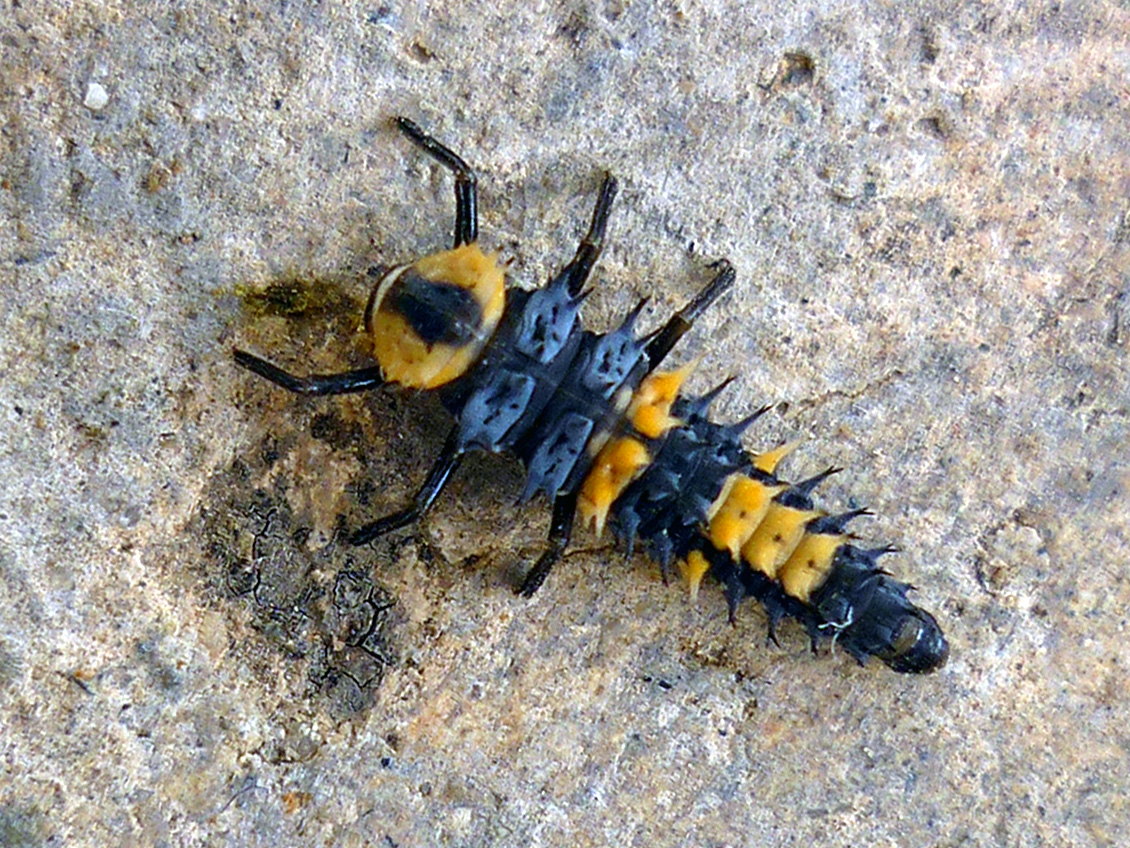
Provisional record. The family is established. Genus and species are not, and will be added if a determination is made.
Class Insecta, order Coleoptera, family Coccinellidae — the ladybird beetles. The larval stage. Genus and species not determined.
Photographed by Wong Fook Yee at 11:42 on 12 December 2011, on the concrete floor of the Ikutmaju Saw Mill beside the river at Merotai, Tawau District, Sabah — about 30 km from Tawau town.
The animal was about 10 mm long, black and yellow-orange, and covered in spines. It was alone, out in the open on bare concrete rather than on any plant, and crawling forward without any obvious direction. It was in a place where a mill worker could easily have trodden on it.
Established: this is the larva of a ladybird beetle — order Coleoptera, family Coccinellidae. The characters are the elongate, tapering, soft-bodied form; the six well-developed legs carried well forward on the thorax; the rows of short branched spines along the back and sides; and the bold black-and-orange pattern. Coccinellid larvae are described in the standard references as flattened and covered with spines, and the combination is not easily mistaken once known.
Not established: the genus and species. There are thousands of coccinellid species worldwide and the Bornean fauna is substantial; larvae of related species resemble one another closely, and the arrangement of pale markings varies within a species as well as between species. No genus is claimed here.
What would settle it: examination by someone who works on the Bornean Coccinellidae, or rearing the larva through to the adult beetle, which is far more readily named. The observation is posted to iNaturalist as observation 397622297, and any determination made there will be brought back to this page.
This page sits in the wingless section of this site, and the reason here is different from the reason on any other page in it.
Beetles undergo complete metamorphosis. The wings develop out of sight, inside the body, and appear only when the animal pupates and emerges as an adult. So no beetle larva has wings at any point — not small ones, not buds, none. The absence here is not a clue to anything about the species; it simply means the animal is not grown up.
That is worth setting beside the other wingless records on this site, because the same observation means three different things:
And the adult it becomes will look nothing like this. The spiny black-and-orange animal crawling across the concrete turns into a smooth, domed, glossy ladybird — one of the few insects almost everyone recognises and rather likes.
The photographer's own field note records the animal as ugly. That reaction is worth putting on the record rather than tidying away, because it is the common one, and it has a consequence.
Ladybird larvae are predators. They spend their whole larval life hunting aphids and other soft-bodied plant pests, and they eat a great many of them. Yet because they are spiny, dark, unfamiliar and quick, they are routinely taken for pests themselves. The University of Florida's account of the family notes plainly that gardeners "mistake the ladybird larvae for pests and spray chemical pesticides that kill them", and adds — with some resignation — that "people knowing nothing about ladybird life cycles are born each minute".
So the useful thing to know about this animal is that it is on your side, and that the instinct to dislike it is exactly the instinct that gets it killed. Everyone recognises the adult. Almost nobody recognises the child.
There is a coccinellid worth mentioning here, because it appears elsewhere on this site. Cryptolaemus montrouzieri, the mealybug destroyer, is a ladybird whose larva coats itself in white wax and comes to resemble the mealybugs it hunts — a predator disguised as its own dinner. It is discussed on the mealybug page, where ruling it out was part of that identification.
The two are worth holding side by side. One member of this family conceals itself completely and is mistaken for its prey; this one advertises itself in black and orange and is mistaken for a pest. Both mistakes are made by people, and both end the same way.
This record comes from an unusual site, and the explanation is the photographer's own, from years of visiting it. The Ikutmaju Saw Mill collects insects from two entirely separate sources.
By night, from the air. The mill runs after dark under bright working lights, and that light draws in large numbers of insects from the surrounding coastal country.
By day, by lorry. Raw timber is brought to the mill from forests all over Sabah. Insects living in and under the bark of those logs travel with them — out of the interior forest and into a coastal industrial yard. Some of them establish themselves in the riverside bushes beside the mill and breed there. Spiders in particular have built up.
That is a genuinely useful piece of local knowledge, and it explains why records from this one concrete yard are worth treating as a set rather than as scattered finds. An insect photographed here may be a coastal species that flew to the lights, or an interior forest species that arrived on a log — and those are very different facts about Sabah.
Page reviewed: 6 September 2026.