Provisional record. This page records an observation that has not yet been identified. It will be revised when a determination is available.
Order Phasmatodea. Family and genus not determined. Possibly an immature.
Photographed by Wong Fook Yee at 09:48 on 31 August 2011, at the car park of the Kinabalu Park Headquarters, Sabah — the main visitor entrance to the park, at about 1,520 m above sea level.
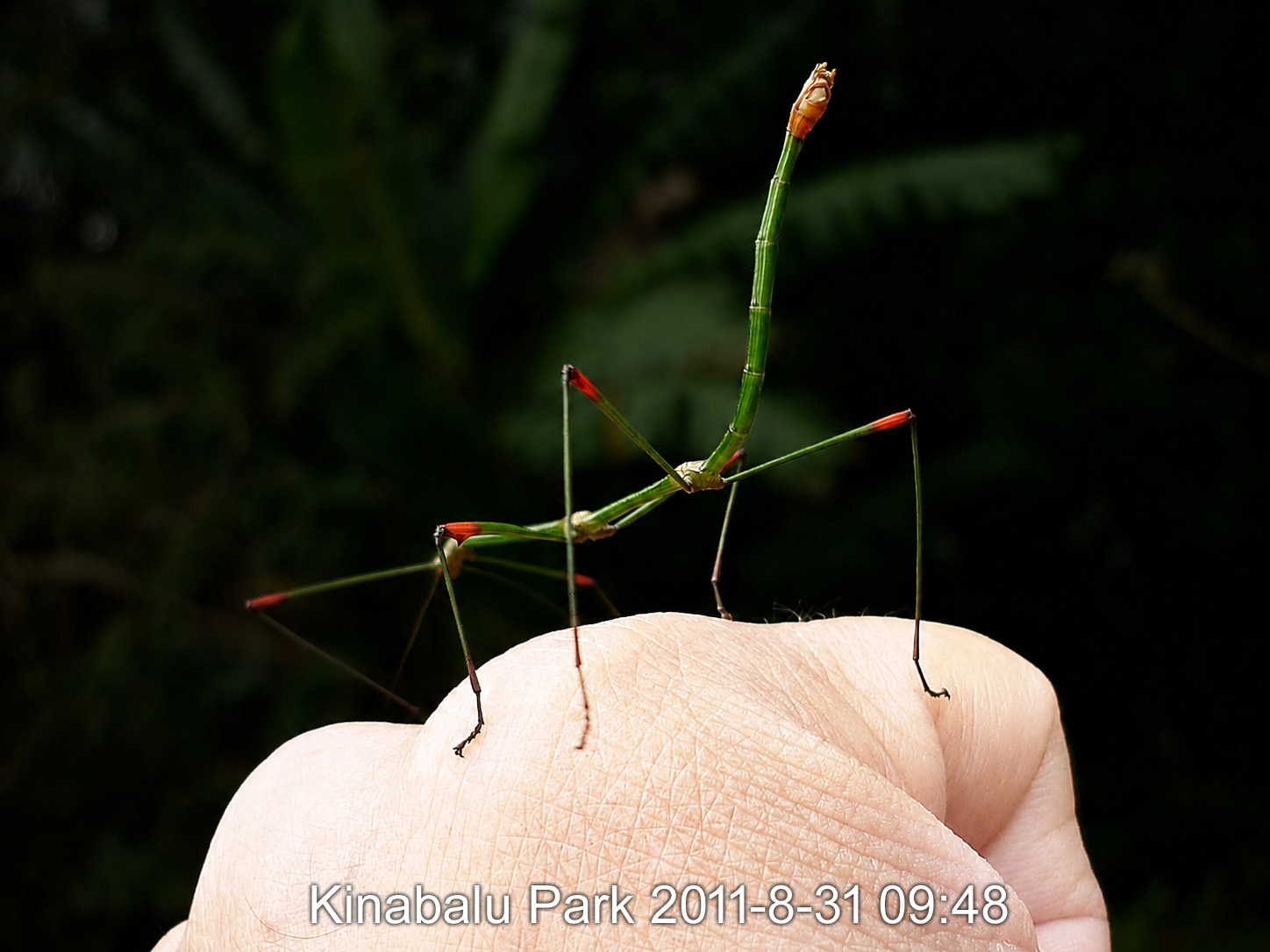
The insect was about 4 inches — roughly 100 mm — in body length, bright green, smooth-bodied and without wings. The legs carried vivid red bands at the joints, and the antennae were long, dark and thread-like. The abdomen was held raised and curved upward, ending in a swollen orange-brown tip.
Unlike most stick insects, this one was active in broad daylight and moving continuously. While close-up photographs were being taken it climbed from the foliage onto the photographer's hand of its own accord, and the second photograph below was taken while it stood there.
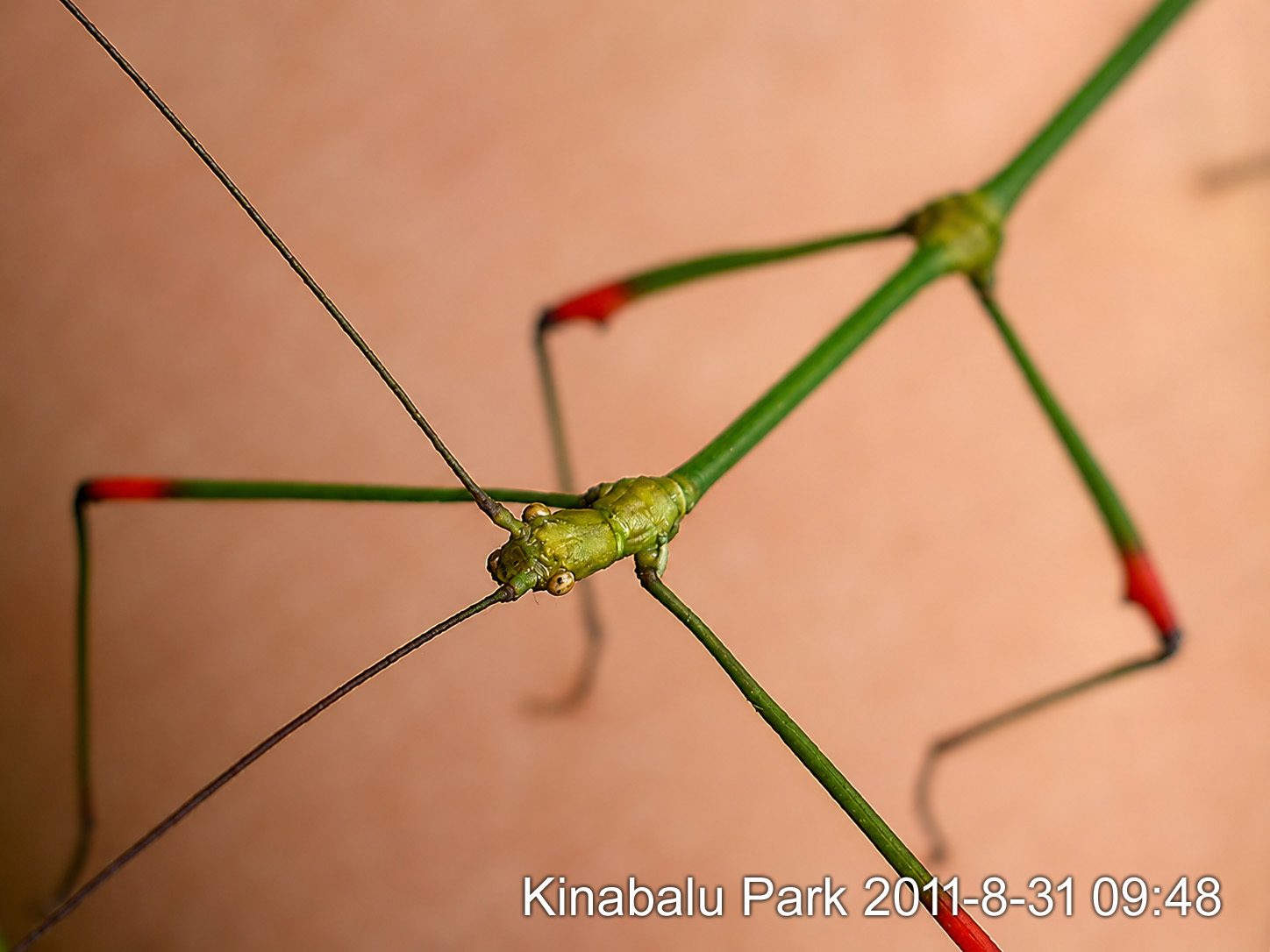
The close view shows the small smooth head, the rounded eyes, and the very long fine antennae. No wings and no wing buds are visible on the thorax.
What is established: the animal is a stick insect, order Phasmatodea.
What is not established: everything below that. Unlike the spiny pair photographed at Sayap, no subfamily is proposed here. The smooth green body, the very long thread-like antennae and the red joint markings are consistent with several groups of South-East Asian stick insects, and choosing between them from photographs alone would be guesswork.
One point matters more than any other, and it is a caution. The absence of wings cannot be used as a character until the animal is known to be adult, because immature stick insects are wingless whatever the adult condition turns out to be. A large nymph of a winged species and a genuinely wingless adult can look much alike in a photograph. At roughly 100 mm this individual could plausibly be either. Anyone identifying it will need to settle that question first, and it is why this page does not describe the animal as a wingless species.
What would settle it: examination by a phasmid specialist. The most useful additional views would be the thorax from directly above — showing whether wing buds are present — and the end of the abdomen, which carries the characters used to separate genera and to tell an adult from a late-stage nymph.
The photographs have been posted to iNaturalist as observation 396594735, where they are open to examination by identifiers worldwide. As at the review date below, the record stands at order level only, and the question of adult or nymph remains open. Any determination reached there will be recorded here, together with its source.
Two things about this encounter are worth recording, because both run against the usual pattern.
It was active by day. Most stick insects are nocturnal, feeding after dark and resting motionless through daylight. This one was moving continuously at a quarter to ten in the morning, in the open, beside a car park.
It climbed onto a hand by itself. The photographer wondered whether body heat attracted it. That is a reasonable question, but the simpler explanation is ordinary climbing behaviour: stick insects habitually climb upward onto whatever support is nearest and highest, and a hand held close to the foliage is exactly that. No claim about heat is made here — the observation is recorded as it happened, and the explanation left open.
The Kinabalu Park Headquarters sits at about 1,520 m on the southern side of Mount Kinabalu and is the most visited part of the park. That an unidentified stick insect was found in the car park, in daylight, is a reminder of how much remains undescribed even in the busiest and most walked-over corner of the massif — new stick insect species are still being described from the Kinabalu massif, including species of Lonchodes.
Page reviewed: 2 September 2026.