Provisional record. This page records an observation that has not yet been identified. It will be revised when a determination is available.
Order Phasmatodea. Family and genus not determined. Possibly an immature.
Photographed by Wong Fook Yee at 19:54 on 7 July 2017, on the night walk trail at the Tawau Hills Park Headquarters, Sabah, at approximately 400 m above sea level.
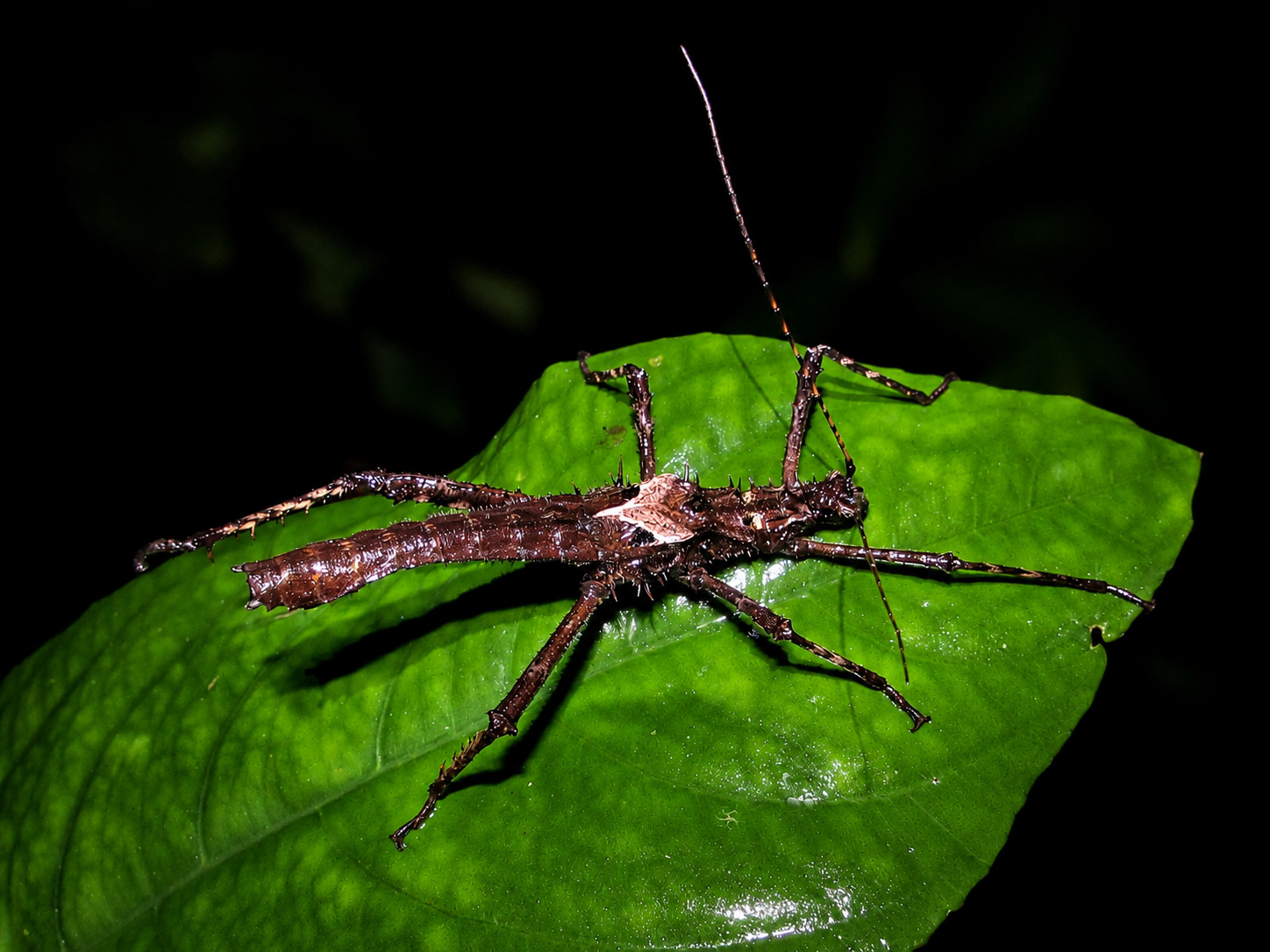
The insect was about 4 inches — roughly 100 mm — in body length, resting on a broad tree leaf and not moving during the photography. It had recently rained, and the wet leaf surface is glossy in the photograph.
The animal is dark brown, robust, and armed with rows of short pale-tipped spines along the thorax, abdomen and legs. A conspicuous cream-white patch marks the top of the thorax — the most distinctive feature visible, and the one most likely to help an identifier. The antennae are long and slender. No wings are visible.
What is established: the animal is a stick insect, order Phasmatodea.
What is not established: the family and everything below it. As with the other records in this section, several groups of South-East Asian stick insects contain heavily spined, wingless, thickset forms, and the characters that separate them are not visible in a single field photograph. No family is proposed here.
It resembles the 2015 record from the same trail. This animal and the spiny stick insect photographed on the same night walk trail in July 2015 share a general build — robust, heavily spined, wingless, brown, comparable in size at roughly 75 and 100 mm. They may well be the same species, or the same species at different stages. They are not recorded here as the same, because that judgement needs a specialist and because superficially similar phasmids are regularly unrelated. Anyone identifying one of these two observations should look at the other; the two together are more informative than either alone. The 2015 animal is iNaturalist observation 396620408.
The same caution as elsewhere on this site applies. The absence of wings cannot be used as a character until the animal is known to be adult, because immature stick insects are wingless whatever the adult condition turns out to be. Spination also changes between instars in this order.
What would settle it: examination by a phasmid specialist. The most useful additional views would be the thorax and head from directly above, showing the arrangement of the spines and the extent of the pale thoracic patch, and the end of the abdomen.
The photograph has been posted to iNaturalist as observation 396772532, where it is open to examination by identifiers worldwide. As at the review date below, the record stands at order level only, and the question of adult or nymph remains open. Any determination reached there will be recorded here, together with its source.
The night walk trail runs from the Park Headquarters at around 400 m above sea level, in the lowland part of the park. Tawau Hills Park covers 27,972 hectares and rises from there to 1,312 m at Gunung Magdalena. It was gazetted to protect the water catchment serving Tawau town and the Semporna peninsula, and oil palm, rubber and cocoa now fringe its boundaries — which makes the forest inside it a genuine island.
Rain matters to a record like this one. Phasmids are most readily found on foliage at night, and a wet night after rain is when a night walk tends to produce them. That both Tawau Hills records in this section come from the same trail, twenty-four months apart and both after dark, says more about when people walk with a torch than about where the animals are.
The park continues to yield species new to science. In June 2026, researchers from Universiti Malaysia Sabah published Metarhizium tawauensis, a previously unknown insect-killing fungus collected in the park's Botanical Garden in January 2023.
Page reviewed: 2 September 2026.