eTawau > Insects of Borneo > Ants > The green queen and the maggots
A weaver ant on a papaya leaf, Tawau — and a question I could not answer
One afternoon in July 2009 I was walking in a papaya garden beside the Tawau River, opposite Pasar Semarak at Km 7 of Jalan Kuhara. On a yellowing papaya leaf I found something I had never seen before, and I still think about it. Let me show it to you, and let us look at it together.
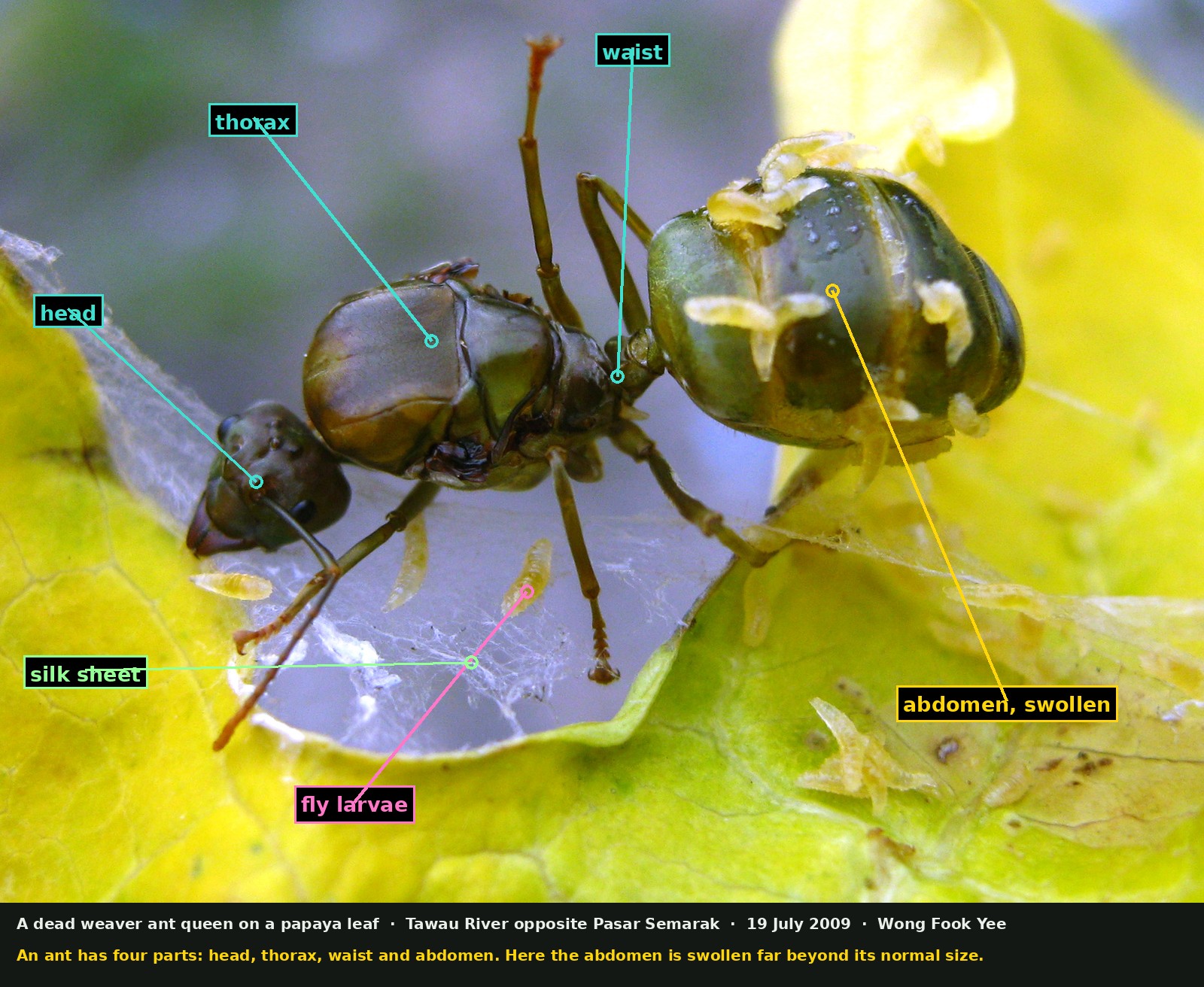
Take your time with that picture before you read on. Ask yourself three things. What kind of animal is this? What are the small pale things? And what happened here?
Your science textbook tells you that an insect has three parts: head, thorax and abdomen. That is correct, and it is worth remembering. But look at the ant in Picture 1 and count. You will see four pieces, not three.
The extra piece is the waist. In an ant the front part of the abdomen is pinched into a narrow stalk with a small lump on it, and behind that stalk the rest of the abdomen swells into a rounded ball. So the rule is not broken — the waist is part of the abdomen, not part of the thorax. It only looks like a separate section.
This narrow waist is one of the surest ways to know you are looking at a true ant. Many insects pretend to be ants, and some of them are very good at it, but a painted stripe is not the same thing as a real pinch. (If you want the harder version: the ant's "thorax" also contains the very first segment of the abdomen, fused on at the back. Scientists therefore use the words mesosoma and gaster rather than thorax and abdomen. Learn the simple version first.)
Now look at the second picture — the front half of the same animal, larger.
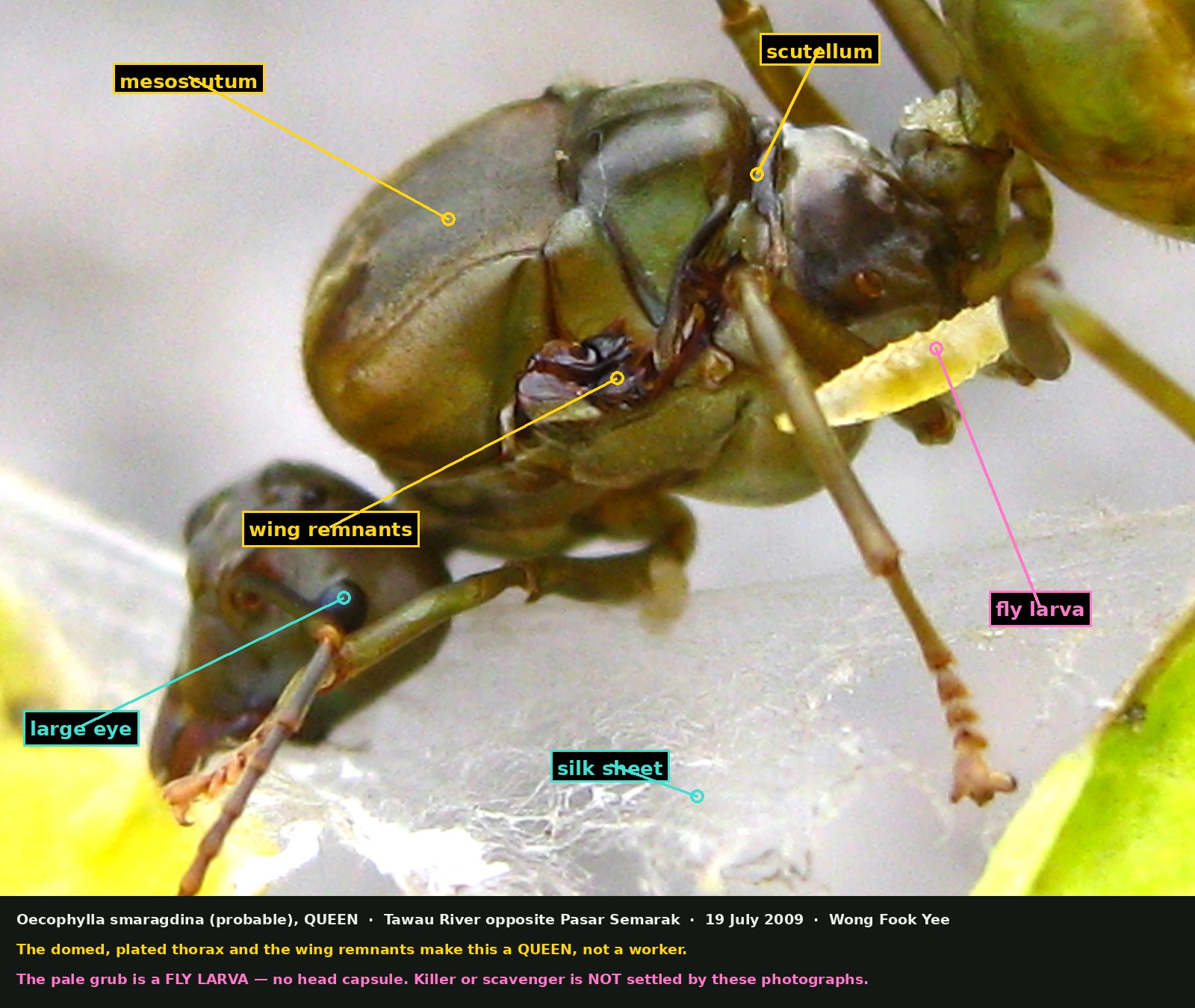
In an ant colony there are different kinds of ant, and they have different bodies. The ones you see running along a branch are workers. Workers never have wings and their thorax is simple and narrow, because there are no flight muscles inside it.
This ant is not a worker. Her thorax is deep and boxy and covered with large smooth plates — the big dome in front is called the mesoscutum and the smaller plate behind it the scutellum. Those plates exist to anchor wing muscles. And at the wing bases you can see a crumpled brown mess: what is left of her wings.
Here is the part I like best. A young queen grows wings, leaves her mother's nest and flies. She mates in the air. Then she lands — and she breaks her own wings off. She will never fly again and she does not need to. From that day she is a walking egg factory. The crumpled brown material in Picture 2 is the stump of a journey she made once and never repeated.
Every child in Tawau knows the kerengga — the weaver ant, Oecophylla smaragdina. They are the fierce reddish ants that live in bundles of living leaves in mango, rambutan and other trees, and that come running out along your arm if you shake the branch.
So why is this ant green?
Because in Malaysia the workers are red but the queens are green — from dark green to a pale yellow-green. That is why almost nobody has seen one. The queen stays inside the nest, and the only time she is out in the open is on the day she flies. The scientific name says it plainly: smaragdina is Latin for emerald. The species was named for a colour that most people never get to see.
Now, the silk. Look again at Picture 1 — the white sheet the ant is lying on, stretched across a hole in the leaf.
When I first saw it I thought of a spider. But it is almost certainly not a spider's web, and the reason is one of the most remarkable things any insect does.
A weaver ant nest is made of living leaves pulled together and glued with silk. But adult ants cannot make silk. Only their larvae — their own grubs — can. So the workers line up along the edge of a leaf, grip it, and haul. Other workers go into the nest, pick up a half-grown larva in their jaws, carry it out, and pass it back and forth across the seam like a living sewing shuttle, tapping its head so that it releases a thread. Leaf by leaf, thread by thread, they build a green house out of their own children.
A big nest — up to half a metre across — can be finished in less than a day.
So the silk on that papaya leaf may well be the remains of a nest. The leaf died and rotted away around it, and the silk, which does not rot so fast, stayed behind.
Bigger than you are imagining.
Read that again, then look at Picture 1 once more. If this queen belonged to an established colony, then the small dead body on that leaf was the beginning of the end for every one of those ants. If she was instead a young queen who had just flown and was trying to start a colony of her own, then what died was a colony that never happened.
Either way, one ant on one leaf is not a small event.
There is a reason to care about weaver ants beyond their being interesting.
Farmers in South-East Asia — in China and Vietnam especially — have used weaver ants in their fruit orchards as pest control for hundreds of years. This is one of the oldest known uses of one animal to control another, and it works: weaver ants patrol the leaves day and night and attack the insects that damage cashew, mango, citrus, cocoa and coconut. In mango orchards where the ants were present, seed weevil damage was under 1%; where they were absent, it ran from 2.5% up to 16%.
I found this queen in a papaya garden. Think about that. The ant that some people knock down with a stick because it bites is, in other countries, deliberately encouraged and even moved from tree to tree by farmers who understand what it is doing for them.
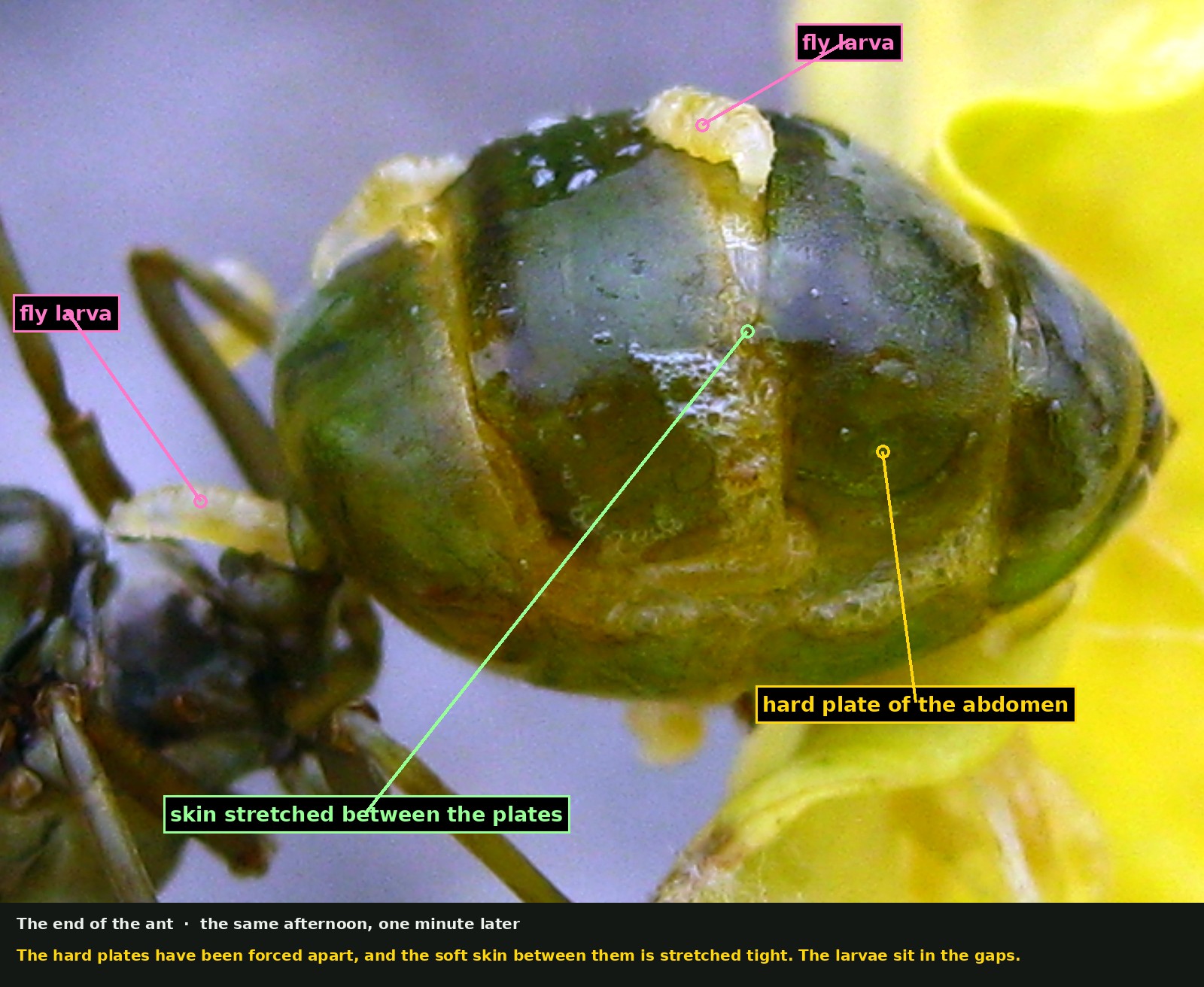
An insect's abdomen is not one solid box. It is a row of hard plates joined by soft, flexible skin, so that the animal can bend and swell. In Picture 3 that soft skin has been stretched to its limit. The plates have been pushed apart until you can see straight through to the pale membrane between them, and the whole abdomen is tight like a balloon.
And sitting in those gaps are the pale grubs.
A fair guess — there are ant larvae in every ant nest, after all. But no, and here is how to tell, because this is a useful thing to be able to do.
Look at the grubs in Picture 1 and Picture 3. Smooth rings, a soft point at one end, blunt at the other, no head. These are fly larvae. They are not the ant's children.
Here it is, and I want you to notice that I am not going to answer it.
Did those maggots kill this queen, or did they simply find her already dead?
When I first saw the photographs, my own answer was immediate: parasites, eating her alive from the inside. That is what it looks like. But "what it looks like" and "what happened" are not the same thing, and a good observer keeps them apart. So let us set out both sides properly, the way you would in an argument where you actually want to find out the truth rather than win.
About the photographs. Three frames taken by Wong Fook Yee on 19 July 2009 with a
Canon PowerShot A470, within one minute of each other. On this page they have been reduced,
and labels have been added, because this page is written to teach rather than to serve as scientific
evidence. The unmarked full-resolution originals are attached to the iNaturalist record above, and
those are the ones a scientist should work from.
All photographs © Wong Fook Yee. Page written 10 September 2026.