eTawau > Insects of Borneo > Ants > When a weaver ant met a nettle caterpillar
Kampung Sayap, Kota Belud — and the ant walked away
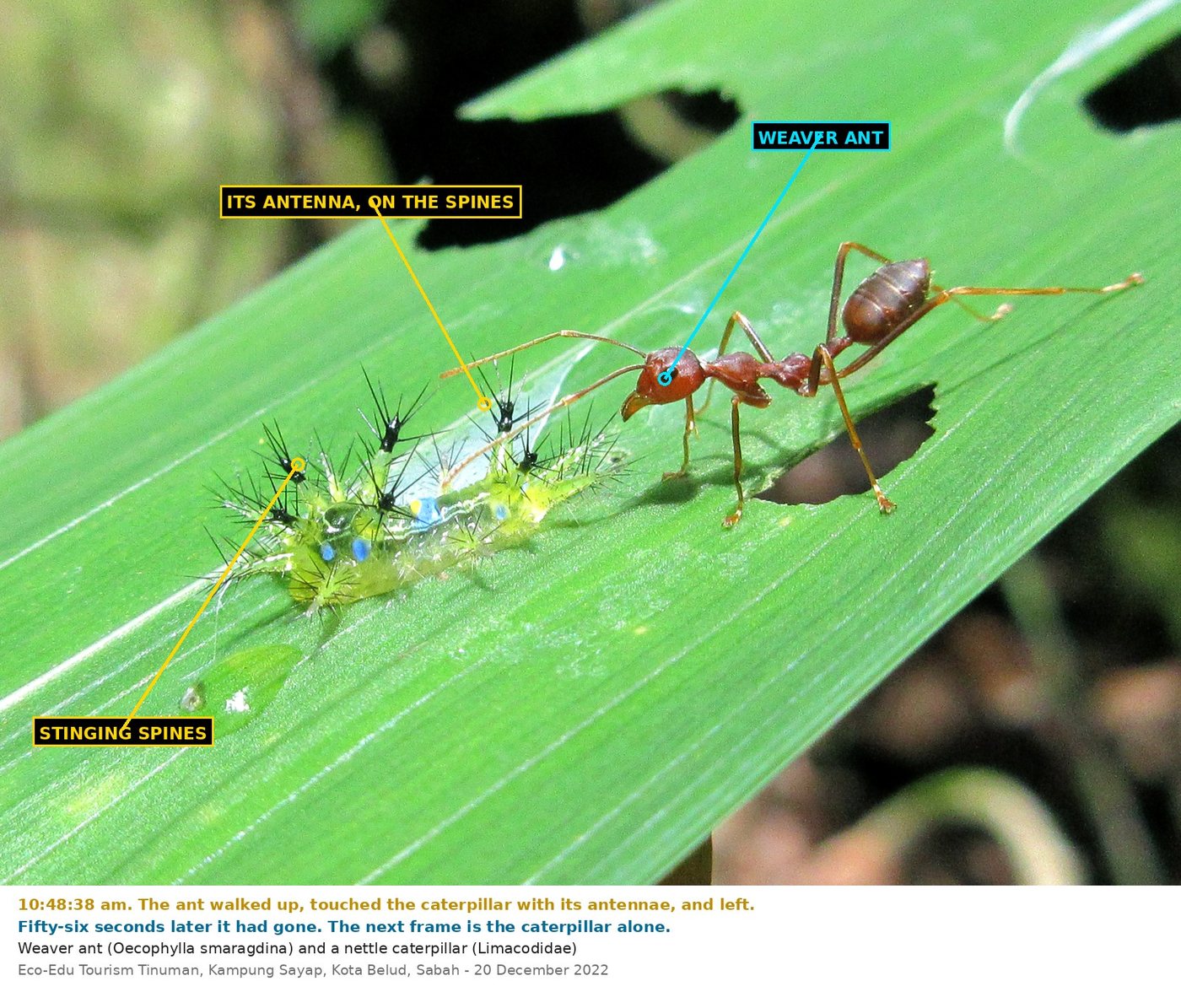
A weaver ant came along a blade of grass and found a small green caterpillar sitting on it. Anyone who has watched kerengga at work knows how that ought to end. These are the fiercest small hunters in the Bornean forest, and the caterpillar was soft, slow and ten millimetres long.
The ant walked up to it, stopped, touched it briefly with its antennae — and left. No bite, no grip, no call for help. Fifty-six seconds later it was gone from the grass blade altogether.
It took me a long time to work out why, and the answer is in the photograph if you know where to look.
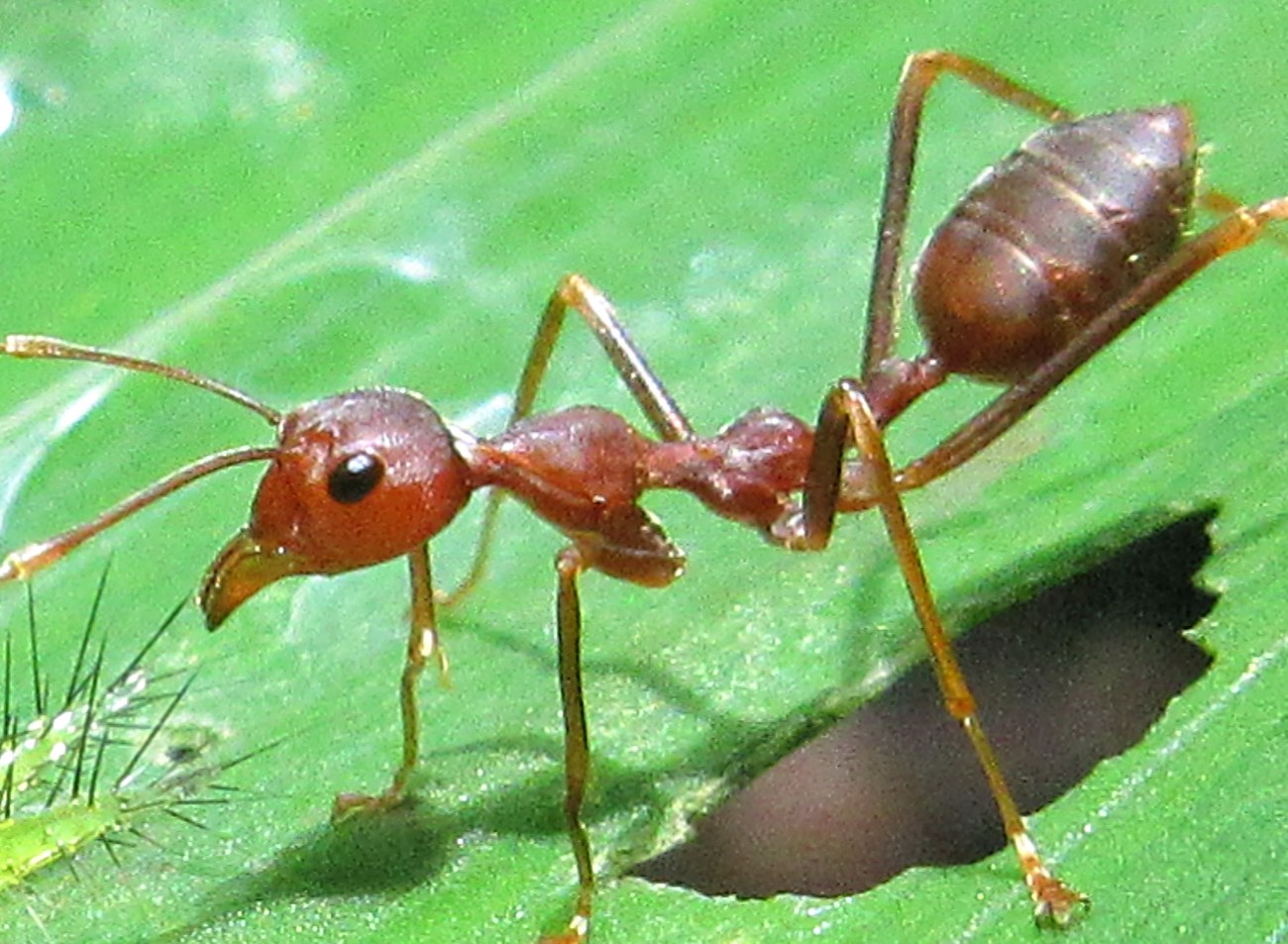
The Asian weaver ant, Oecophylla smaragdina, is the ant that binds living leaves into nests using silk squeezed from its own part-grown larvae. Colonies run into the hundreds of thousands and hold whole trees against all comers. They are aggressive, fast, extremely territorial, and they hunt everything they can overpower.
They are so good at it that people have been putting them to work for a very long time. Weaver ants are among the oldest biological control agents on record — Chinese citrus growers were carrying their nests from tree to tree centuries ago — and they are still used that way in tropical orchards today, including in this region. A caterpillar on a leaf is exactly the kind of thing a weaver ant colony is employed to remove.
It belongs to the Limacodidae, the slug caterpillars — known across Malaysia as the nettle caterpillars, and the name is a warning rather than a description.
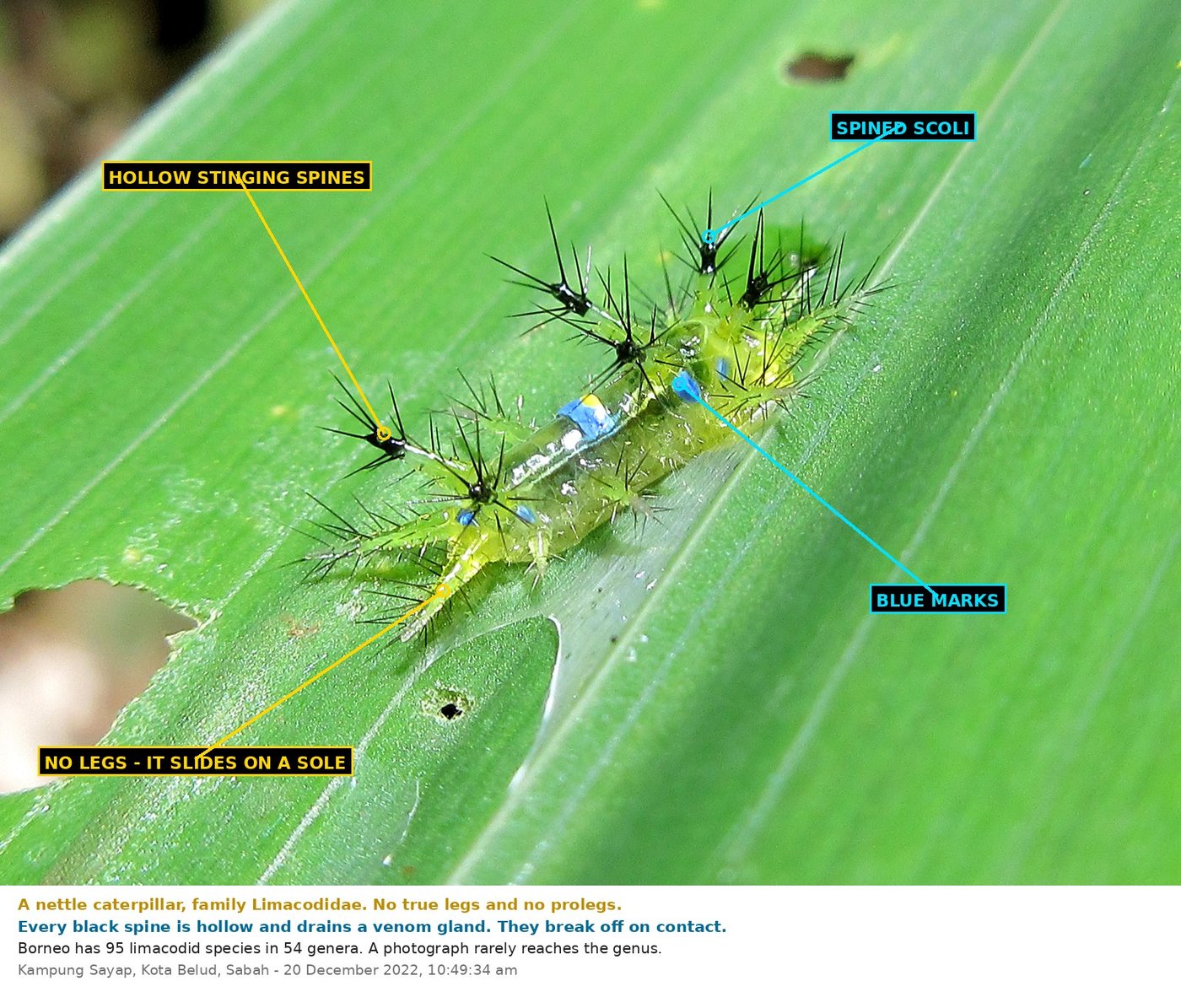
What it has instead is armour. Those star-shaped clusters are called scoli, and every black spine radiating from them is hollow and drains a poison gland under the skin. They are built to break off on contact, so that the contents run out into whatever touched them. Brushing against one is often compared to a bee sting, and the pain lasts a day or two.
Here is the part worth carrying away. Think about how an ant actually kills something.
It has to get its jaws onto the animal, hold on, and spray formic acid into the wound. Every single step of that requires contact with the body surface. And a dense field of long, brittle, venom-filled spines standing out in every direction does exactly one thing: it holds the jaws away from the skin. There is nowhere on this caterpillar for an ant to take hold. The defence is not really poison. The defence is distance — the poison is what makes trying it expensive.
I photographed the meeting at 10:48:38, and the caterpillar on its own at 10:49:34. I did not time anything — I only found the interval afterwards, in the camera's own record of when it opened the shutter.
It is worth saying to anyone who photographs animals: your camera is writing down the time whether you ask it to or not, and when a record is a sequence, the gap between the frames is itself an observation. It turned "the ant walked away" from something I remembered into something I can show.
This site tries to keep what was seen apart from what was worked out afterwards. Three honest alternatives:
When I showed these pictures around, the first thing people said was that the two knew each other — that the ant had greeted an old friend and moved on. It is a lovely idea, and it is not foolish, because ants and caterpillars really do have friendships.
The caterpillars of many blue butterflies (family Lycaenidae) carry glands that feed ants a sweet secretion, and in exchange the ants guard them from wasps and spiders. Some are even carried down into the ants' nest and raised there. If you ever see a smooth, flat, legless-looking caterpillar with ants fussing attentively over it, that is what you are watching, and it is worth stopping for.
But this is the opposite animal. A lycaenid caterpillar is smooth because it wants the ants to touch it. This one is covered in venom because it wants nothing to touch it at all. The ant came, found out, and went. Not friendship — a warning, read correctly.
Eco-Edu Tourism Tinuman, about 3 km before the centre of
Kampung
Sayap, in the Kota Belud district of Sabah, on the northern flank of Mount Kinabalu. I had
car-camped there alone the night before.
One weaver ant, Oecophylla smaragdina, a major worker, and one
nettle caterpillar, family Limacodidae — genus not determined.
Both about 10 mm, each alone, on a blade of the long grass the people here call
larang. Two frames, 10:48:38 and 10:49:34. Neither animal was handled or moved; both were
left where they were.
— iNaturalist observation
399882665
About the photographs. Taken by Wong Fook Yee with a Canon IXUS 285 HS at Eco-Edu
Tourism Tinuman, Kampung Sayap, Kota Belud, on 20 December 2022 at 10:48:38 and 10:49:34 am. For this
page they have been reduced and labelled, because a visitor wants to be shown what to look at. The
unmarked originals are attached to the iNaturalist record above, which is where anyone working on the
identification should start.
The Bornean limacodid figures and the larval characters follow The Moths of Borneo, Part 1;
the structure of the stinging spines follows the Virginia Cooperative Extension account of stinging
slug caterpillars. All photographs © Wong Fook Yee. Page written 13 September 2026.