Originally published on this site as "Lice on Cicada", at the address
CicadaLice.htm. The animal is almost certainly not a louse — see
Identification — so both the title and the file name have been
changed. The old address redirects here.
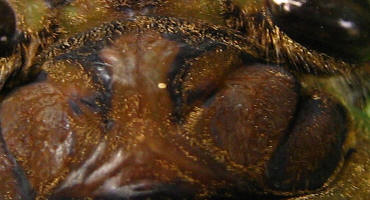
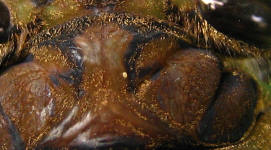
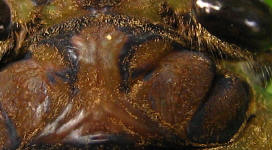
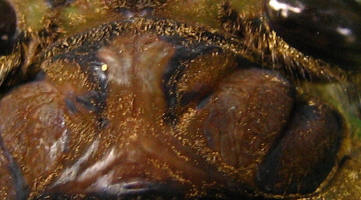
Tawau, Sabah. A cicada was resting on a leaf and had been photographed at close range. Reviewing the frames afterwards, a tiny yellow dot showed on the top of the cicada's head, between the eyes, at the three o'clock position. Dust, presumably. The next frame was opened to check.
In the second frame the yellow dot had moved to four o'clock. In the third it was at twelve o'clock. In the fourth and last of the sequence it was at ten o'clock. It was not dust. It was something alive, and it was walking about on the cicada's head.
Camera in hand, back out to the leaf. The cicada was still there, in the same position. The animal was far too small to see with the naked eye, so the search had to be done through the camera screen with the macro function on — and it was no longer where it had been.
Then the cicada shifted, raised a front leg, and scratched at its left eye. Something was irritating it. Following that clue, the camera was repositioned to look at the side of the face, and there it was.
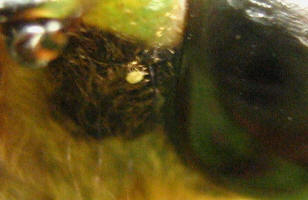
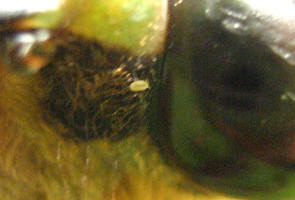
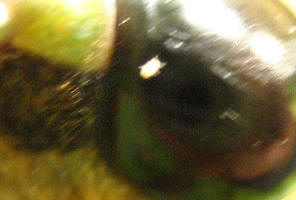
It made a short crossing over the hairy face and then went onto the eye itself. It appeared to prefer the eye — smooth and hairless where the rest of the head is bristly — and spent most of its time going round, and round, and round the cicada's left eyeball.
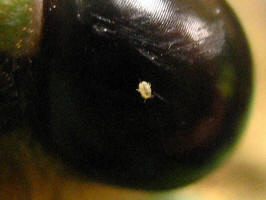
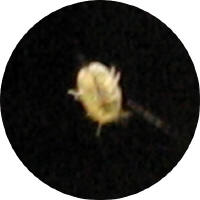
Enlarged about 500 times from the photograph, it has a definite shape: a compact rounded pale body with short limbs projecting around the edge. At life size it is smaller than a printed letter on this page — well under a millimetre.
Established: a minute, mobile, pale yellow arthropod, well under a millimetre long, moving over the head and left compound eye of a living cicada; present across eight frames; and provoking a directed grooming response from its host.
Not established: what it is. No name is given here, because none is supported.
What it is not. It is not a louse. This is worth stating plainly, because the page carried that name for years. True lice (order Phthiraptera) fall into the chewing lice, which parasitize birds and mammals, and the sucking lice, which parasitize mammals only. No louse parasitizes an insect. "Cicada lice" is not a group that exists.
The first thing to rule out — offered as a candidate to test, not as a determination — is the larva of a parasitengone mite (Acari: Trombidiformes: Erythraeidae), such as Leptus or Charletonia. The fit is close on several counts. These larvae are minute and brightly coloured, typically red to orange. They are ectoparasites that ride on and feed from other arthropods. Their recorded host range is wide and explicitly includes Hemiptera — the cicada's own order — with leafhoppers (Cicadellidae) and shield bugs (Pentatomidae) named among the hosts in the Chinese checklist cited below. And a recent study describes new erythraeid species taken specifically as ectoparasites of leafhoppers, which are close relatives of cicadas.
Alternatives that should not be dismissed without looking: a mite of some other family; a thrips (Thysanoptera) merely wandering across; or an immature booklouse (Psocodea) — which, despite the name, is not a true louse either. But the behaviour on record here — staying with the host, returning to it, and irritating it enough to be scratched at — points at something attached to the cicada rather than something passing over it.
Count the legs. A parasitengone mite has six legs in the larval stage — the stage that parasitizes insects — and eight in every later stage. An insect has six at all stages, but on a clearly segmented body with a distinct head and antennae. So six legs on a rounded unsegmented body, with a small forward-projecting mouth cone, would point to a mite larva; eight would mean a mite of a later stage; six on a segmented body with antennae would bring the thrips and booklouse possibilities back.
The enlargement above is not good enough to do it. The image published here is the 200-pixel web copy made in 2009, and at that size the projections around the animal's margin blur into one another. They can be seen; they cannot be counted. Brightening or sharpening the web copy does not help — it only invents edges that are not in the file.
What is needed is the full-resolution camera original of this one frame. If it still exists, that single file may answer the question outright, and would be worth posting to iNaturalist alongside the host cicada. Acarologists are active there, and a dated host association of this kind is exactly what they collect.
The page originally asked: can a cicada feel? What the sequence shows is that the cicada detected the irritation and responded to it in a directed way — it raised a foreleg and groomed the eye that had something on it, not the other one. That is a real observation about the animal's sensory world, and it is what led to the second half of the photographs. Whether it amounts to "feeling" in the sense the question intends is a much larger argument, and one this page does not try to settle.
© Wong Fook Yee. Page reviewed: 5 September 2026.