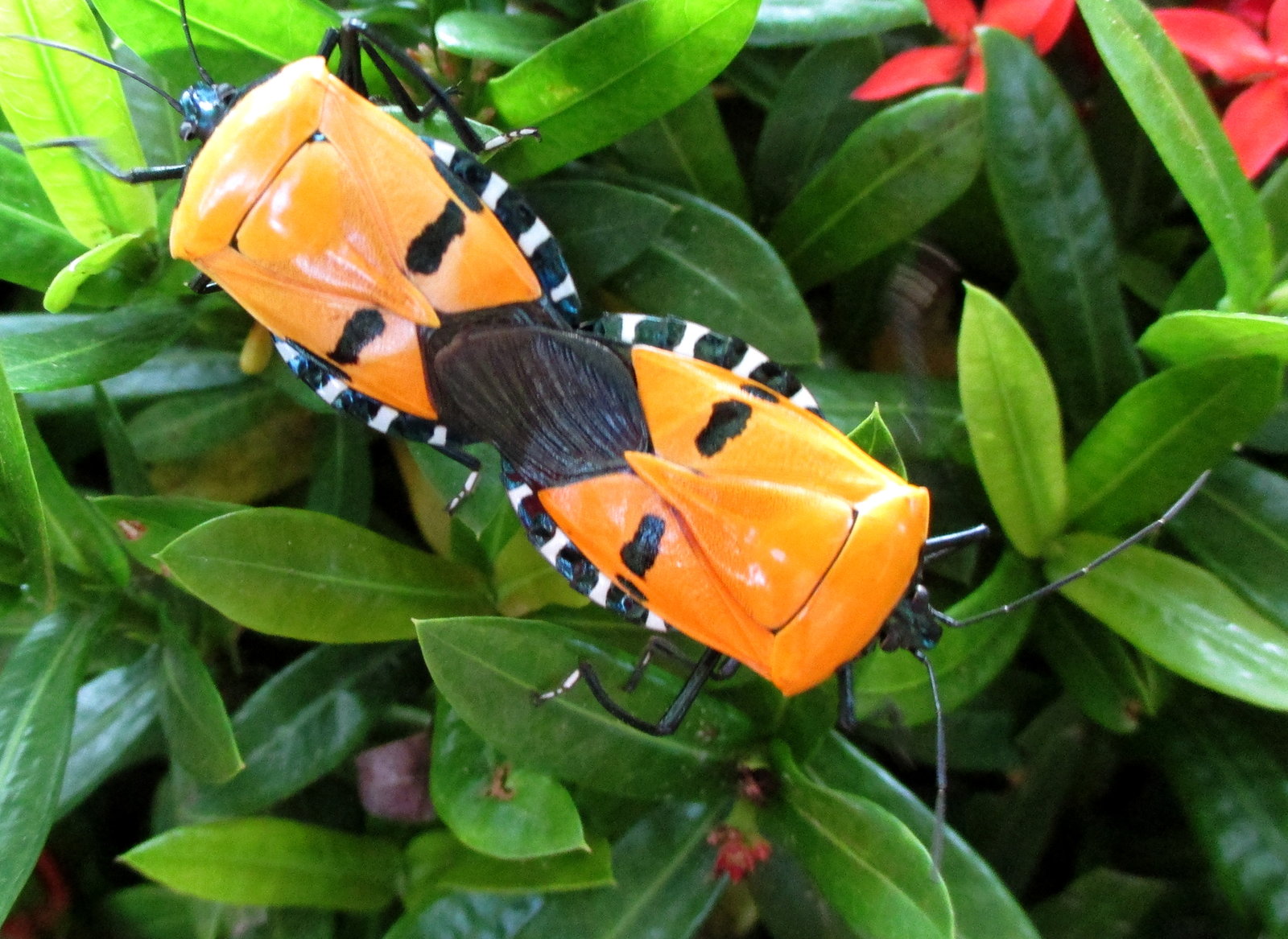
Determined to species. That is unusual on this site and it is stated deliberately — most records here stop at family or order. The reason it is safe in this case is given below.
Order Hemiptera, suborder Heteroptera, family Pentatomidae — the shield bugs or stink bugs. Catacanthus incarnatus, the man-faced stink bug.
Photographed by Wong Fook Yee at 17:04 on 19 October 2014, in the garden of Pu Zhao Temple (普照寺), also known as the Tawau Buddhist Lodge, in Tawau, Sabah.
A pair, mating, joined end to end on the leaves of a flowering shrub, and completely motionless. Each bug was about 30 mm long — the photographer's field estimate, not a measurement. Bright orange above, with the head, legs and antennae metallic blue-black, and a black-and-white banded border down each side of the abdomen.
They stayed where they were long enough to be photographed twice with two different cameras, four minutes apart.
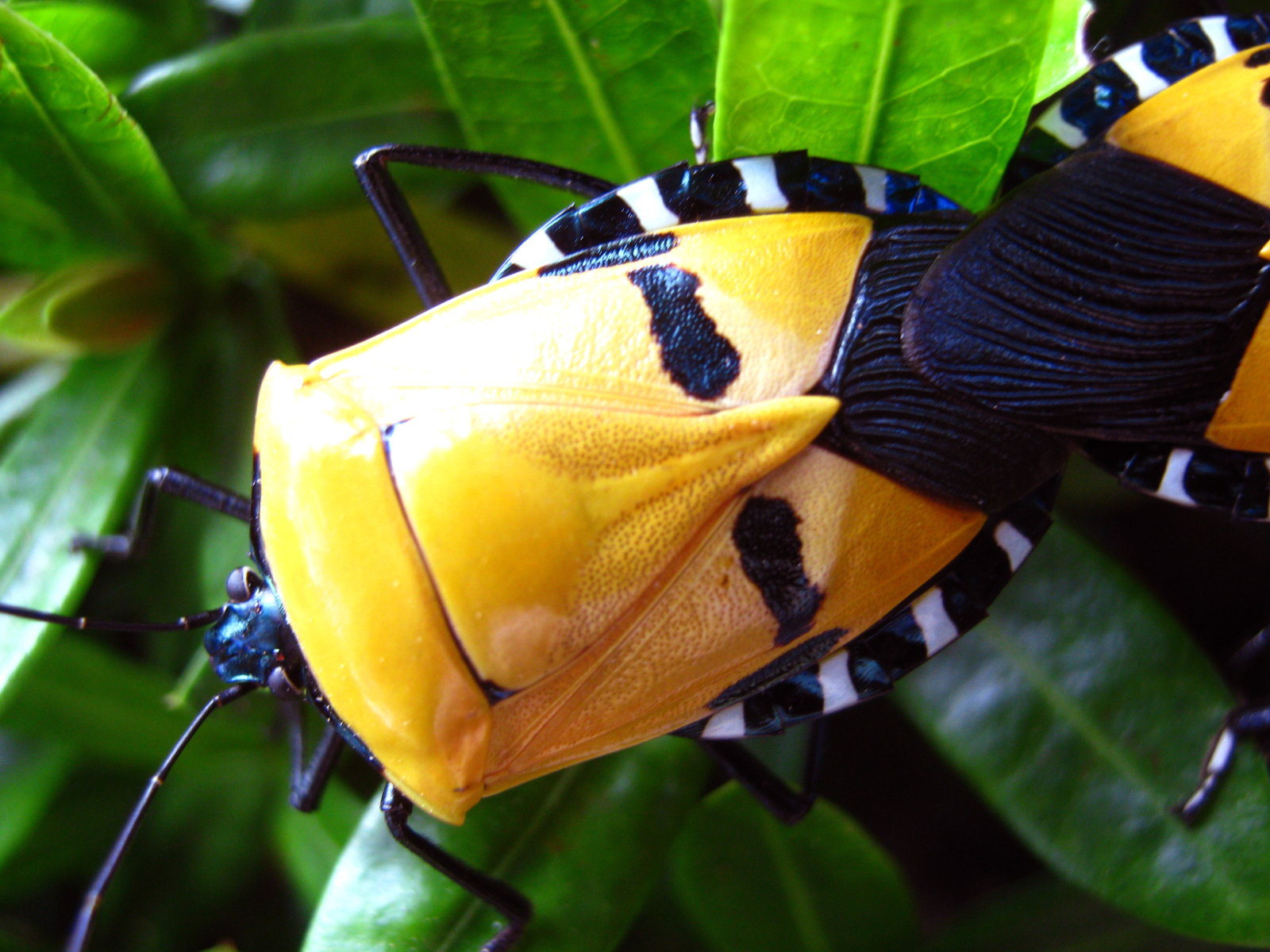
The name comes from the pattern on the back, and the curious thing about it is that the face is the wrong way round.
The two large black blotches sit where a pair of eyes would be. The dark area behind them reads as a shock of hair or a heavy beard. But that dark area is at the rear of the animal, and the bug's actual head — small, metallic blue-black, with the antennae — is at the other end, visible at the lower left of the photograph above. So the hair belongs to the tail end and the chin points forward toward the real head. The face looks back at you along the animal's body, facing the opposite way to the bug wearing it.
Entomologists have remarked that the effect is less a generic face than a specific one: the resemblance most often noted is to Elvis Presley.
Look closely at the dark patch in the second photograph and it is finely striped, like combed hair. Those stripes are wing veins, and the fact explains the whole pattern.
A heteropteran's forewing is a hemelytron — "half-wing" — and it is built in two parts: hardened and leathery near the base, thin and membranous at the tip. On a resting shield bug the two hemelytra fold flat over the back with their membranous tips overlapping across the rear of the body.
So the face is assembled from ordinary bug anatomy:
In the first photograph the two mating bugs are joined tail to tail, so their two dark membranes meet and make a single dark bow-tie in the middle of the pair — one animal's hair running straight into the other's.
This record is a good illustration of the character that defines the suborder, and it is why it is
filed in 2_pairWings/. See
the Hemiptera index for why bugs are gathered above the wing-count
folders rather than inside them.
Several names have been withdrawn from this site because they were taken from references for other parts of the world and applied to Bornean photographs. That is worth saying on a page that does put a species name on the animal, because the reasoning has to be different.
Catacanthus incarnatus is named here on the pattern itself, which is diagnostic and not shared with anything else in the region: the broad orange or yellow hemelytra with two bold black blotches, the metallic blue-black head and legs, and the strongly banded black-and-white abdominal border. The genus Catacanthus is recorded across Asia and the Indo-Pacific, Malaysia included, and C. incarnatus is the widespread Southeast Asian species. The identification is open to challenge on the iNaturalist observation like every other on this site.
The one figure not established is the size. Thirty millimetres is the photographer's estimate in the field, revised down from a first figure of 35 mm. No published measurement has been verified for this page, and a second opinion on it would be welcome.
The genus name is worth a line of its own: Catacanthus means "having downward-pointing thorns".
The shrub is an Ixora, almost certainly Ixora coccinea or a garden form of it. The characters are all in the first photograph: dense rounded clusters of small tubular scarlet flowers, and glossy, leathery, oblong leaves carried in opposite pairs. It is native to southern India, Bangladesh and Sri Lanka, is used throughout the warm tropics for hedges and screens because it tolerates hard pruning, and is one of the commonest roadside and garden hedge plants in Malaysia.
The species is left open; the genus is not in doubt. It is worth adding that the reference article on the genus Catacanthus illustrates this same bug on an Ixora — the association in this photograph is not a coincidence of one afternoon.
Pu Zhao Temple stands on about five acres, with the Mahavira Hall and a seven-tier pagoda, and the whole of the ground is landscaped with flowering plants — the largest garden of its kind in Tawau town. It is already promoted locally as a visitor attraction, for the buildings.
The planting is the reason it belongs on this site. Flowering shrubs in quantity, kept watered and pruned, in the middle of a town, draw a wide variety of insects, and this pair was on one of them at five in the afternoon. It is the first urban locality recorded in this series — everything else so far has been forest, riverbank or working saw mill — and it is the easiest of them all to visit. A garden lover and an insect photographer want the same half-hour here.
Page reviewed: 6 September 2026.