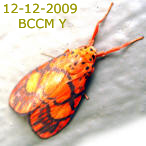
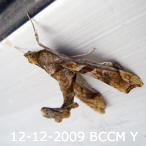
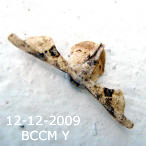
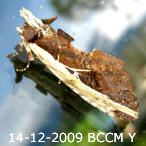
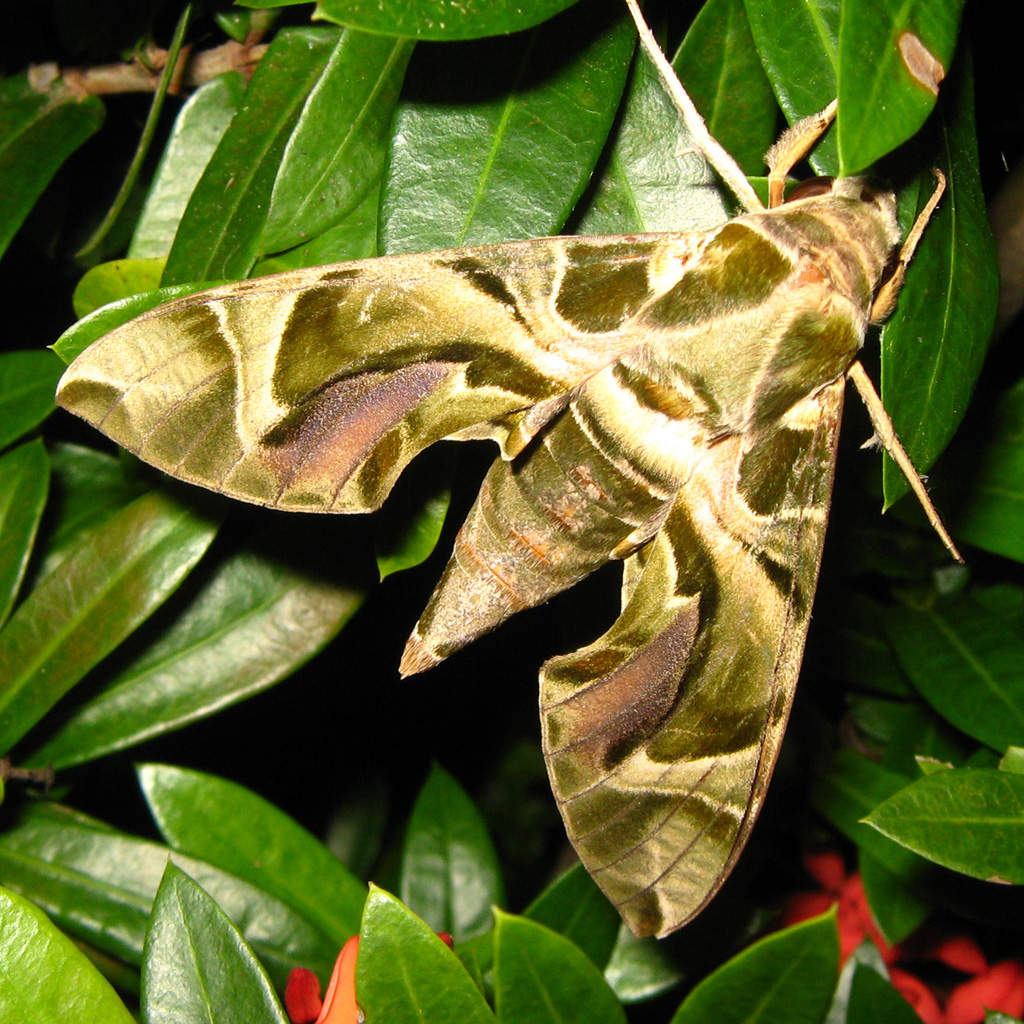
MOTHS are generally dull coloured and fly at night,
and are seldom noticed. But there are moths which
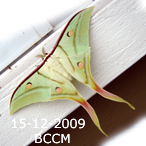
are colourful, like the spectacular Atlas Moth
above, and moths which are diurnal in habit. This
section of the Picture Gallery displays some moths
that I have encountered while out looking for
butterflies. They were photographed in a by-the-way
manner only when I happened to see them. Butterflies
are still my main interest as photography subjects.
While I have many reference books on Malaysian
butterflies, my resources on moths are rather
limited. If you can identify the species shown here,
particularly those at the bottom of the page, I
would be happy if you will kindly let me know the
name of the species, or email me if I've got the
identification or facts wrong.
Please click on either the thumbnail image or
the name of the species to see a bigger picture of
the moth (or larva, in some cases). The picture
opens in a new window. You can navigate to a
limited extent within that window. After viewing it,
close that window to return to this page.
|
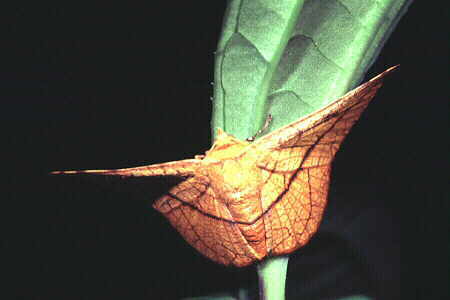
Family Thyrididae
|
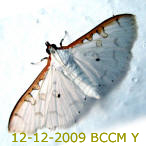
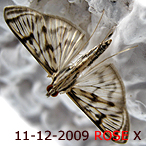
Telchines vialis is a leaf-mimicking moth. With
many lines on its wings simulating leaf veins and a golden
brown colour, this moth bears some resemblance to a dead
leaf. This species is found in northern India, Malaysia and
Indonesia. |
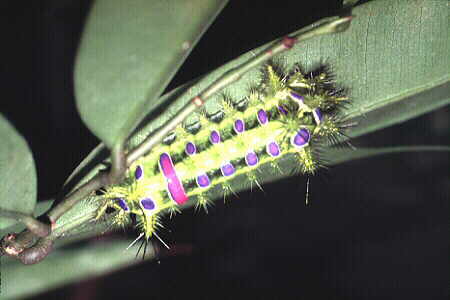
Family Limacodidae
|
This pretty
larva of a Limacodid moth is armed with spines which can
cause a nasty itch. I accidentally brushed my hand against
this caterpillar while trying to photograph an insect, and
it left a stinging sensation for hours on that part of my
hand that had touched it. |
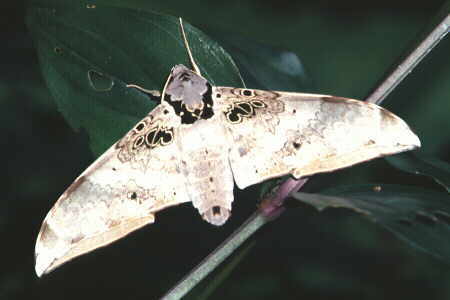
Family Sphingidae
|
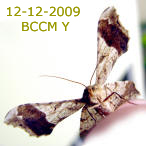
Ambulyx (formerly Oxyambulyx) canescens is
considered a forest pest because its larvae feed on the
leaves of young Dryobalanops lanceolata, a timber
tree. This hawkmoth is found in Indochina, Malaysia,
Sumatra, Java, Borneo and the Philippines. |
|
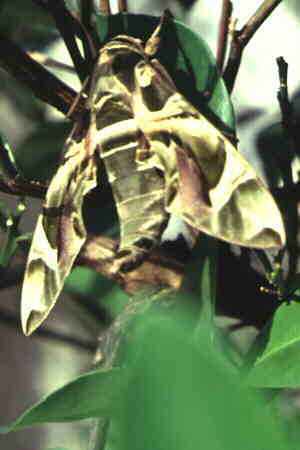
The Oleander Hawkmoth (Daphnis nerii) has a very
wide geographical range. This species occurs in the
Afrotropical and Indo-Australian regions, and is known to
migrate northwards to Europe. However, I have seen it only
once. |
Family Arctiidae
|
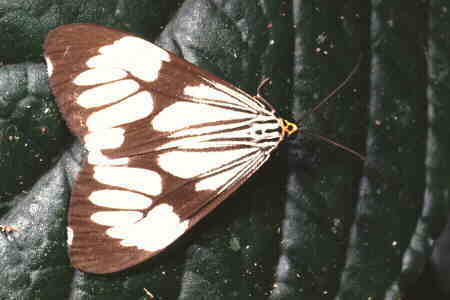
Nyctemera coleta belongs to a group of day-flying
moths known as Marbled White Moths. It is a common species
usually encountered in secondary growth. Besides Malaysia,
it is also found in India, Sri Lanka to south China, Taiwan,
the Philippines and New Guinea. |
|
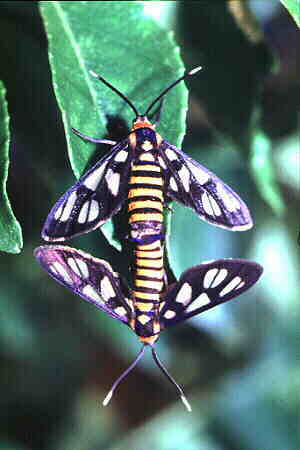
Amata huebneri is regarded as a wasp mimic with
the common name of Wasp Moth. It is a day-flying species
about the same size as a small wasp. This species was
formerly known as Syntomis huebneri (subfamily
Syntominae). |
|
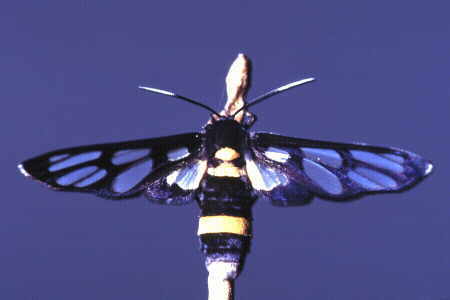
This is possibly
Syntomoides (Ceryx) imaon. It is also a wasp
mimic but is commonly known as the Handmaiden Moth. Like
Amata huebneri, it is a day-flying species belonging to
the subfamily Syntominae, but it is much larger than the
former. |
Lymantriidae
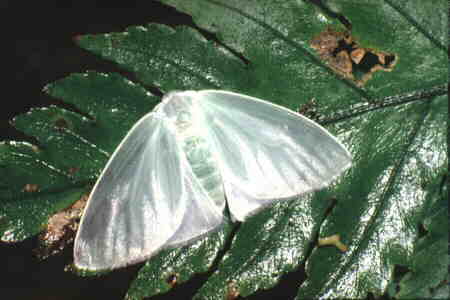
|
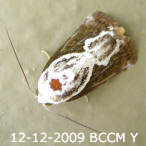
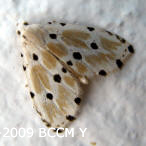
What drew my attention to this white
moth is the satin-like gloss on its wings. This is a
Leucoma sp., possibly impressa. Another
completely white moth of about the same size found in
Malaysia is Chasmina nigropunctata (Noctuidae). |
Family Noctuidae

|
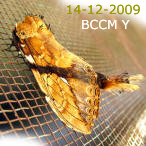
Othreis smaragdipicta (Catocalinae) is a master
of disguise that blends in perfectly with the detritus and
green growth on the forest floor. Its common name of Yellow
Underwing refers to its hindwings which "flash" to startle a
would-be predator when it is disturbed and takes flight. |
|
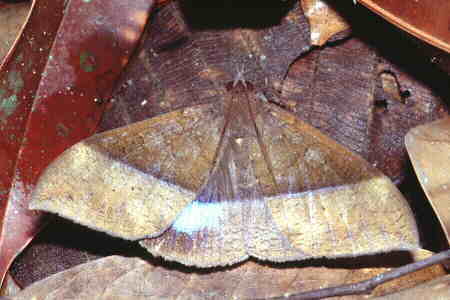
Ischyja inferna (Catocalinae) is a leaf-mimicking
moth that prefers to settle on the forest floor and "hide"
among the dead leaves and other detritus. Its disguise would
have been totally effective but for the bit of light blue on
the hindwings which gave the moth away. |
|
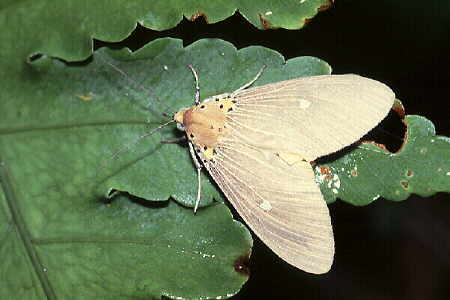
Asota caricae (Aganainae) belongs to a group of
moths commonly known as Tiger Moths. This species has a wide
range and is found in the Indo-Australian region. The larval
food plant is Ficus oppositifolia. The species has
also been recorded as a pest of papaya. |
Drepanidae

|
This moth is another leaf mimic. It
looks like a dead leaf that has fallen on a green (living)
leaf in the forest understorey. A bit of forest detritus
lying next to it makes the moth's disguise even more
realistic. It is a species of
Oreta, possibly bicolor (subfamily
Oretinae). |
|
Family Geometridae
|
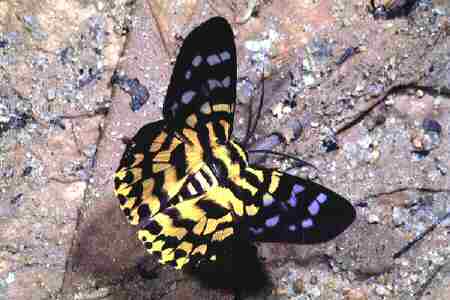
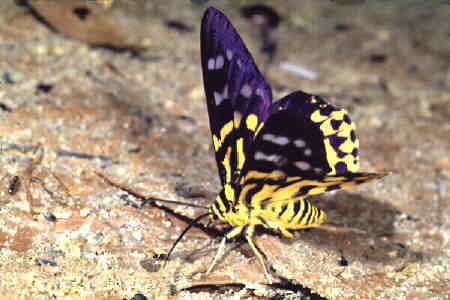
Dysphania subrepleta is a day-flying moth
which I found drinking from the ground just like some
butterflies (especially Papilionids and Pierids) have
the habit of doing. The striking blue-and-yellow colour
combination is possibly a sign that this species is
poisonous. |
|
The same specimen of
D. subrepleta as above. This shot shows the
bright yellow body marked with blue bands. This species
of moth could be easily mistaken for the Burnet Moth,
Psaphis euschemoides, of the family Zygaenidae as it
has similar wing markings. |

|
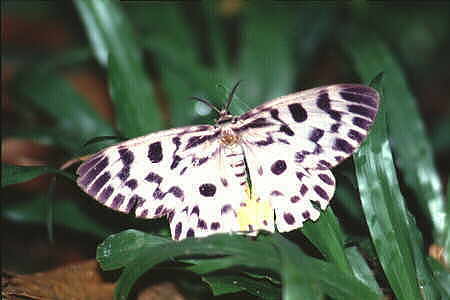
This is a another
Dysphania sp., possibly sagana. Its
wing pattern is different from that of subrepleta
although it has the same blue and yellow colours. There
are far fewer blue spots on this specimen. This photo
was taken at the same locality but on a different
occasion. |
|
Dysphania malayanus is a nocturnal moth (it
flies at night). This one was probably a sick or injured
specimen that I found one morning on grass-covered
ground near a forest. It did not bother to fly away
until I prodded it with a finger. |
|
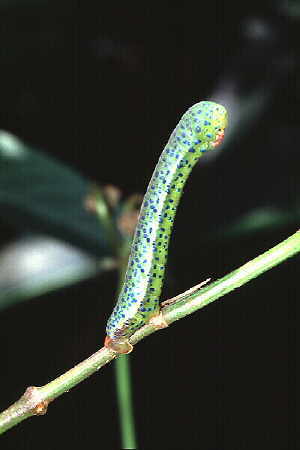
This
larva of a Geometrid moth may look like a twig or
bud to the casual observer as it sticks out at an angle
to a real twig. This is possibly a form of mimicry
employed by the caterpillar to disguise itself and avoid
the attention of predators. |
|
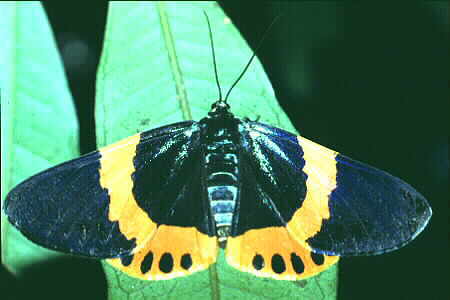
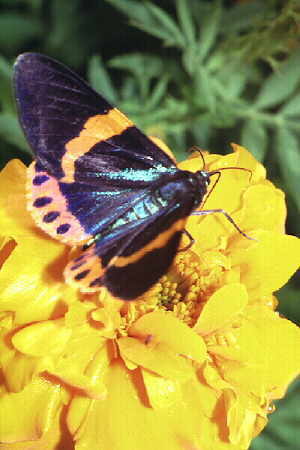
Milionia basalis is a day-flying moth of
medium size; it has a wingspan of about 5-6cm (2-2.5
inches). The caterpillars feed on the leaves of some
native coniferous trees that grow naturally at high
altitudes, and in the lowlands where they are
cultivated. |
|
I photographed this
Milionia basalis in the Cameron Highlands.
When it settled on a marygold flower, I had then thought
it was a butterfly. With its striking colours and the
fact that it was flying in broad daylight, it was easy
to mistake this moth for a butterfly. |
|
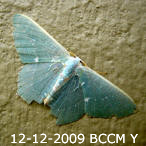
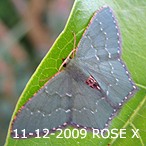
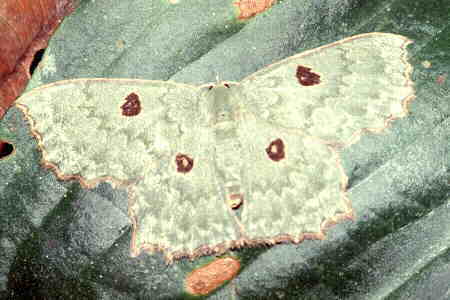
Euxena albiguttata belongs to a group
commonly known as the Emerald Moths. Their attractive
green colour often fades to a dull yellow after death.
Euxena albiguttata is found in Peninsular
Malaysia, Borneo, Java and Sulawesi. |
|
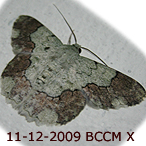
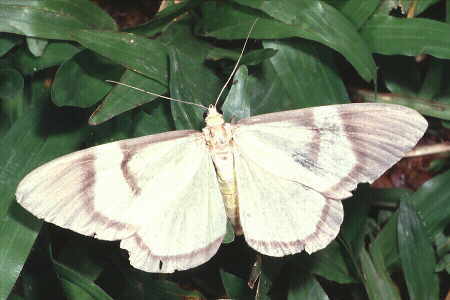
This subtly coloured moth looks
like
Celerena signata which has very similar light
brown wing markings. It could be an old and faded
specimen. While the ground colour of this specimen is
off-white, that of C. signata is bright yellow as
seen in mounted specimens. |

|
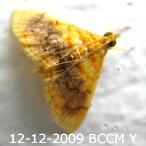
There are more than a dozen species
of Eumelea with colour ranging from yellow to
orange and red. This one looks like
rosalia, a fairly common moth encountered in
secondary growth. E. rosalia is found in the
tropical parts of the Indo-Australian region. |
Family Uraniidae

|
Lyssa zampa is a large moth commonly
encountered in primary forests or secondary growth.
It may fly into houses at night, attracted by bright
lights, especially if they are close to wooded
areas. The species is found in the Indo-Australian
region. [The food plants are species of Endospermum
(Euphorbiaceae) and not Eugenia malaccensis
(Myrtaceae) – Shen-Horn] |
|
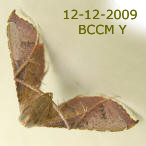
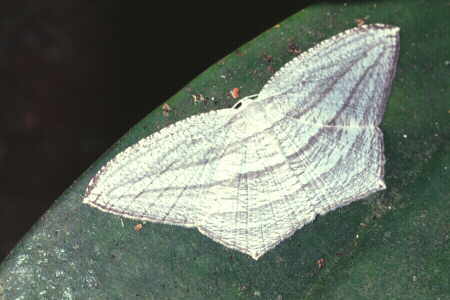
This moth has a weak flight,
and when it flies, it looks like a small piece of
paper fluttering in the wind. It is a species of
Acropteris, but not iphiata which
has distinguishing chestnut brown apical patches.
(Could it be ciniferaria?) |
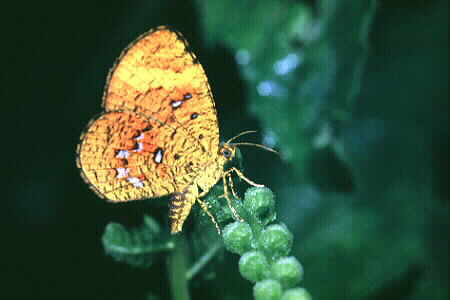
Family Callidulidae
|
The Callies (Callidula sumatrensis) are
small moths which can be mistaken for butterflies
because they not only fly in the day but also settle
with their wings folded. Callidula sumatrensis
may be found in well-shaded and damp undergrowth
near streams. |
|
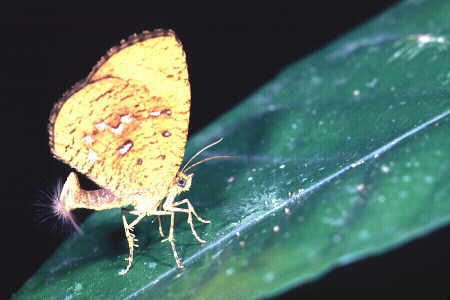
This is possibly a female
Callidula sumatrensis looking for a mate.
It had struck up an unusual pose with abdomen lifted
up. I believe the tuft of fine hairs at the
posterior was being used to disperse scents
(pheromones) to attract males for the purpose of
mating. |
|
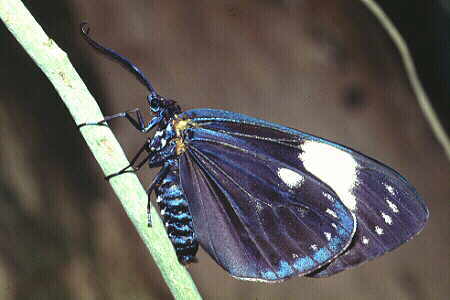
I photographed this iridescent
blue moth in Tenom, Sabah, in March 1990. A visitor
to my website, who is an expert in systematics and
biology of oriental lepidoptera, has identified the
species as
Cyclosia macularis. (Thank you, Shen-Horn.) |
|
|
|