SABAH > TAWAU DIVISION > SEMPORNA TOWN > Regatta Lepa-Lepa
Regatta Lepa-Lepa
Annual Regatta Lepa Festival Dates
| Year | Date |
| 2018 | 20 – 22 Apr 2018 |
| 2017 | 21 – 23 Apr 2017 |
| 2016 | 22 – 24 Apr 2016 |
| 2015 | 24 – 26 Apr 2015 |
| 2014 | 25 – 27 Apr 2014 |
| 2013 | 26 – 28 Apr 2013 20th anniversary |
| 2012 | 20 – 21 Apr 2012 |
| 2011 | 22 – 23 Apr 2011 |
| 2010 | 23 – 25 Apr 2010 |
| 2009 | 18 – 19 Apr 2009 |
| 2008 | 18 – 20 Apr 2008 15th anniversary |
| 2007 | 20 – 22 Apr 2007 |
| 2006 | 14 – 16 Apr 2006 |
| 2005 | 16 – 17 Apr 2005 |
| 2004 | 10 – 11 Apr 2004 |
| 2003 | 14 Apr 2003 10th anniversary – Regatta Lepa is declared a national festival |
| 2002 | 14 Apr 2002 |
| 2001 | 08 Apr 2001 |
| 2000 | 09 Apr 2000 |
| 1999 | April |
| 1998 | 29 Mar 1998 5th anniversary |
| 1997 | April |
| 1996 | April |
| 1995 | April |
|
1994 |
April |
|
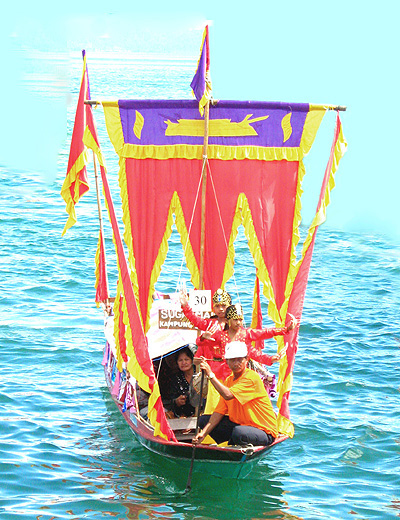
Two beautiful LEPA boats in Semporna |
|
|
|
|


The Bajau community on the East Coast of Sabah have a very unique lifestyle – They live on Lepa and only come ashore for food, water supply and during this LEPA festival.
LEPA
: In Sabah East Coast Bajau community dialect, lepa means "boat". The lepa boat is a cultural legacy inherited by Bajau people from many generations ago. The existence of lepa is believed to originate from the fishing community who live in Bum Bum Island and used by the Pa'alau people along the coast of Semporna.One can see the Sea Bajau (Bajau Laut) fish on the clear and shallow water of Semporna. The live in their boats on the sea most of their life. Present day, some groups have settled on tiny islands.
From an event observed only by the sea gypsies of Sabah, the Regatta Lepa Semporna is now an official state festival; an important agenda in the national tourism calendar.
More about :
THE TRADITIONAL LEPA BOAT OF THE BAJAU
Judging the most beautiful LEPA
Every one is excited as the colorful
sails take to the sea to compete for
the prize of the most beautiful
lepa. This is judged based on its
decoration, local ethnic music and
dances performed on board,
sambulayang (sails) and tipas-tipas
(small flags). Points are awarded
based on decorations, the
intricacies of the carvings and
designs, ethic music, regalia and
traditional dances performed on
board.
Highlight of
LEPA : The high light of LEPA event is to choose the most
dazzling Lepa from the beautifully,
colorfully adorned boats which are
lined up at the waterfront.
On the decks are smiling dancers and
musicians dressed in equally
colorful traditional attires.
Other attractions in Regatta LEPA : include sea sports such as rowboat, sailing and kelleh-kelleh (small dugout boat) competitions, lepa tug of war, and duck catching competition. Colorful cultural night performance.
 |
 |
 |
|
| Regatta Lepa 18 | Regatta Lepa 23 | ||
| 2009 | 2010 | 2011 | 2016 |


More about the Sea Bajau of Borneo : THE BAJAU OF SABAH
Regatta Lepa
Semporna
|
|
|
|||||||
|
|
|

"Continuous publicity by the government through the federal and state tourism ministry, as well as the private sector, has raised the festival's popularity to a reputable level,"
Datuk Sri Nasir
Tun Sakaran.
during the launch of the 18th Regatta Lepa Festival
22th April 2011
"The Regatta Lepa-Lepa is an annual event held to highlight the Bajau community. More specifically, it highlights the age-old seafaring East Coast Bajau’s strong skills in boat craftsmanship."
WWF (World Wide Fund for Nature)
http://www.wwf.org.my
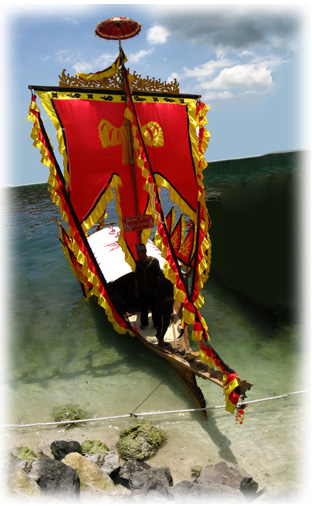
A brightly colored Bajau flag.
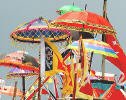
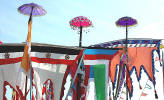
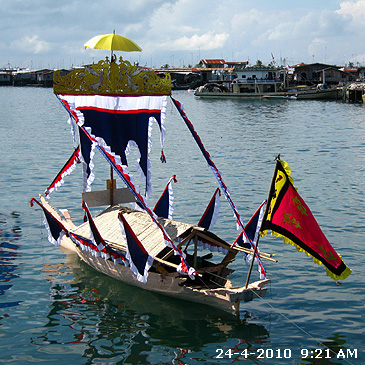
The lepa boats are heavily decorated with colorful sambulayang in contrasting combinations of red and other bright colors. Traditionally in red, white and black.
The colorful sails are made from medium weight cotton.
Sambulayang is raised on special occasions like weddings, national day celebrations, welcome State leaders and Regatta LEPA.
This decorative sails hang from a 5 to 7 meters tall T-framed mast topped with a ceremonial umbrella to symbolize sheltering of inhabitants from sun and rain.
Flags, banners and buntings are strung from the bowsprit and cross members from front to stern fluttering gaily in the breeze.

The skills to make a Lepa-Lepa are passed down from generation to generation with fathers teaching their sons and grandsons and so on.
The Bajau feel that this is their identity and heritage that needs to be instilled in the hearts of their descendents.
This is a legacy that must never be left behind even in the construction of a modern Malaysia.
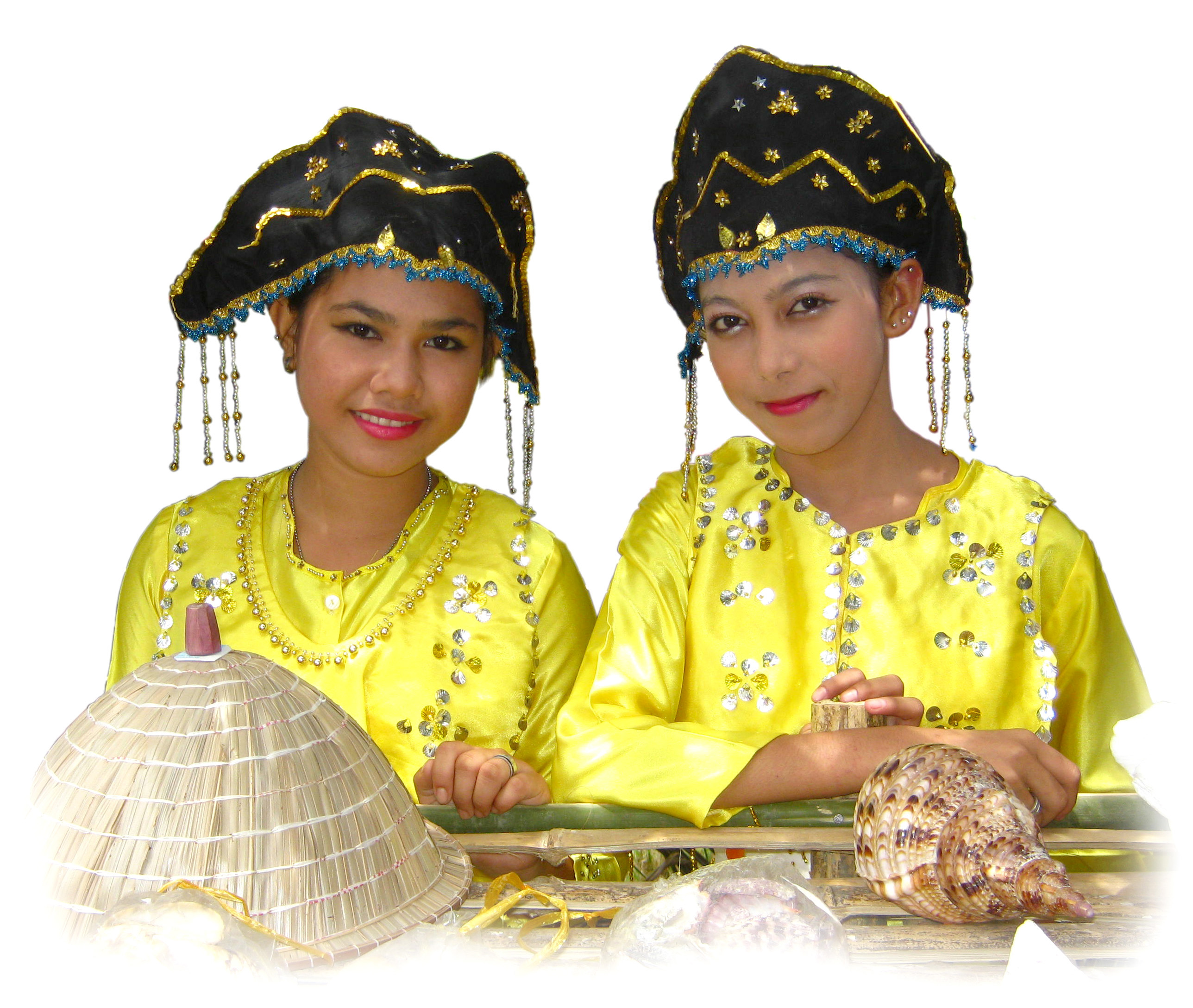
The Bajau are skillful in weaving and needlework.
Young Bajau girls design and make their own traditional headgear which is worn during auspicious occasion such as Regatta Lepa-Lepa festival.
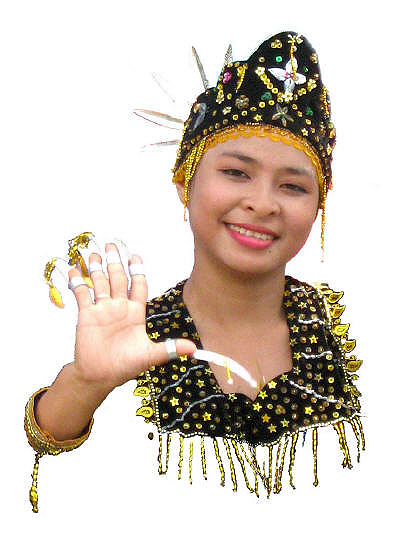
JANGGAY (metal
"fingernails" )
U
The dancer uses janggay, the ornamented metal nails to enhance graceful hand movements accentuated by the shoulder and sensuous hip movements.
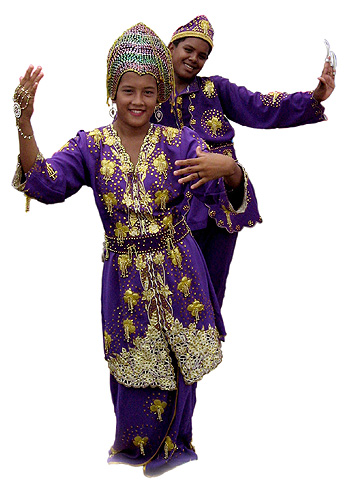
A "fingernail" dance showing dancer's flexibility and maneuvering ability in the elbow, wrist, and shoulder.
Bajau dance usually presented during formal festivities such as weddings.
A Bajau Dance with both male and female dancers is called Daling-Daling.
Regatta Lepa-Lepa
1) The Seafest Hotel pier where the traditional boats were docked
2) The Semporna town padang, where a concert stage and some traditional houses were built.
The Regatta Lepa has been celebrated every year since 1994 to commemorate the Bajau tradition of building these splendid boats.
First held in 1994 as a district-level event before being upgraded into Sabah state festival in 2003.
Regatta Lepa is now an Malaysia national event in water festival.
The Bajau seafarers' proud maritime heritage came alive in this annual festival of Regatta LEPA, featuring their LRPA boats, with participants dancing at the helm of their boats, decorated in full color.
The event attracted thousands each year.
In East Coast of Sabah, "lepa" means "boat" - the traditional houseboat of the seagoing Bajau Laut. Lepa cultural legacy is inherited by Bajau people from many many generations ago. The existence of Lepa boat is believed to originate from the Bajau fishing community. Generations ago, the Lepa-Lepa were created solely as a mode of transportation for the Bajau. Communication was close to none for the people at that time as they could barely travel and knew not of modern amenities. They led a humble existence, living to survive. The sea was the provider of their food and the sole bridge to neighboring islands.
This three-day cultural festival Regatta Lepa held annually in Semporna is a celebration of the lepa lifestyle, which nowadays has been replaced by village dwelling and engine-driven houseboats.
Both village dwelling and engine-driven houseboats are social developments that began in the 1950s. However, the lepa has remained a cultural symbol, so much so that in the mid-1990s, local politicians came up with the idea of a cultural event revolving around the boat as the emblem of a way of life.
Organized by the Semporna Pejabat Daerah (Semporna District Office) and well in tune with Sabah State’s official policy, the Regatta Lepa soon became an event with a political dimension to it.
The Regatta Lepa festival opens with the arrival of various boats from different villages, headed by the village leader known as OT.
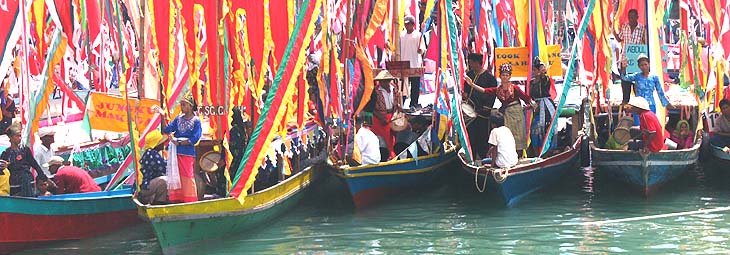
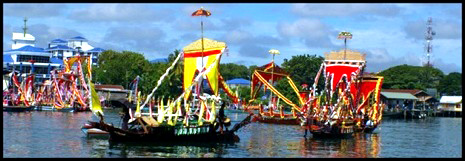
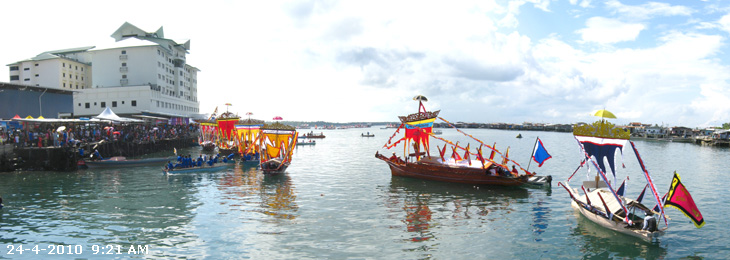
On that day, these beautiful LEPA boats dot the dock of Semporna side by side shimmering in all their glory.
The highlight of the Regatta Lepa includes a competition of the most beautiful Lepa-Lepa based on the boat's decoration, local ethnic music and traditional dances performed on board.
The night embraces colorful cultural dances performed by the Bajau.
Lepa Boat
The whole afternoon is one big dramatic audio-visual arc: the colorfully decorated lepas, arriving one by one, are manned by families dressed in equally colorful traditional costumes, and on every boat, a complete kulintangan ensemble is playing at all times.
Some of them will be moving at any given time, which yields an interesting aural effect. A dancer, usually one of the family’s teenage daughters, is dancing on each lepa prow.
Lepa and kumpit boats in Regatta Lepa
| Lepa Boats | Kumpit Boats |
|
The traditional "lepa," a Bajau Laut houseboat is
about 8m long and measures 1.5m wide at the center, where it is
widest.
Very flat and often equipped with outriggers, it glides smoothly over the sea, but is not a great fit for boat engines. |
For this reason, it nowadays often is replaced by the "kumpit," a slightly larger boat that is used in lieu of the lepa in daily affairs. |
There are two types of boats made by the
Bajau:
The Kumpit (Sappit), is a bigger boat used mainly as a mode
of transportation and when fishing in the deep sea.
The Lepa-Lepa boats are smaller in size and usually seen at
ceremonies like the Regatta, weddings and other religious
occasions.
Lepa- Lepa is still widely used today among the Bajau. It is
mainly used to transport, travel when fishing and to relay
the religion of Islam to others. Islam was first introduced
to the Bajau in the early 17th century. When the Bajau
adopted this religion and its way of living, they translated
its teachings onto their boats in the form of carvings.
Few actually knew that the carvings on the Lepa-Lepa were of
specific excerpts from the Quran. These carvings are
similarly found on Muslim gravestones and at the pulpit in
the mosques. The Bajau people used this concept to share
Muslim teachings with those who lived around them. These
carvings are unique to the Bajau and are deeply rooted in
their religious history.
The traditional lepa way of life that the Regatta Lepa
celebrates each year might, for most Bajau Laut, be a thing of the past, a
nostalgic reminiscence of their recent forefathers’ world, characterized by
single boats scattered over a vast water surface.
Fifty years earlier, kulintangan music was a means to reach people on other
boats; the sound of gongs carries much farther over water than a human voice
possibly can.
Although the lepa boats, as these people’s only living space, have become a
rare sight as the Bajau Laut celebrate the 16th Regatta Lepa, the
kulintangan ensemble's music remains a communication form that is as
nostalgia-laden as it is natural, and as evocative of the past as it is a
part of the present.
Kulintang is a modern term for an ancient instrumental form
of music composed on a row of small, horizontally-laid gongs that function
melodically, accompanied by larger, suspended gongs and drums.
As part of the larger gong-chime culture of Southeast Asia, kulintang music
ensembles have been playing for many centuries in regions of the Eastern
Malay Archipelago — the Southern Philippines, Eastern Indonesia, Eastern
Malaysia, Brunei and Timor,[6] although this article has a focus on the
Philippine Kulintang traditions of the Maranao and Maguindanao peoples in
particular.
Kulintang evolved from a simple native signaling tradition, and developed
into its present form with the incorporation of knobbed gongs from Sunda.[5]
Its importance stems from its association with the indigenous cultures that
inhabited these islands prior to the influences of Hinduism, Buddhism,
Islam, Christianity or the West, making Kulintang the most developed
tradition of Southeast Asian archaic gong-chime ensembles.
Technically, kulintang is the Maguindanao, Ternate and Timor term for the
idiophone of metal gong kettles which are laid horizontally upon a rack to
create an entire kulintang set.
It is played by striking the bosses of the gongs with two wooden beaters.
Due to its use across a wide variety groups and languages, the kulintang is
also called kolintang by the Maranao and those in Sulawesi, kulintangan,
gulintangan by those in Sabah and the Sulu Archipelago and totobuang by
those in central Maluku.[8]
By the twentieth century, the term kulintang had also come to denote an
entire Maguindanao ensemble of five to six instruments.
Traditionally the Maguindanao term for the entire ensemble is basalen or
palabunibunyan, the latter term meaning “an ensemble of loud instruments” or
“music-making” or in this case “music-making using a kulintang.”
Considerably independent from political contexts,
strategies, and implications, the Regatta Lepa attracts around 15,000
visitors, mostly Malaysian, every year.
The program is similar every year and the official part spreads over two
days.
Traditional lepa boats competed for the much-coveted Regatta Lepa award. The
Regatta Lepa's central event is the selection of the “most beautiful” lepa.
Together with the lepa boats, hundred of kumpit boats also gathered at the
moorage in order to partake in the celebration.
In the evening, the "Ratu Lepa," or "Lepa Queen," was crowned.
The next morning, Saturday, marked the event's official start and began
early, virtually after dawn.
By 8am, the official program had commenced, which included a race of the
lepa boats and, later in the day, the evening launching ceremony for the
overall event featuring both national and local performers and notables.
Sea sports activities abounded, such as traditional boat tug-of-wars and
canoe racing competitions (keleh keleh).
The event concluded with the central procession of lepa boats before the
judges and the awarding of the prizes for the most beautiful boats.
These activities were spread over two locations: the pier, where the lepa
and kumpit boats docked, and the Semporna town padang, consisting of a few
traditional-style huts built around a dance stage.
Throughout the program, two elements' constant presence was such a matter of course that it did not even merit mentioning: music and dance.
Ratu Lepa
The Ratu Lepa Competition is a beauty contest. Beauty, however, is not merely a matter of looks; after all, the public display of physical beauty is a sensitive issue in a Muslim environment.
The judges, therefore, pay attention to the (dance) costumes' ‘authenticity," overall "grace," and dance.
The quality of the latter is centrally important. Every potential ratu is required to perform a dance of her choice that includes one of three traditional dances combined with one of three contemporary dances.
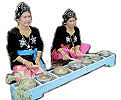
The first-mentioned dances were accompanied by a kulintangan ensemble, the traditional musical accompaniment of Bajau Laut dancing that consists of a set of usually between 8 and 10 bossed metal discs or brass gongs; two agung, big brass gongs hanging from a wooden frame; and a tambul, a brass cylindrical snare drum.
performing arts world wide
Three days in April every year, the sleepy fishing town of Semporna, East Coast Borneo (Malaysia) turns into a bustling little hive of activity, dance, and music: the Regatta Lepa takes over.
The Southeast Asian island world is home to several maritime communities whose people often are referred to as "sea nomads" or "sea gypsies," names that appeal to the exoticist imagination especially of Ang Mos (“redheads"), as white travelers and residents are called winkingly in Malaysia and Singapore. The Sama Dilaut, one of these sea-going peoples, live all over the Philippine Sulu Archipelago, southwestern Mindanao, Sabah/Borneo, east Kalimantan, Sulawesi, and many of the eastern Indonesian islands. In East Coast Borneo, the Bajau Laut, as the Sama Dilaut around Semporna, Sabah/Borneo call themselves, have strong ties with their related communities in the Philippines. Locations in both countries as well as other, often sacred, sites in the archipelago play important roles for them. Some of these Bajau Laut have maintained their nomadic or semi-nomadic lifestyle, living in houseboats and only temporarily setting up makeshift huts on small islets in the Celebes and South China Seas, the eery borderlands between the Philippines and Malaysia. Not quite in keeping with romantic Ang Mo dreams about unlimited freedom and vagabond life, clear turquoise waters and simple living, however, others have become sedentary, living in the stilt houses of the so-called "floating villages" that started to grow considerably in Semporna during the 1960s. And yet, they remain “Bajau Laut”: “Sea Bajau.” .................
The Bake (pronounce Bahkuh) Society , was founded in 1984 as a counterpart to the Ethnomusicological Centre “Jaap Kunst”. The society, named after the illustrious musicologist and singer Arnold Bake, organizes conferences, seminars and workshops.
http://web.me.com/dvaita/Bake_Society



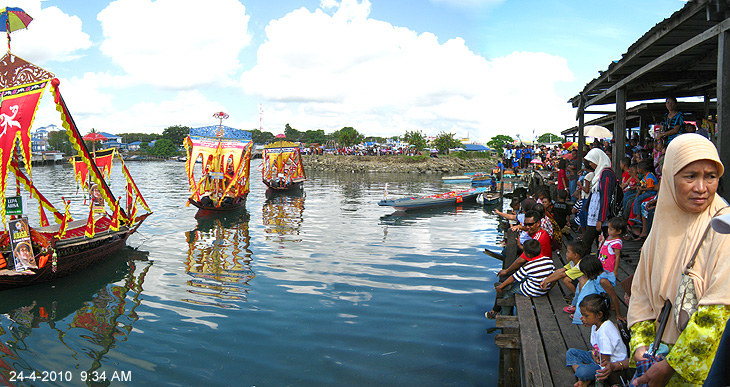
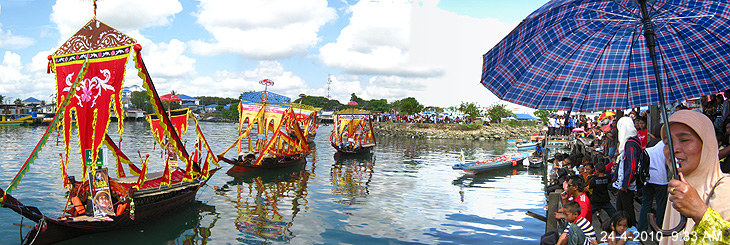
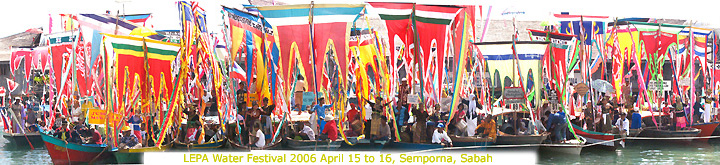
Each boat a beauty dancer
Every LEPA family has they own beautiful girl welcoming visitors with graceful igal-igal dance.
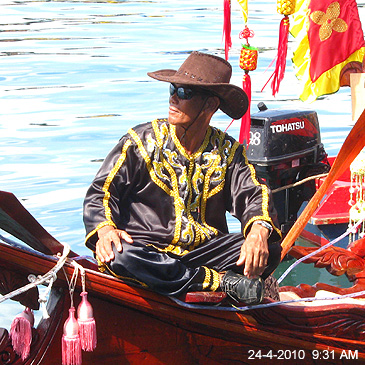
During the Regatta Lepa, the boats are decorated with brightly colored sails known as sambulayang and tipas (small triangular flags).
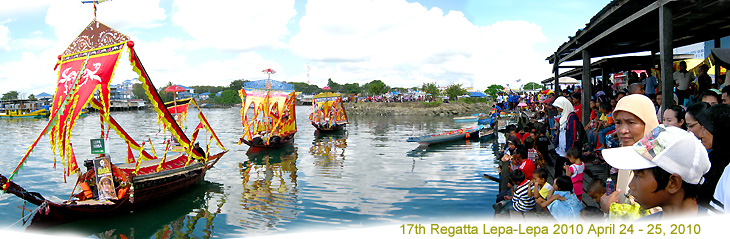
The highlight of the event is the sail-past of the lepa, each boat decked with smiling dancers and lively musicians, hoping to be crowned ‘Most Beautiful Lepa’ – the grand prize of this much-anticipated water festival.
More on
igal-igal Bajau dance.

Each Boat an artistic masterpiece with elaborate carvings
The LEPA Boat is sleek and typically made of ubar suluk (red seraya) wood. An artistic masterpiece with elaborate carvings depicting the sea and animistic designs. Other sea-themed motifs include fishes, mermaids, sea horses and waves. These intricate carvings normally cover the stern to the bow, side to roof and mast.
More about elaborate carvings
of LEPA LEPA

Photo courtesy Sabah Museum, Kota Kinabalu
One can view a traditional LEPA boat at Sabah Museum in Kota Kinabalu City.
In the museum's Heritage Village displays a Lepa house boat. This boat was used as an abode by a local community in the Semporna.
The Sabah Museum Heritage Village is situated within the Ethnobotanical Gardens in the Sabah Museum Complex. Formally, the Sabah Museum Heritage Village was known as The Sabah Museum Traditional Houses.

People with a Proud Heritage
The annual Regatta Lepa held every April in Semporna. During the event, the waterfront of Semporna town is decked with a colorful line-up of boats, each one more brilliantly decorated.
These LEPA boats are the proud heritage of the Sea Bajau of Malaysia.
PHOTO above : 15th Regatta Lepa, 18–20 April, 2008

The Sea Gipsy of Malaysia