
Jumping Spiders of Sabah, Malaysia
Victims of Jumping Spiders
 |
 |
|
|
Jumping Spider HuntingJumping spiders capture their prey by jumping on it several inches away, and they may jump from twig to twig or leaf to leaf. They can jump thirty times their body length. They can carry out complex maneuvers such as detours around obstacles in order to reach their prey. Their eyesight is much better than that of other spiders and insects. Most other spiders will only eat prey that they have captured live because they are unable to see dead prey (some long-legged sac spiders and anyphaenid sac spiders are exceptions as they recognize insect eggs as food) but jumping spiders will eat flies that have been killed for them. One jumping spider (Evarcha culicivora) is even known to only capture mosquitos full of blood, using their eyesight and smell. |
 |
|
 |
|
 |
|
| Body regions | Spiders | Insects |
|---|---|---|
| two (cephalothorax, abdomen) | three (head, thorax, abdomen) | |
| Legs | eight | six |
| Eyes | simple, usually eight (rarely six) | compound, two |
| Wings | none | four (sometimes two or none) |
| Antennae | none | two |
| Mouthparts | chelicerae (fangs) | mandibles (jaws) |
| Spiders are a common and familiar
group of arthropods. They are similar to insects in that they both
have exoskeletons (their skeletons are on the outside of their
bodies) and jointed legs.
All spiders produce silk throughout their lifetime. Spiders use silk to build webs and other types of snares, egg cases, draglines, and refuges. Silk is also produced by spiderlings (young spiders) during a process called ballooning in which the spiderlings shoot silk into the air and are carried away by the wind. Spiders are predators feeding mainly on insects. All spiders have venom but most spiders are harmless to human. They are very shy and usually remain hidden in undisturbed areas. Many are active only at night. They are not aggressive and they will try to escape when confronted. Only a few spiders bite. |


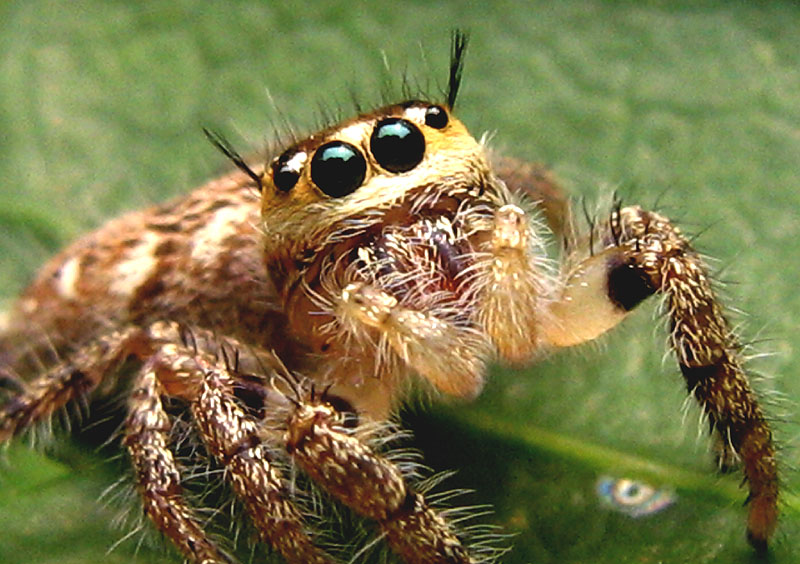
Jumping Spiders of Sabah, Malaysia
COMMON JUMPING SPIDERS IN TAWAU
Victims of Jumping Spiders
 |
 |
|
|
Jumping Spider HuntingJumping spiders capture their prey by jumping on it several inches away, and they may jump from twig to twig or leaf to leaf. They can jump thirty times their body length. They can carry out complex maneuvers such as detours around obstacles in order to reach their prey. Their eyesight is much better than that of other spiders and insects. Most other spiders will only eat prey that they have captured live because they are unable to see dead prey (some long-legged sac spiders and anyphaenid sac spiders are exceptions as they recognize insect eggs as food) but jumping spiders will eat flies that have been killed for them. One jumping spider (Evarcha culicivora) is even known to only capture mosquitos full of blood, using their eyesight and smell. |
 |
|
 |
|
 |
|
| Body regions | Spiders | Insects |
|---|---|---|
| two (cephalothorax, abdomen) | three (head, thorax, abdomen) | |
| Legs | eight | six |
| Eyes | simple, usually eight (rarely six) | compound, two |
| Wings | none | four (sometimes two or none) |
| Antennae | none | two |
| Mouthparts | chelicerae (fangs) | mandibles (jaws) |
| Spiders are a common and familiar
group of arthropods. They are similar to insects in that they both
have exoskeletons (their skeletons are on the outside of their
bodies) and jointed legs.
All spiders produce silk throughout their lifetime. Spiders use silk to build webs and other types of snares, egg cases, draglines, and refuges. Silk is also produced by spiderlings (young spiders) during a process called ballooning in which the spiderlings shoot silk into the air and are carried away by the wind. Spiders are predators feeding mainly on insects. All spiders have venom but most spiders are harmless to human. They are very shy and usually remain hidden in undisturbed areas. Many are active only at night. They are not aggressive and they will try to escape when confronted. Only a few spiders bite. |


