Pseudoscorpian
Pseudo-scorpion and Scorpion
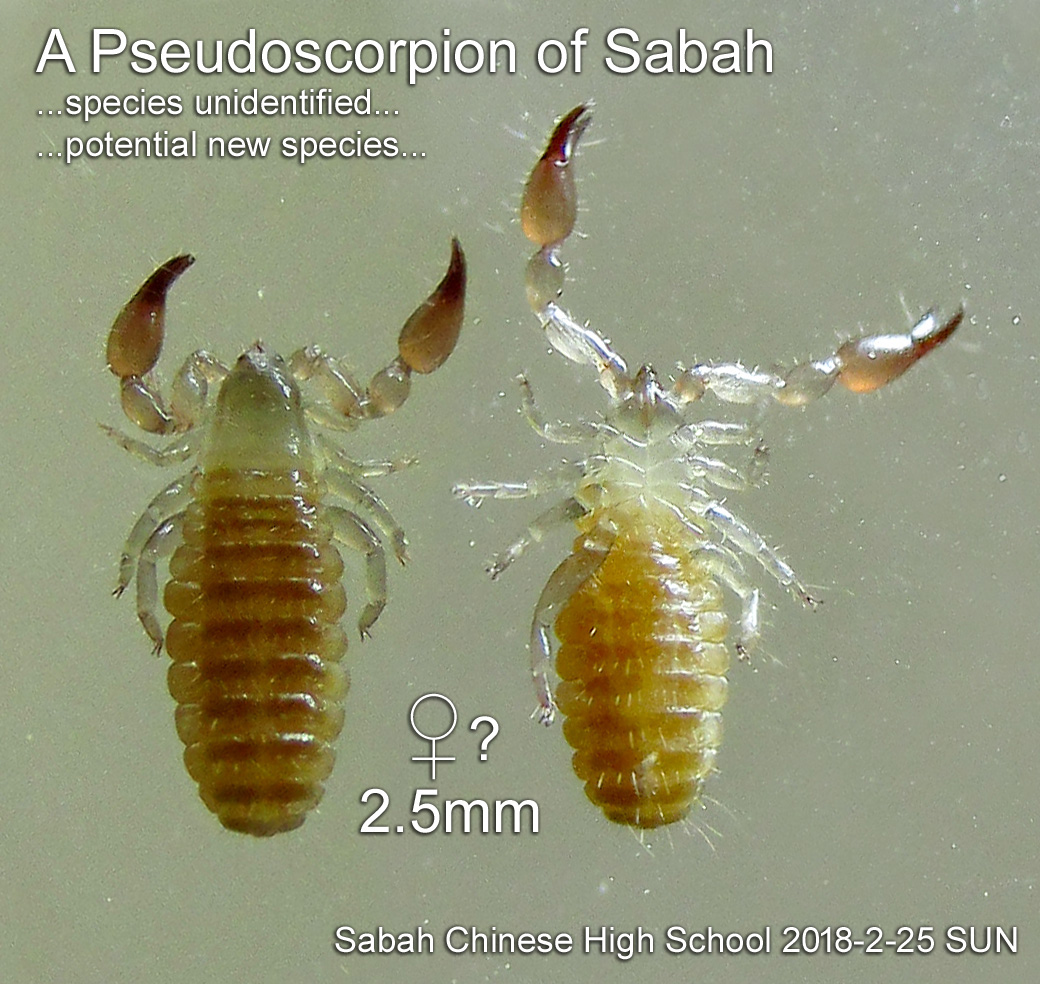
A Pseudoscorpion of Sabah.
species unidentified
♀?2.5mm body length
Sabah Chinese High School 2018-2-25 SUN
tiny and are rarely seen due to their small size. no sting
Found in one of the three eucalyptus trees in Sabah Chinese High School

Pseudoscorpions of Sabah
They’re called pseudoscorpions, belonging to the Pseudoscorpiones group of arachnids related to true scorpions and spiders. There are over 3,500 species of them worldwide [1], a whopping number when you consider that there are less than 300 species of mammals belonging to the Carnivora group [2]. North America in particular has approximately 420 species [3].
These creatures are incredibly diverse and exist worldwide [3,4,5]. Despite their high levels of diversity, they are rarely seen because they live under bark or stones, in leaf litter or mosses, and between the boards of buildings [5]. One particular species even lives in houses, hunting the small insects that would otherwise be house pests [4]. Should we be scared? After all, they do have pinching claws that produce venom [3].
Pseudoscorpions are not harmful to humans, and are in fact helpful! They do not damage property, eat tiny pests like mites, and their venom is not dangerous to us in such small amounts [4].
| A pseudoscorpion, (false scorpion or book scorpion), is an arachnid
belonging to the order Pseudoscorpionida, ( Pseudoscorpiones or
Chelonethida) Pseudoscorpions are generally beneficial to humans since they prey on clothes moth larvae, carpet beetle larvae, booklice, ants, mites, and small flies. They are small and inoffensive, and are rarely seen due to their size. Pseudoscorpions are small arachnids with a flat, pear-shaped body and pincers that resemble those of scorpions. They usually range from 2 to 8 millimetres (0.079 to 0.31 in) in length.The largest known species is Garypus titanius of Ascension Island at up to 12 mm. The abdomen, known as the opisthosoma, is made up of twelve segments, each protected by plates (called tergites above and sternites below) made of chitin. The abdomen is short and rounded at the rear, rather than extending into a segmented tail and stinger like true scorpions. The color of the body can be yellowish-tan to dark-brown, with the
paired claws often a contrasting color. They may have two, four or no
eyes.
Micrographia.
Another reference in the 1780s, when George Adams wrote of: "A
lobster-insect, spied by some labouring men who were drinking their
porter, and borne away by an ingenious gentleman, who brought it to my
lodging. |