Last Updated on Saturday, 23 September, 2023 11:02:27 AM
INDEX > Dragonflies of Borneo > Family Libellulidae > Genus Sieboldius > Sieboldius japponicus Selys, 1854
Family Libellulidae
Sieboldius japponicus Selys, 1854
Found in Asia: Brunei Darussalam, Borneo, China, Indonesia, Myanmar, Malaysia, Peninsular Malaysia, Thailand
Sieboldius japponicus is fairly widely distributed, common at some locations
at least, and tolerant of quite a high degree of disturbance.
Sieboldius japponicus is known from southern Thailand (e.g. Hämälainen and
Pinratana 1999) as far north as Trang, Peninsular Malaysia (e.g. Orr 2005),
Sumatra (e.g. Lieftinck 1954), and Borneo. No published records records and no
specimens from Kalimantan are known from, but it occurs in Sarawak (e.g. Dow and
Reels 2008), Sabah (e.g. Huisman and van Tol 1989) and Brunei (Orr 2001) and
must occur in Kalimantan.
Native to Brunei Darussalam; Indonesia (Sumatera); Malaysia (Peninsular
Malaysia, Sabah, Sarawak); Thailand
Although there are not many records of this Sieboldius japponicus, it can be
quite common in parts of its range; in the Tama Abu Range in Sarawak it is
encountered with some frequency and in 2005 it was extremely abundant on the
Pa’Dapur river near Bario.
Orr (2005) gives the habitat of Sieboldius japponicus as “clear, swift flowing
forest streams, 0-600 m”. However it is abundant on the highly turbid Pa’Dapur
river in the Tama Abu range in Sarawak, and along some sections where the
Sieboldius japponicus was abundant the forest was extremely disturbed (R. Dow
pers. comm. 2011). It also occurs on the Sungai Melinau on the border of Gunung
Mulu National Park in places where the forest is extremely disturbed on the
non-park bank. This Sieboldius japponicus is clearly tolerant of some
disturbance to its habitats. It has been found above 1,100 m in the Tama Abu
Range (R. Dow pers. comm. 2011). There is no evidence yet that it can survive in
plantation streams.
Individual populations are threatened by deforestation, large-scale
hydroelectric projects and plantation establishment.
There is a need for fresh data from Sumatra, and further data on the
distribution of Sieboldius japponicus, and on threats and its ability to survive
in plantation areas. The chances of survival of this and other forest stream
odonates in areas being converted to plantation would be greatly improved by the
provision of adequate buffer zones of original vegetation around streams. Beyond
this no specific measures appear to be needed at this time. The Sieboldius
japponicus is certainly present in some large protected areas, for instance
Gunung Mulu National Park in Sarawak and Endau Rompin National Park in
Peninsular Malaysia.

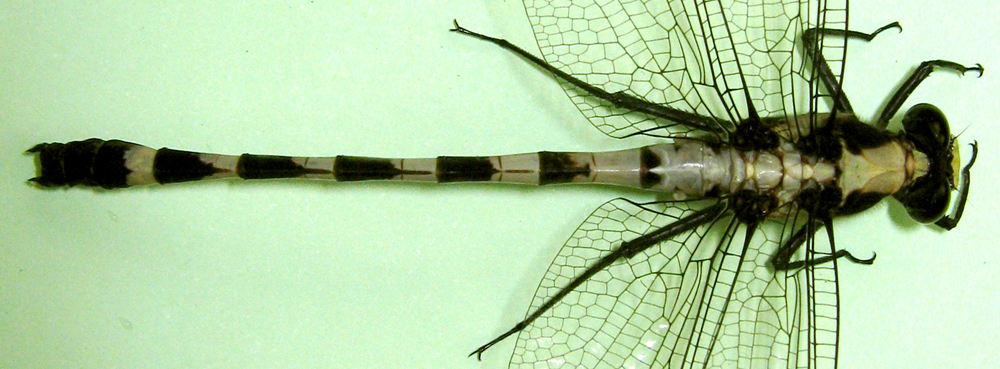
This male Sieboldius japponicus was found in a swift flowing stream in a
Malaysian forest reserve in Sabah.
The black and white body color make it unique from the green color of other in
the same family Gomphidae.
The measurement is :
Wing span = 6cm
Body length = 8.3cm

In the middle of the secondary genitalia (the accessory organ) on segment 2 of
this male Sieboldius japponicus is a pair of extended hamulus.
The hamulus is a pair of hooks used to hold the female’s genitalia during
copulation.
The hamulus is also a set of “surgical tool” that a male uses for removing sperm
left by other males during previous mating.

Sieboldius japponicus Selys, 1854
Anal Appendages of a male dragonfly usually in a set of 2 long superior
appendages and 1 short inferior appendage.
But this male Sieboldius japponicus's superior and inferior appendages are both
in a pair (2 each) and both are short.
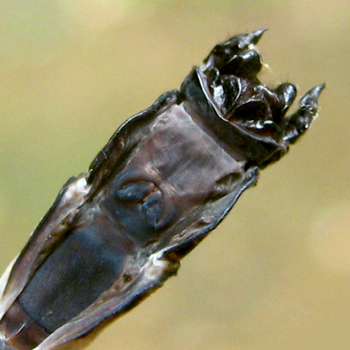
♂ Sieboldius japponicus Selys, 1854
TAWAU HP 31-8-2009
Bottom view
Anal Appendages of a male dragonfly usually in a set of 2 long superior
appendages and 1 short inferior appendage.
But this male Sieboldius japponicus's superior and inferior appendages are both
in a pair (2 each) and both are short.
The 3 families of dragonflies found in Borneo Island:
1 Family of Aeshnidae
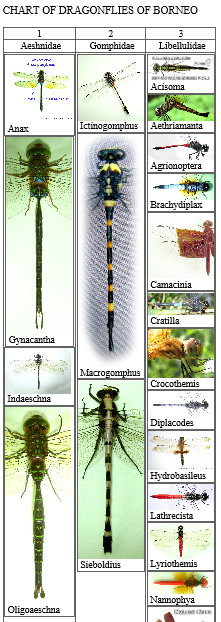
CHART OF DRAGONFLIES OF BORNEO
RELATED TOPICS

INTRODUCTION TO THE DAMSELFLIES OF SABAH, BORNEO ISLAND
Insects are diverse and dominant inhabitants of the tropical rainforests in Borneo Island. New species are discovered too often. Entomologists are still struggling to cope with the documentation of tropical insect diversity.
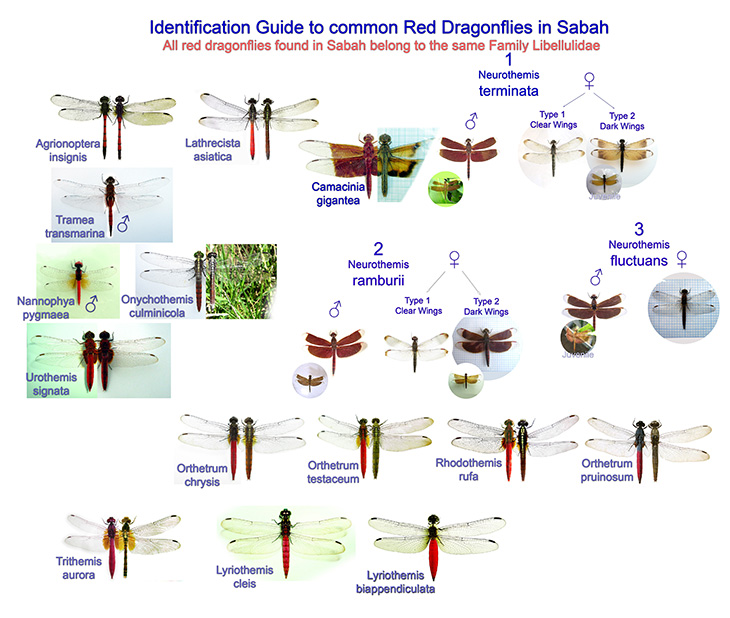
Most of the common dragonflies in Sabah are red coloured, especially from the family Libellulidae. Some red pecies are even confused as same species, for example the three species of Genus Neurothemis.


The compound eyes of dragonflies
Dragonflies and damselflies have large compound eyes that can see in all directions. When the compound eye is magnified several hundred times, each individual facet (ommatidium) is shown to be hexagonal in shape.
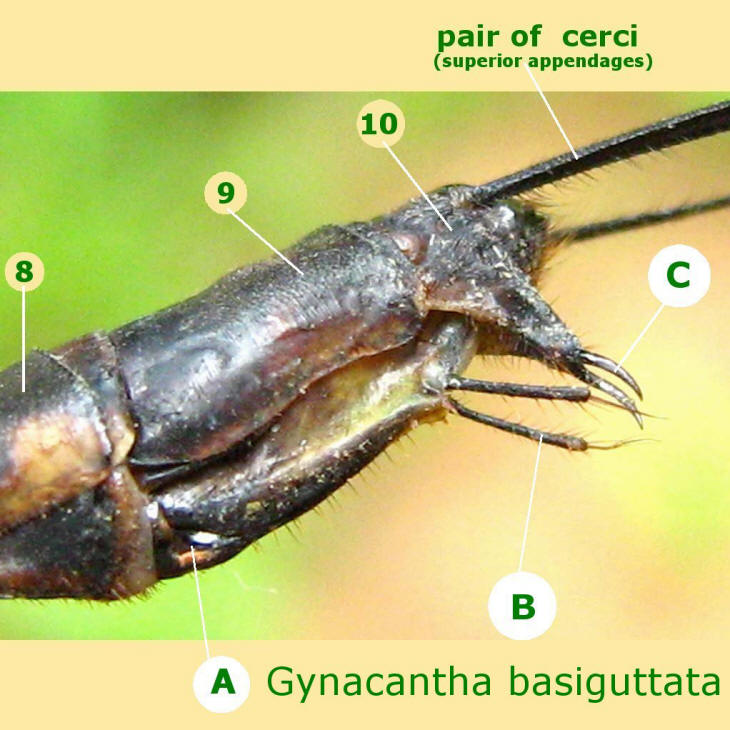
Ovipositor (Vulvar Lamina)
of Female Dragonflies and Damselflies
Female dragonflies have either one of the two method of depositing eggs from
the abdomen:
1- using Ovipositor Structure
2- using Vulvar Lamina
Male do not have an ovipositor. Instead male dragonfly and damselfly have appendages.
|
GO FURTHER FLORA Borneo has 150 species of wild fig trees. Most of them are found in forests of Sabah. FISHERIES Prawn farming is a main commercial activities in Tawau. Spawners from Tawau are graded the best in Malaysia. For decades, Tawau has been exporting high-grade tiger prawns to several countries such as Korea, Japan, Taiwan, China, Vietnam, Singapore, Egypt and Australia. |
|
|
Damselflies of Borneo |