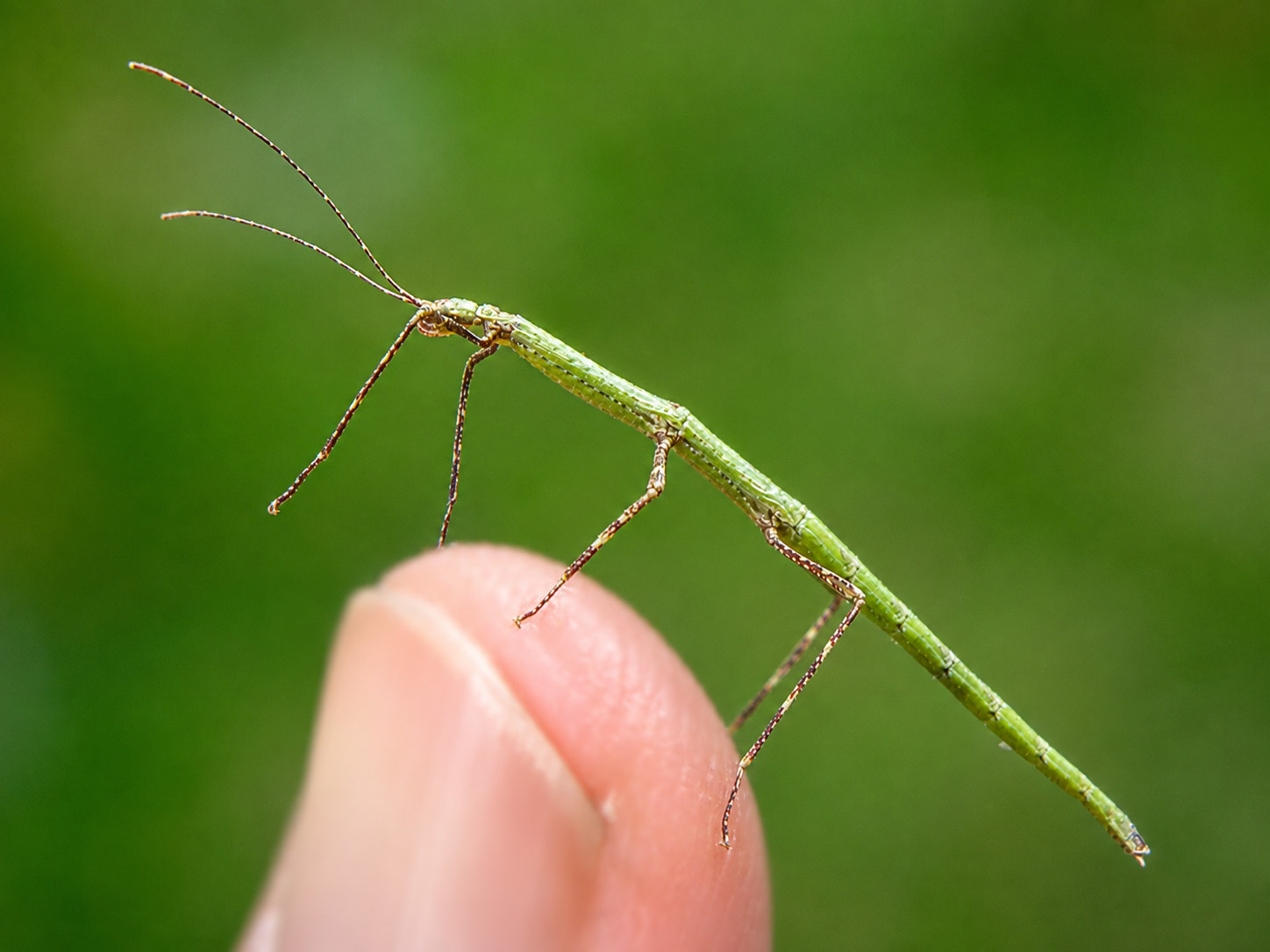
Provisional record. This page records an observation that has not yet been identified. It will be revised when a determination is available.
Order Phasmatodea. Family and genus not determined. Possibly a nymph.
Photographed by Wong Fook Yee at 13:17 on 21 March 2009, on Pulau Sapi, Tunku Abdul Rahman Park, off Kota Kinabalu, Sabah — in coastal scrub about 50 m inland from the shore, effectively at sea level.
It measured about 30 mm in body length. It is bright green and very slender, with long fine antennae and thin legs, both boldly banded in dark brown and cream. No wings are visible. It sat on the photographer's fingertip, where the photograph was taken.
This photograph was taken in daylight without flash, which is why the background is green. The large individual photographed seven minutes earlier, in the same bush, was taken with flash and so has a black background — the two records look as though they come from different times of day, but both were taken around one o'clock in the afternoon. Both animals were moving quickly in bright sun.
What is established: the animal is a stick insect, order Phasmatodea. No family is proposed here.
The relationship to the large individual is an open question, and an interesting one. The two were found in the same bush minutes apart, and were at first taken to be a female and her male partner. The measurements make that doubtful: roughly 30 mm against roughly 200 mm is a difference of about sevenfold. Female phasmids are commonly larger than males, sometimes markedly so, but a male a seventh of his mate's length could not couple with her. The proportions here point the same way — the antennae are very long relative to the body and the build is delicate, as is usual in young phasmids.
So this is more likely a nymph than an adult male. Whether it is a nymph of the same species as the large individual, or of some other stick insect that happened to be in the same bush, cannot be told from these photographs. Both questions have been put to identifiers.
If it is a nymph of the same species, the record says something the adult alone does not: that the species is breeding on the island, rather than the large individual being a stray.
What would settle it: examination by a phasmid specialist. Nymphs are harder to identify than adults, and an early instar may not be determinable below family at all — which is itself a legitimate outcome.
The photograph has been posted to iNaturalist as observation 397107639, together with the questions above. The large individual is observation 397049860. As at the review date below, both records stand at order level only. Any determination reached will be recorded here, together with its source.
Pulau Sapi is one of the five islands of Tunku Abdul Rahman Park, gazetted in 1974 and covering 50 square kilometres in Gaya Bay, about 3 km offshore from Kota Kinabalu. Sapi is among the smallest — roughly 200 m wide and half a kilometre long — and is a heavily visited day-trip island for snorkelling and beach picnics.
Two stick insects of very different sizes in one bush, on an island that small and that close to a city, is worth recording for its own sake. Small islands are where distinctive forms arise and where populations are most easily lost, and an island's insects are rarely surveyed with the attention given to its reefs.
Page reviewed: 2 September 2026.