Provisional record. This page records an observation that has not yet been identified. It will be revised when a determination is available.
Order Phasmatodea. Family and genus not determined.
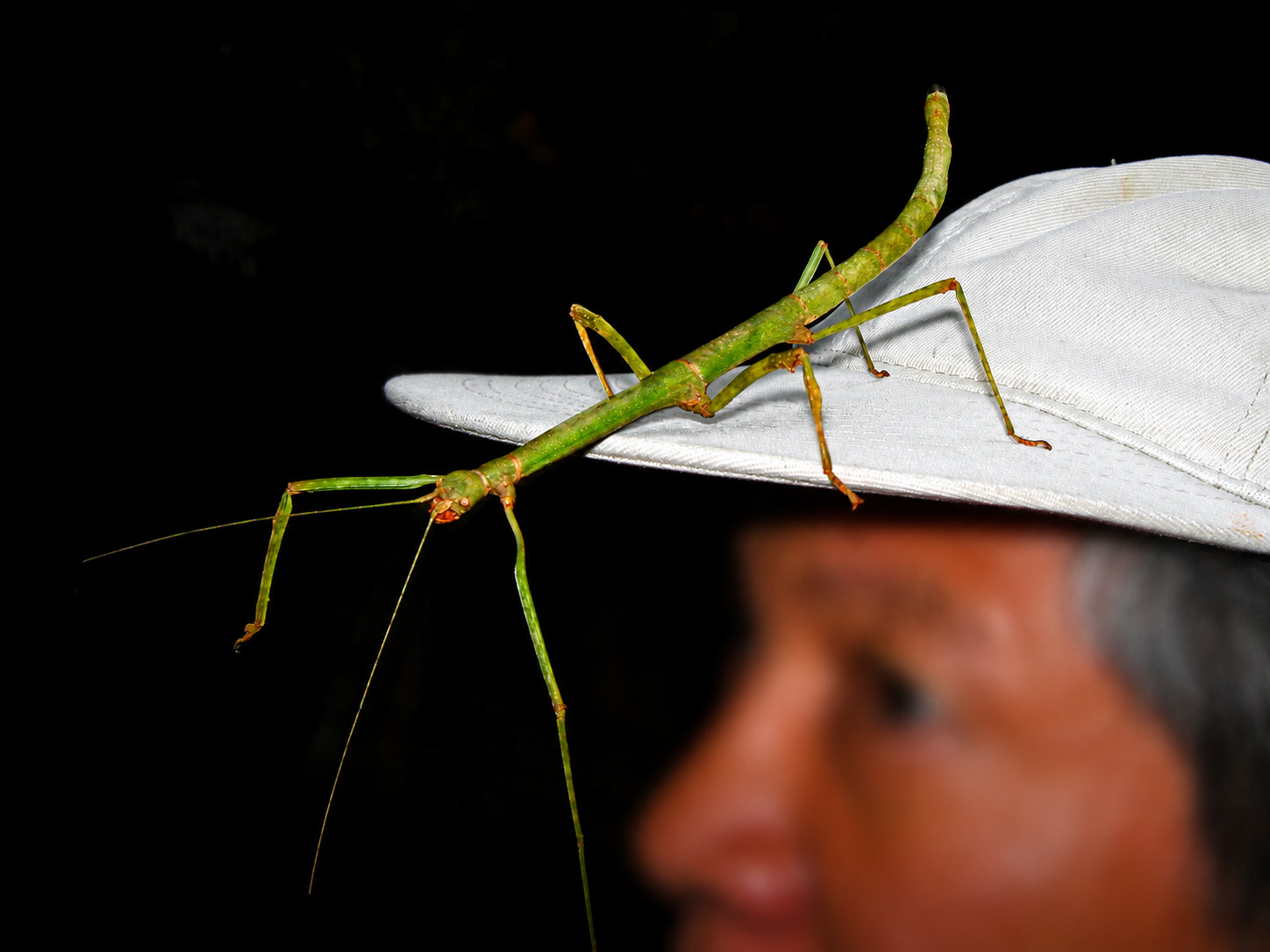
Photographed by Wong Fook Yee at 13:10 on 21 March 2009, on Pulau Sapi, one of the five islands of Tunku Abdul Rahman Park, about 3 km offshore from Kota Kinabalu, Sabah. The insect was in bushy scrub roughly 50 m inland from the sandy shore — effectively at sea level.
It measured about 8 inches — roughly 200 mm — in body length, and is the largest stick insect the photographer has recorded. It is bright green and slender, with reddish-orange tinges at the leg joints and feet and very long, fine antennae. No wings are visible. It had climbed onto the photographer's cap, where the photograph was taken.
This is a daylight record. The background is black only because flash was used; the photograph was taken in bright midday sunshine. This matters, because the animals were active and moving quickly in full sun — behaviour that runs against the usual nocturnal habit of the order, and the same pattern seen in the green stick insect photographed by day at Kinabalu Park Headquarters in 2011.
A second, much smaller stick insect was found in the same bush, and photographed seven minutes later. It was at first taken to be the male partner of this individual, but it measures only about 30 mm — roughly a seventh of this animal's length — and is more likely a nymph than an adult male. Whether it is a nymph of this same species is an open question.
What is established: the animal is a stick insect, order Phasmatodea.
What is not established: the family and everything below it. The smooth green body, the long fine antennae and the reddish leg joints are consistent with several groups of South-East Asian stick insects. No family is proposed here. The same features appear on the 2011 Kinabalu Park animal, which is also undetermined; whether the two are related is exactly the kind of question that needs a specialist rather than a resemblance noticed by the photographer.
Adult or immature? The absence of wings cannot settle this, since immature stick insects are wingless whatever the adult condition turns out to be. At roughly 200 mm, however, this individual is large, and large size is at least consistent with an adult. That remains an inference, not a determination.
What would settle it: examination by a phasmid specialist. The most useful additional views would be the thorax from above and the end of the abdomen. If the small individual from the same bush can be confirmed as a nymph of this species, the two records together would show the species breeding on the island, which neither shows alone. The small individual is iNaturalist observation 397107639.
The photograph has been posted to iNaturalist as observation 397049860, where it is open to examination by identifiers worldwide. As at the review date below, the record stands at order level only. Any determination reached there will be recorded here, together with its source.
Tunku Abdul Rahman Park was gazetted in 1974 as Sabah's second national park. It covers 50 square kilometres across five islands in Gaya Bay — Gaya, Manukan, Mamutik, Sapi and Sulug — about 3 km offshore from Kota Kinabalu. Pulau Sapi is one of the smallest, roughly 200 m wide and half a kilometre long, with some 5 km of nature trails.
That matters for a record like this one. Sapi is a heavily visited day-trip island for snorkelling and beach picnics, and a very small one. A 200 mm stick insect living in the scrub behind the beach, on an island a few hundred metres across and three kilometres from a city, is a reminder that the interesting animals are not confined to the remote interior. Small island populations are also of particular interest to taxonomists, since isolation is where distinctive forms arise.
Page reviewed: 2 September 2026.