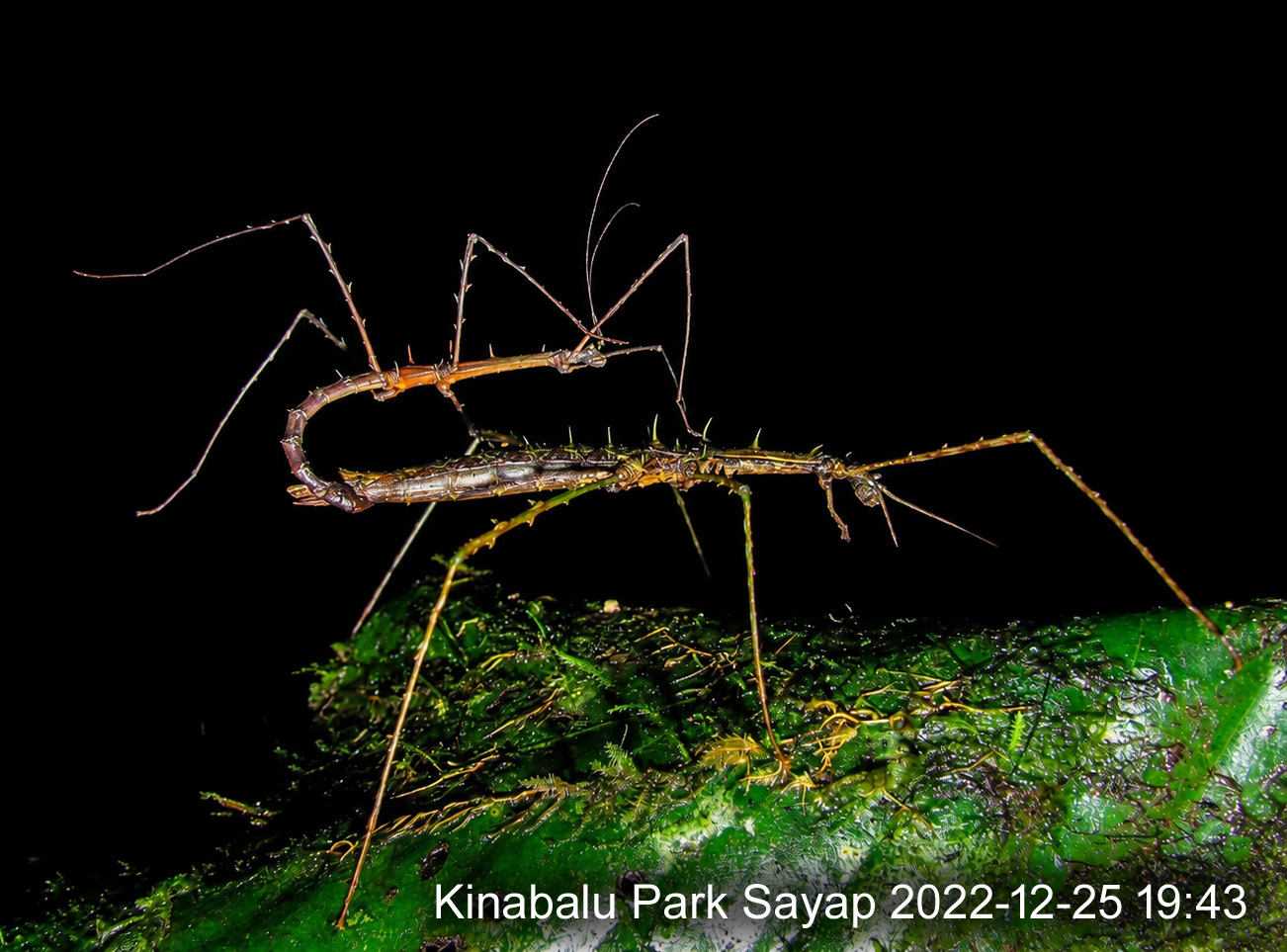
Order Phasmatodea. Probably family Lonchodidae, subfamily Lonchodinae. Genus not determined.
Photographed by Wong Fook Yee at 19:43 on 25 December 2022, at the Sayap Substation of Kinabalu Park, in the Kota Belud district of Sabah, on the northern side of Mount Kinabalu, at approximately 1,000 m above sea level.
The two insects were resting motionless, in copula, on a leaf of a tree branch. The larger insect is the female; the much smaller and more slender individual is the male. The female measured about 5 inches — roughly 125 mm — in body length.
Both sexes are completely wingless, and both carry rows of sharp spines along the body and legs. Their colouring matched the mossy leaf so closely that the pair was effectively invisible; they were found only with a strong torch, and they did not move while being photographed.
This was the photographer's first encounter with this animal.
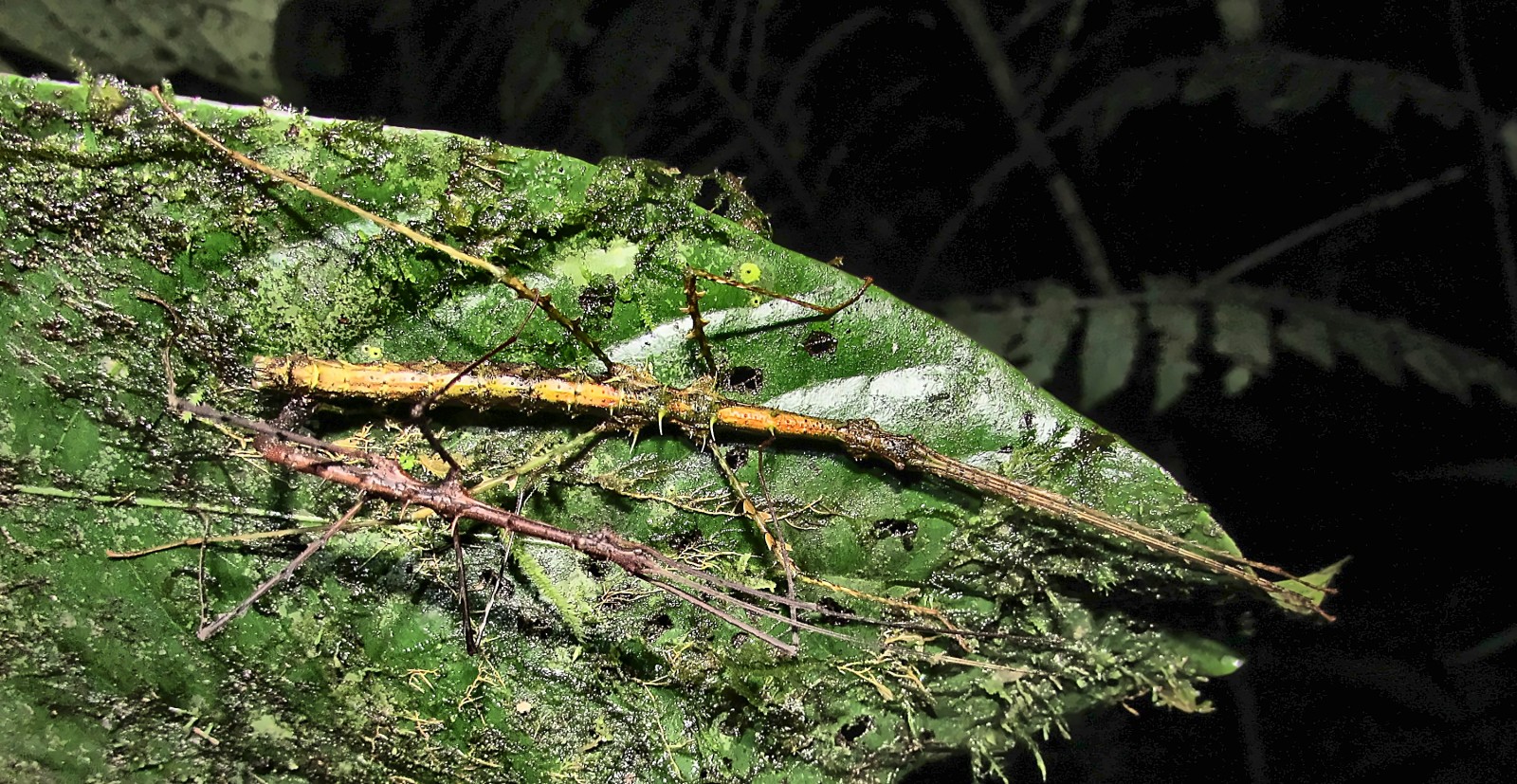
The same pair seen from above, showing the spines along the body and the extent of the legs and antennae. This frame has been brightened from the original night exposure so that the animals can be seen; nothing has been added to or removed from the image. The difficulty of picking the insects out from the moss and epiphytes on the leaf is not an artefact of the photograph — it is what the animals looked like in the torchlight.
What is established: the pair is unambiguously a stick insect, order Phasmatodea. The combination of a long, slender, entirely wingless body in both sexes, the extreme difference in size between female and male, and the spination of the body and legs fits the subfamily Lonchodinae (family Lonchodidae) well.
What is not established: the genus. Borneo holds a large and still incompletely described phasmid fauna, and several lonchodine genera share this general appearance. New species continue to be described from Mount Kinabalu itself. Separating the genera generally requires characters that a field photograph cannot show — the arrangement and number of spines on the thorax and head, the shape of the terminal abdominal segments, and in many cases the male genitalia. No genus is claimed here.
One genus is worth naming only in order to set it aside. Acanthomenexenus Brock & Hennemann, 2009 is a spiny, wingless lonchodine of very similar proportions, and its name is sometimes attached to photographs of this kind. It is a monotypic genus containing only Acanthomenexenus polyacanthus (Dohrn, 1910), the Sangihe Spiny Stick-insect, and it is recorded only from Sangihe Island, north of Sulawesi — some 1,500 km east of Kinabalu. It is not known from Borneo, and the identification is not supported here.
What would settle it: examination by a phasmid specialist, ideally of further views — a close photograph of the female's thorax showing the spine arrangement, and a view of the end of the male's abdomen. The original photographs have been posted to iNaturalist as observation 396445193, where they are open to examination by identifiers worldwide. As at the review date below, the record stands at order level only. Any determination reached there will be recorded here, together with its source.
Stick insects (Phasmatodea) are plant-feeders whose defence is almost entirely concealment. Most are nocturnal, feeding after dark and spending the day motionless among the foliage they resemble. The pair described here fits that pattern: found active at night, holding completely still, and coloured to match the mossy surface it sat on.
Strong sexual dimorphism is characteristic of Lonchodinae. Females are large-bodied and comparatively heavy — they carry the eggs — while males are markedly smaller, more slender and longer-legged, built for locating and reaching females rather than for bulk. In a number of phasmid species, pairs remain coupled for very long periods, hours to days, and this prolonged coupling is generally interpreted as a form of mate guarding by the male rather than as the time needed for insemination. Mating duration has been studied directly in the North American walkingstick Diapheromera velii.
The subfamily Lonchodinae was formerly placed in Diapheromeridae; in 2018 it was transferred, together with Necrosciinae, to the re-established family Lonchodidae. Older books and websites will therefore place these insects in a different family, and the name combination given in earlier sources may not match current usage.
The Sayap Substation lies on the northern side of Kinabalu Park, reached from Kota Belud rather than from the main Park Headquarters at Kundasang. At about 1,000 m it sits some 500 m lower than the Headquarters area, and it is far less visited; its forest is correspondingly less surveyed for insects.
Kinabalu Park is a UNESCO World Heritage Site and one of the richest sites for endemic species in South-East Asia. That richness extends to its stick insects: new phasmid species are still being described from the Kinabalu massif, including species of Lonchodes — which is part of why an undetermined lonchodine from Sayap is worth recording rather than passing over.
Because the substation is off the main tourist route, night observations from Sayap are comparatively scarce. A dated, located photograph of a mating pair — which links a male to its female, something dry museum material often cannot do — has value beyond the picture itself.
Page reviewed: 31 August 2026.