eTawau > Insects of Borneo > Stick insects > A winged pair at Bukit Gemok
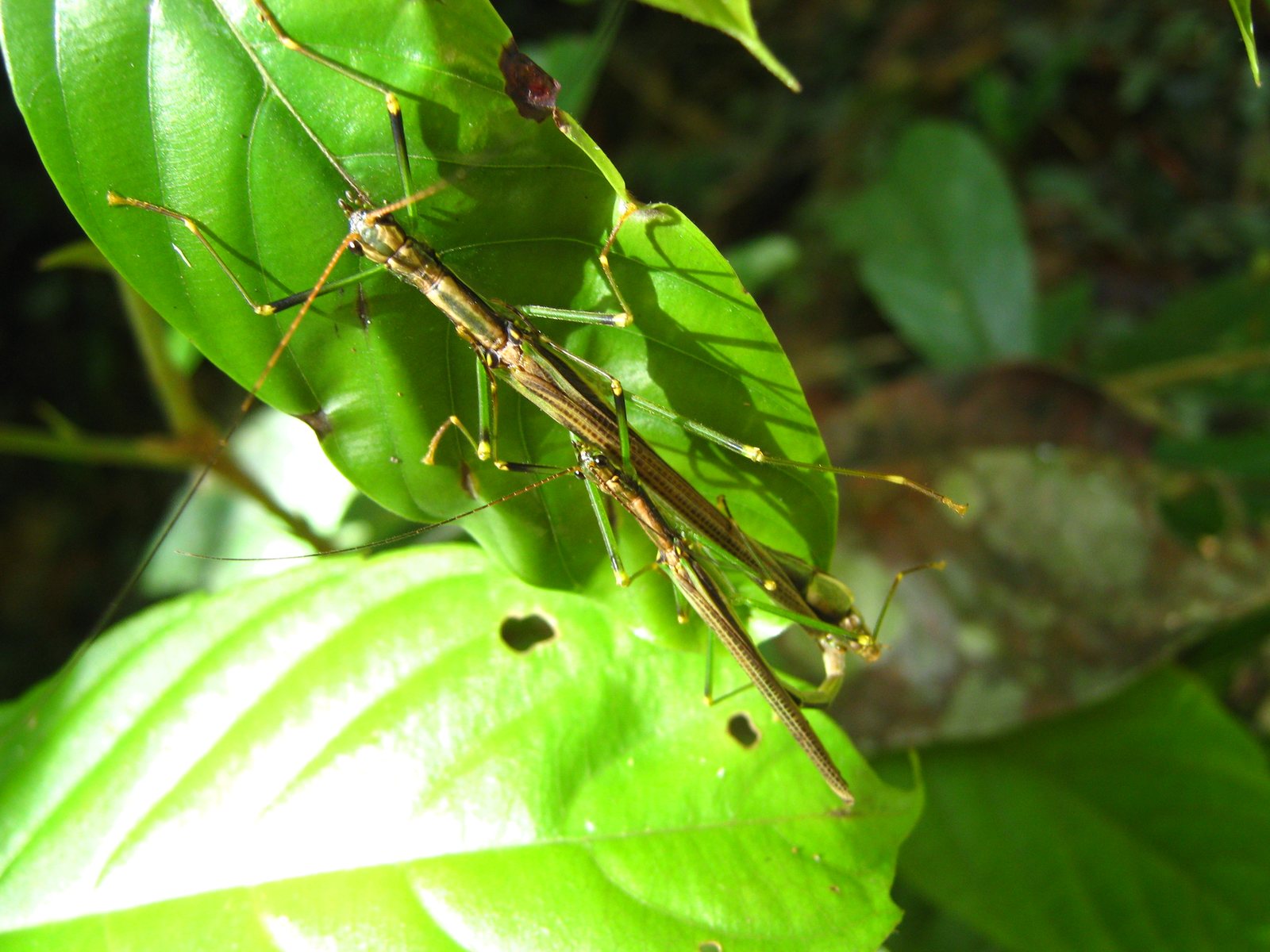
A mating pair on a shrub leaf at Bukit Gemok, on a November morning — and where their wings were hiding
Most people picture a stick insect as a twig with legs, and most of the stick insects on this site fit that picture: long, slow, wingless. This pair does not. Both of them have wings, folded so tightly along the back that you would take them for a stripe on the body. I found them on the leaf of a shrub at Bukit Gemok, the male on the larger female, and they stayed together while I photographed them.
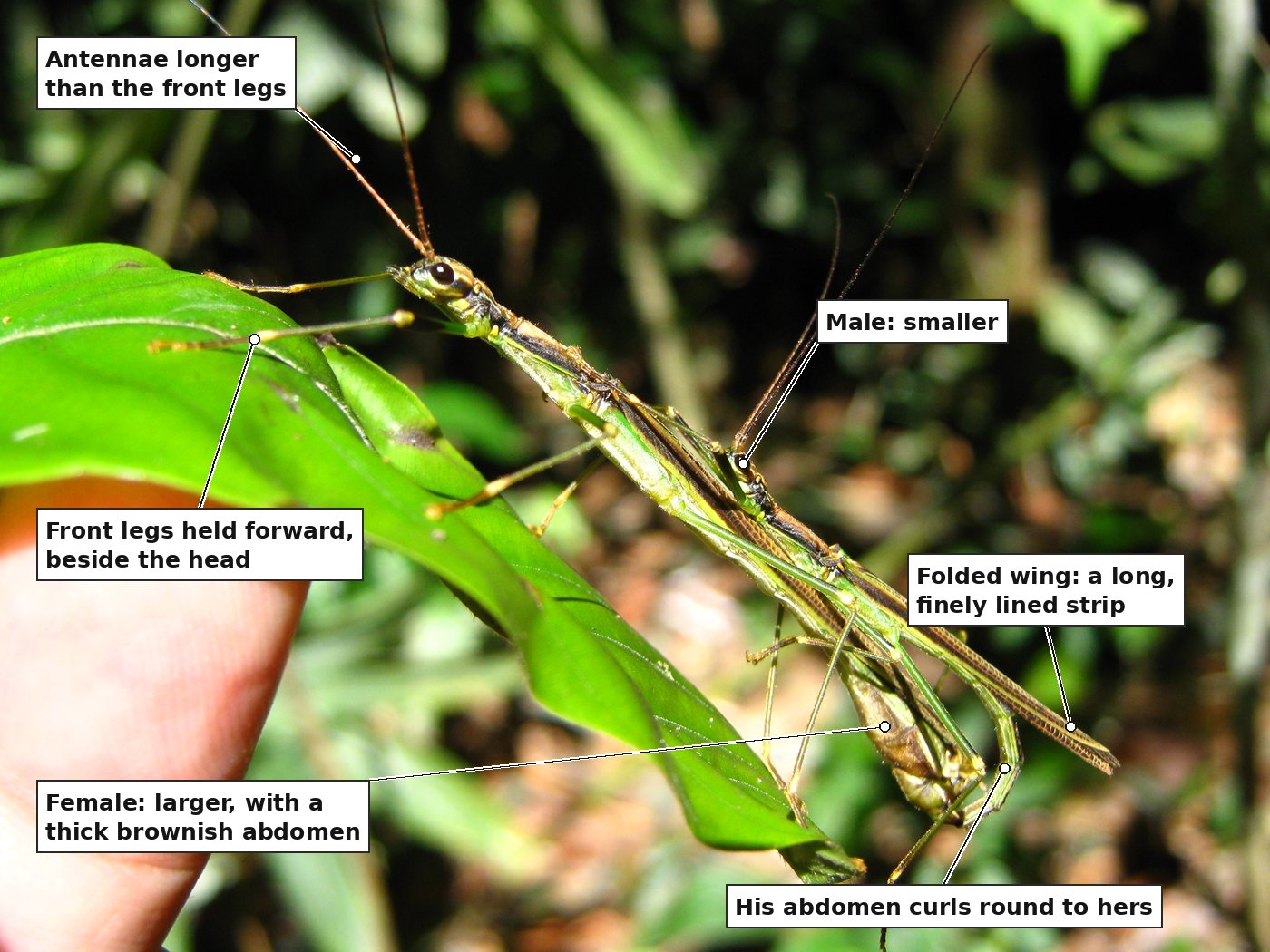
Long, thin, green-and-brown insects with long legs are sometimes taken for praying mantises. Two things settle it here, and you can see both without touching the animal:
They are not grasshoppers either: their back legs are as slender as the rest, with none of the thick thigh a grasshopper jumps with. They are stick insects, order Phasmatodea.
Look along the back of each insect and you will see a long, narrow brown strip, finely lined along its length, reaching almost to the end of the body. That is the wing, folded.
In winged stick insects the front wings are usually short, and it is the back wings that do the flying. At rest the back wing folds up lengthways like a closed fan and tucks along the body, so only its stiff front edge shows: the lined strip in these photographs. Opened, it would be a broad, thin, fan-shaped wing, many times wider than the strip you see.
In stick insects the female is usually the larger, because she carries the eggs, and the male is smaller and slimmer. My field note says the smaller male was on top of the larger female, and the photographs agree:
Mating stick insects often stay joined for hours, sometimes much longer, which is why a pair like this will sit still for a camera. It is also why you are more likely to find a pair in the daytime than to see one courting.
Two things would take it further: a photograph of the hind wing opened, whose colour and pattern often separate the genera, and close views of the end of the abdomen of each sex. Both need the animal in the hand, and this pair was left alone.
Bukit Gemok Recreational Forest Park,
Tawau, Sabah. One pair, not measured, on the leaf of an unidentified shrub
tree, mating: the smaller male on the larger female, his abdomen curled round to hers. Both slender
and stick-like; antennae very long and thin, longer than the front legs; front legs held forward
beside the head; legs green with yellow joints and yellow feet; head marked with yellow and black;
both winged, the folded hind wings lying along the back as a long, narrow, finely lined brown strip.
Female with a thick brownish abdomen, male with a slender green one.
Phasmatodea — stick insects. Family, genus and species not determined. One pair
only. Two frames, 09:48:19 and 09:49:20. The leaf was held steady for the second
frame; the insects were not touched and were left where they were.
— iNaturalist observation
403177919
At 10:45 the same morning, about an hour later, I followed a Fish Hook Ant for six and a half minutes on a twig at Bukit Gemok. Two records from one walk: a pair of insects that trust stillness to keep them hidden, and an ant that trusts a pair of hooks.
All the small animals of Bukit Gemok are gathered on one page, from a caterpillar pretending to be a dead leaf to millipedes and a centipede's shed skin.
About the photographs. Two frames by Wong Fook Yee with a Canon PowerShot A470 in
macro mode, no flash, f/3.0, ISO 100, 6.3 mm, taken at 09:48:19 and 09:49:20 on 1 November 2009 at
Bukit Gemok Recreational Forest Park, Tawau, Sabah. Both are camera originals that have never been
opened in an editor. For this page they have been reduced and labelled; nothing has been
sharpened, recoloured, added or removed. The unmarked full frames are on the iNaturalist record
above.
The account of how stick insect wings fold, of the size difference between the sexes and of the
length of mating is from the general entomological literature. The locality, date, times, the
plant, the mating and which insect was on top are the photographer's own field observations. The
plant is not identified. All photographs © Wong Fook Yee. Page written 25 September 2026.