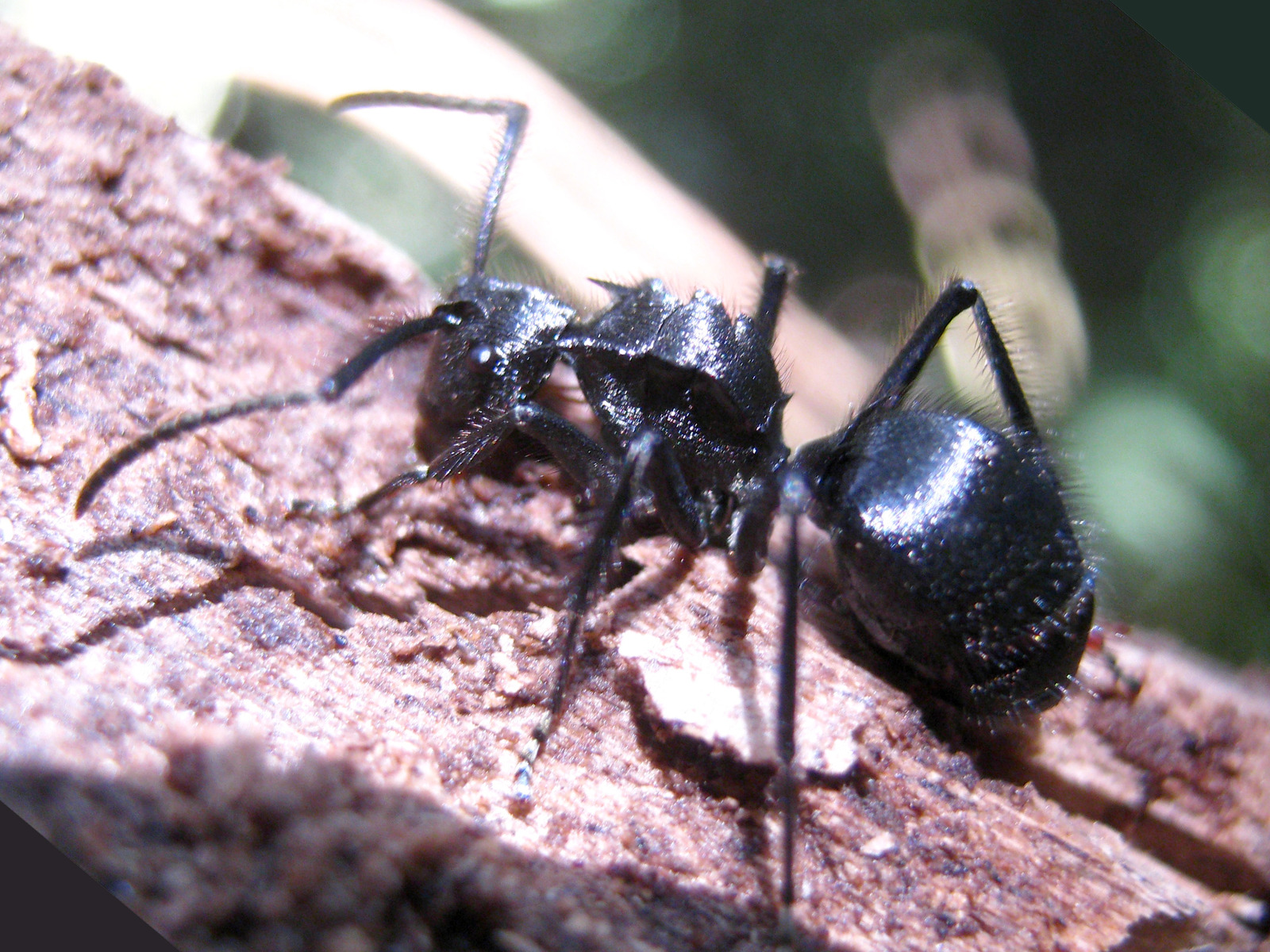
Provisional record. The family, subfamily and genus are certain. The species is not determined. A second photograph was taken specifically to settle it and it did not, for a reason set out below.
Class Insecta, order Hymenoptera, family Formicidae, subfamily Formicinae, tribe Camponotini, genus Polyrhachis — the spiny ants. A worker. Species not determined.
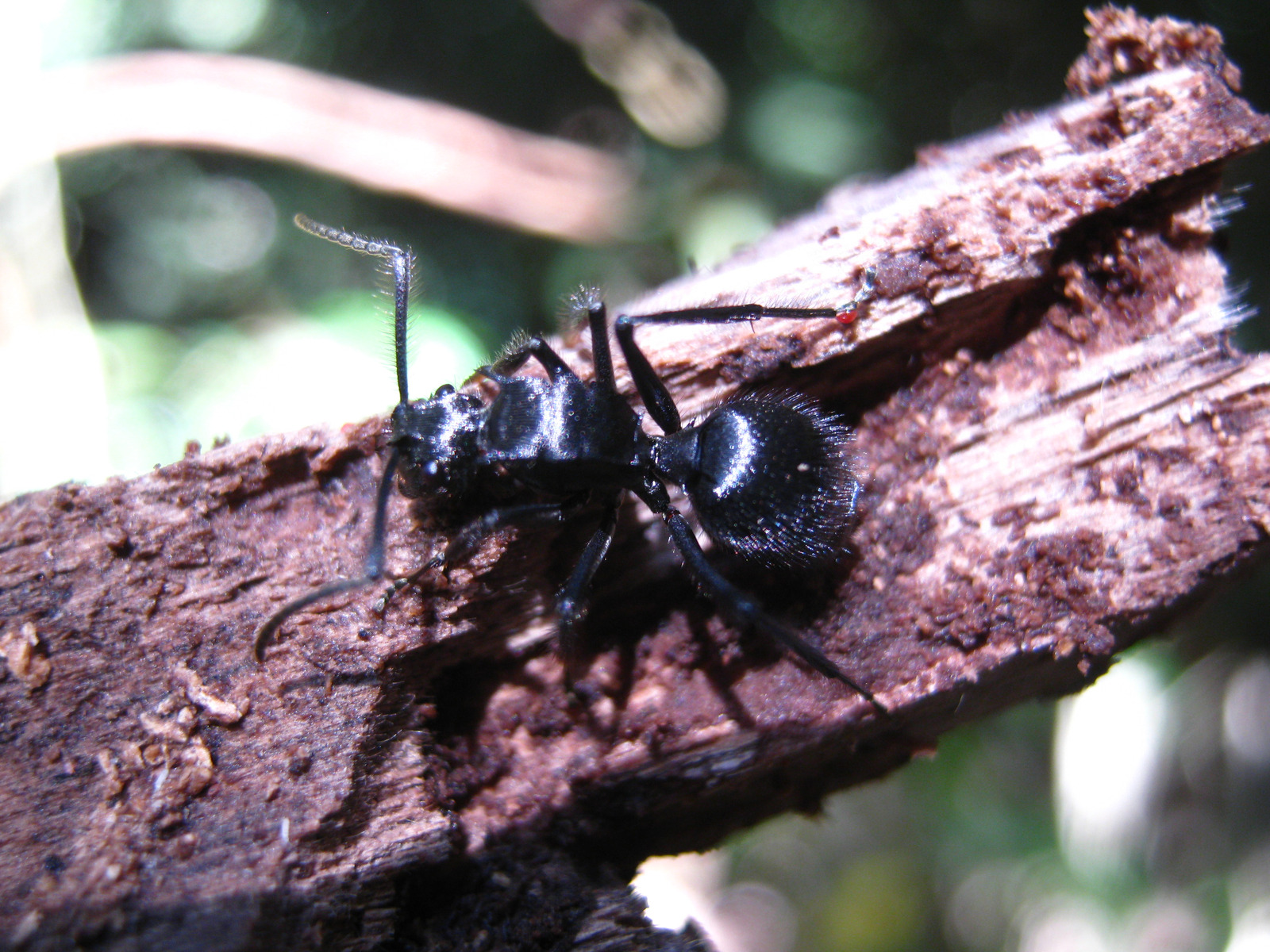
Photographed by Wong Fook Yee at 13:51 on 4 September 2015, on the strip of ground opposite Tawau Hills Park, Tawau District, Sabah — the margin between the park boundary and an oil palm plantation, which since 2021 has been planted as the Plant4Tawau fig garden.
About 10 mm long, black and strongly shining, on a split piece of rotten wood. It was alone, walking steadily and without hurry, and it did not stop while it was being photographed. The two frames are fifteen seconds apart — 13:51:05 and 13:51:20 — and are the same individual.
Look along the top of the thorax in the first photograph. Its upper surface is bordered on each side by a raised, sharp-edged rim that runs the whole length, and that rim is drawn out into points: a long spine projecting forward and outward at the front, further teeth along the margin, and a stout triangular spine pointing backwards at the rear corner.
That armature is what Polyrhachis means. The genus is diagnosed among the Formicinae by exactly this: a pronotum bearing spines, teeth or tubercles, and a propodeum typically carrying two spines or ridges. It is one of the largest ant genera on earth — 782 described species — and it is at its richest in South-East Asia, where it originated some 58 million years ago.
The first frame left the species open, and for a specific reason: Polyrhachis species are separated largely on the spines of the petiole — the narrow waist segment between thorax and abdomen — which carry four in most species, sometimes two, sometimes six. In the side view the waist was turned away from the camera and in deep shadow.
So a second photograph was looked for, taken from above with the waist lit. There is one: the frame at 13:51:20, fifteen seconds after the first, and it is the unedited camera original at full resolution.
It is a better photograph, and it still does not settle the species. It is worth saying exactly what it did and did not give, because the difference is the whole of the honest answer:
It is worth knowing what the field looks like. Polyrhachis is the largest ant genus in Borneo, with 98 recorded species on the island, out of 717 valid Bornean ant species in all. A photograph of one black spiny ant, taken with a compact camera as the animal walked away, is not evidence for one of ninety-eight.
What would still settle it: the same view with the light on the waist rather than behind it, and with no leg across it — or, failing that, a specimen. The genus is under continuing revision and is described as difficult even with the animal in hand.
The dorsal frame carries a detail the side view does not. A small, bright red, rounded body sits at the very tip of one foreleg, where the foot grips the wood; a second, smaller and darker red one sits at a joint of a hind leg.
Both are most probably mites. They are attached at a leg tip and a leg joint, which is where mites riding on ants normally attach — the membranous places. Neither can be identified from these frames, and neither is claimed as anything more than probable. They are recorded because a passenger on a photographed animal is part of the record, and because an identifier may recognise what could not be recognised here.
Ninety-four minutes earlier, at 12:17, and a few paces away on the same strip, Wong photographed a quite different black ant — slender, unarmed, long-legged, walking a grass stem. This one is heavily built and armed.
Two ant genera out of one half-kilometre of plantation edge in an hour and a half. Kept as two records rather than one, because that is what they are; read together, they are a better answer than either to the question of what "a black ant" means in Borneo.
In 2015 this strip was forest buffer between Tawau Hills Park and an oil palm plantation. In March 2021 the conservation group 1Stop Borneo Wildlife began planting figs on it, and it became the Plant4Tawau fig garden — a corridor intended to reconnect Tawau Hills Park with the isolated forest of Bukit Gemok.
That makes this photograph, and the one from 12:17, baseline records: what was living on the ground before the restoration began. A planting project can measure everything it plants and nothing that was there beforehand. Both ants were photographed six years early, by accident, which is the only way baselines ever get made.
Page reviewed: 10 September 2026.