eTawau > Insects of Borneo > Ants > The Fish Hook Ant
Polyrhachis bihamata — ten millimetres long, and better armed than anything else its size on the trail
In twenty-odd years of walking the forests around Tawau with a camera, I have met this ant twice. Once in 2009, on a young tree in the protected forest of Bukit Gemok. Once in 2023, in the young fig garden opposite Tawau Hills Park. Fourteen years and about twenty kilometres apart, and in two completely different kinds of ground.
Both times it was alone, and both times it was in a hurry. Let me show you why it is worth stopping for.
Every ant has a narrow waist between its thorax and its abdomen. On most ants it is a small bump you need a lens to see.
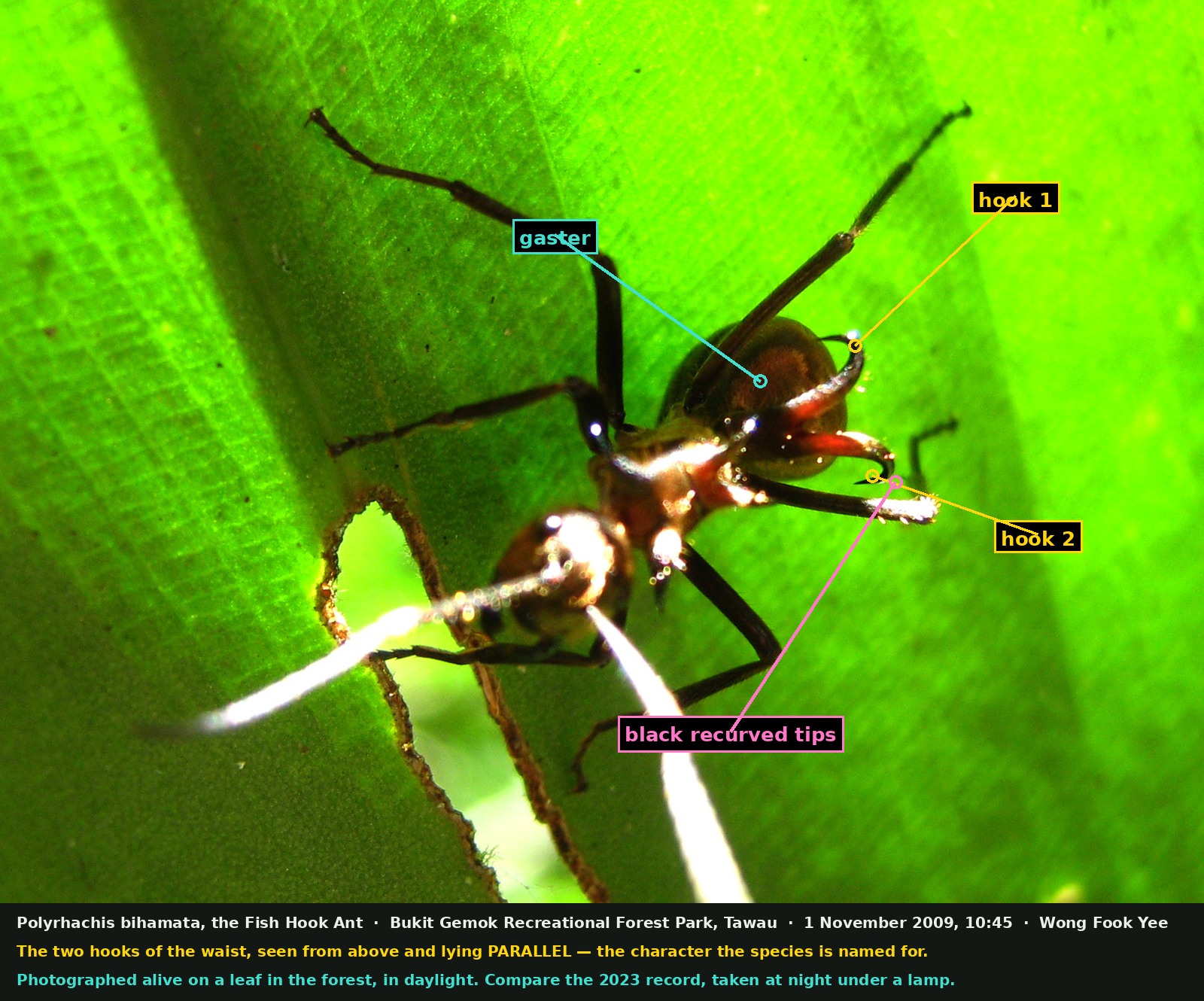
On this one it carries two long, curved, black-tipped hooks lying side by side, arching back over the body like the business end of a fishing tackle box. They are the largest structures on the animal, and they are perfectly shaped: the curve turns inward, so that anything which slides along one is drawn onto the point rather than off it.
That is not my interpretation. It is in the name. The species is Polyrhachis bihamata, and bihamata means "two-hooked". Whoever described it in 1773 looked at the same two spines you are looking at now and named the animal after them.
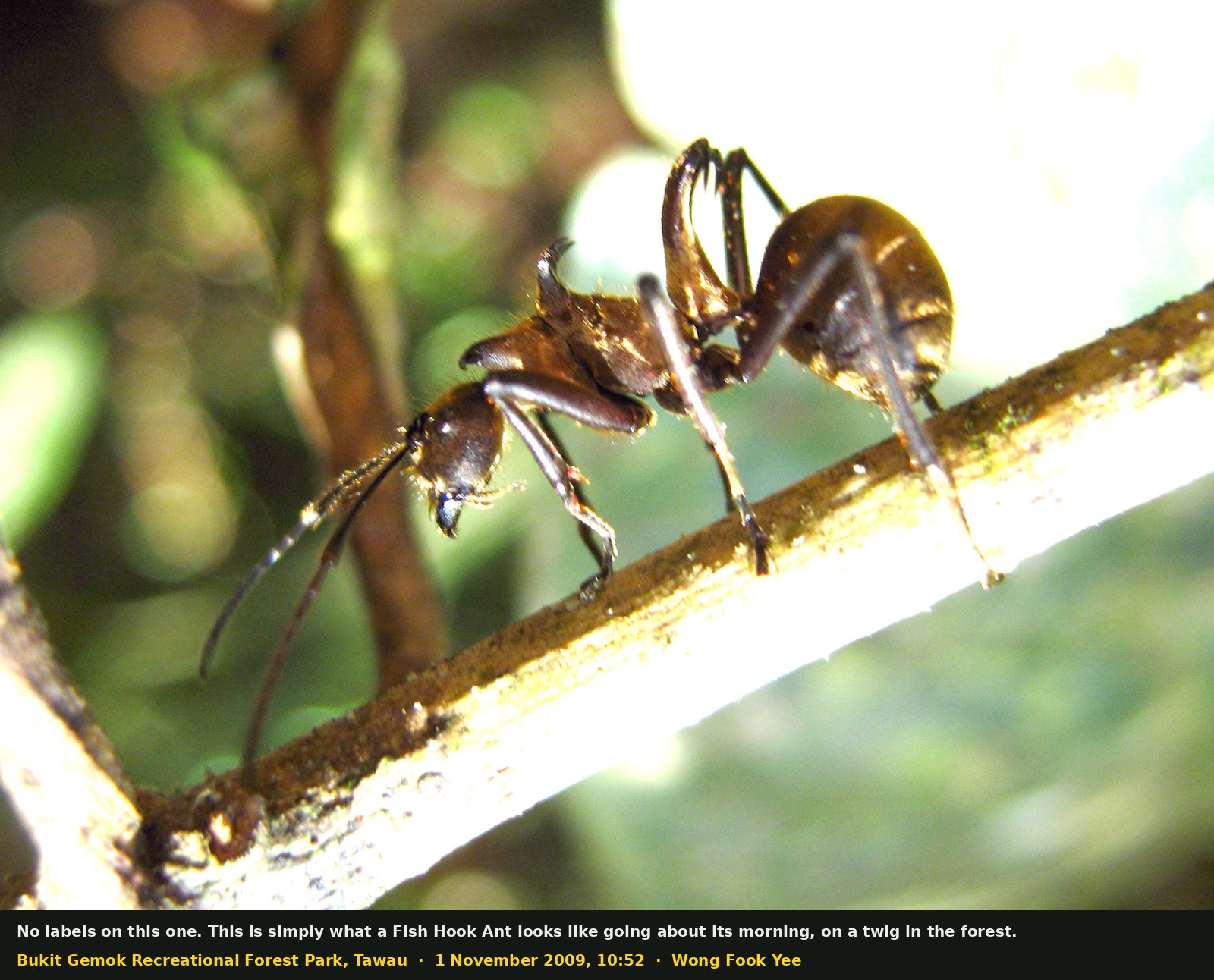
That is the honest picture. A fast brown ant, a few millimetres of shine, and two absurd hooks standing up off its back. If you are not expecting them you will walk past; once you have seen them once you will never miss another.
Four things together, and you will not need a specialist:
When I wrote my first note on the 2023 ant I described it as "greenish dark in whole body". Look at the sunlit pictures above. It is not greenish at all — it is orange-brown under a golden pile, and the abdomen is frankly bronze.
The explanation is simple, and it is worth carrying with you. I photographed the 2023 ant at night, indoors, under an electric light bulb. A tungsten bulb throws a completely different light from the sun, and an insect's colour under it is not the colour it is. My eye was reading the ant under a lamp; the camera was doing the same; and both of us were wrong in the same direction.
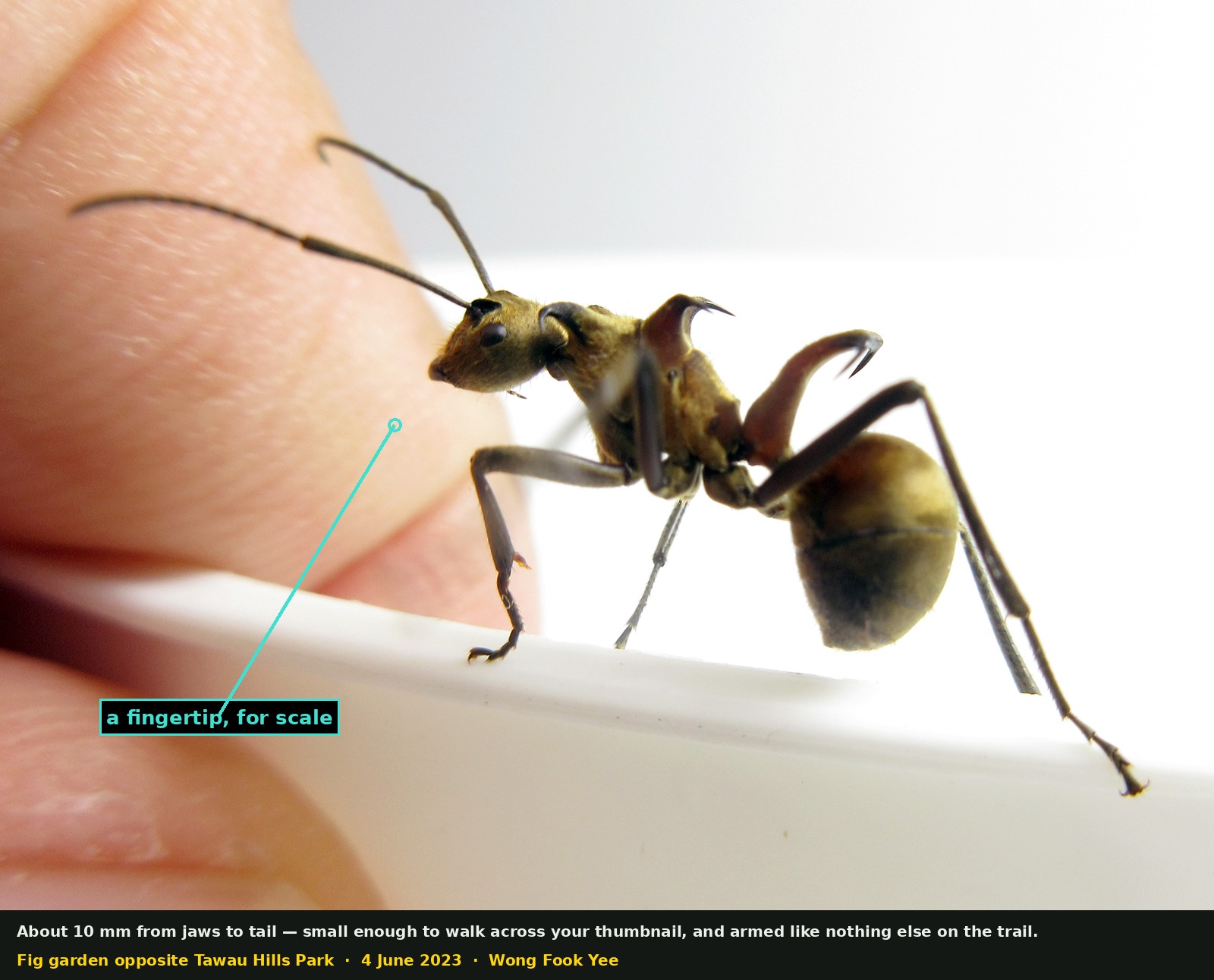
And while you have that picture in front of you: about ten millimetres. You could stand it on your thumbnail. Photographs of insects always lie about size, and half the pleasure of finding one in the field is the shock of how small the thing actually is.
The honest answer is that the obvious explanation is probably right, and the exciting explanation is unproven.
The obvious one: defence. A recurved hook is far harder to pull out of a mouth than a straight spine. A small bird or a lizard that takes a mouthful of this ant is going to regret it, and is going to remember. That is the same principle as the barb on a fishing hook, which is why the common name sticks so well.
The exciting one: you will find it repeated all over the internet — that these ants link themselves together by their hooks into chains and clumps that a predator cannot pull apart. It is a wonderful image, and it may well be true. But I have not been able to find a scientific source for it. The proper species description sets out the shape of the hooks in detail and says nothing at all about what the ant does with them.
So I will tell you the first and not the second. If you are a myrmecologist reading this and you know the original observation, I would genuinely like to hear from you.
This page holds every record I have of the species. There are two so far, and I hope there will be more.
Bukit Gemok Recreational Forest Park, about 12 km from Tawau town centre. One
individual, walking rapidly and alone on a young tree, which I
followed for six and a half minutes — from 10:45 to 10:52, from a leaf onto a twig.
About 10 mm. Photographed alive where I found it, in daylight, and left where it was.
This is the better of my two records, and the pictures at the top of this page are from it.
— iNaturalist observation
399156799
The fig garden opposite Tawau Hills
Park, about 25 km from town. Seen walking rapidly and alone in low bush. I carried this one home
and photographed it the same night in a white ice-cream box — which is why that picture has a plain
background and a misleading colour — and then took it back and released it.
About 10 mm.
Not forest: this is the strip of old oil palm land that has been planted with figs since 2021.
— iNaturalist observation
399103222
My practice with every insect on this site is the same: photograph them alive, and put them back — where they came from, or on natural ground close by. Nothing here has been killed to make a picture.
Now the part I find genuinely moving, and it only became visible when the two records were put on one page.
The fig garden was begun in March 2021 with a single purpose: to grow a corridor of fig trees that will one day let wildlife move again between Tawau Hills Park and the isolated forest of Bukit Gemok — which agriculture has cut off from it. The planting is measured in decades. The stated horizon is fifty years.
And here is this ant, already living at both ends of it. In the forest at Bukit Gemok in 2009, and on the restored plantation edge at Tawau Hills in 2023.
That proves nothing on its own — one ant at each end is not a corridor, and I would not pretend otherwise. But it is exactly the kind of before-and-after a restoration project can almost never go back and collect, and it is the reason I keep photographing small brown things and writing down the date.
If you take one thing away from this page, let it be this.
The Malaysia Biodiversity Information System — the national record of what lives where in this country — currently lists the Fish Hook Ant from Negeri Sembilan and Perak only. Both are in Peninsular Malaysia. There is no Sabah locality showing. Published range statements do extend the species south to Borneo, so it is certainly here; but the national database has nothing from our state.
That is what a gap in the record looks like, and it is filled by ordinary people with cameras. The two records on this page are now two dated Sabah localities, fourteen years apart, in two different habitats. A dated, located photograph, posted where scientists can see it, is a real contribution — not a lesser version of research, but the raw material of it.
So please: photograph what you find in Sabah. Note the date and the place. Put it somewhere a specialist can reach it. You do not need to know what it is.
About the photographs. Taken by Wong Fook Yee with a Canon PowerShot A470 (Bukit
Gemok, 1 November 2009) and a Canon IXUS 285 HS (fig garden, 4 June 2023). For this page they have
been reduced and labelled, because a visitor wants to be shown what to look at. The unmarked
originals are attached to the iNaturalist records above, which is where a specialist should work
from.
Identification characters follow the published species account on AntWiki; the Malaysian
distribution is from the Malaysia Biodiversity Information System. All photographs
© Wong Fook Yee. Page written 11 September 2026, and added to as further records are made.