eTawau > Insects of Borneo > Flies > A stalk-eyed fly at Bukit Gemok
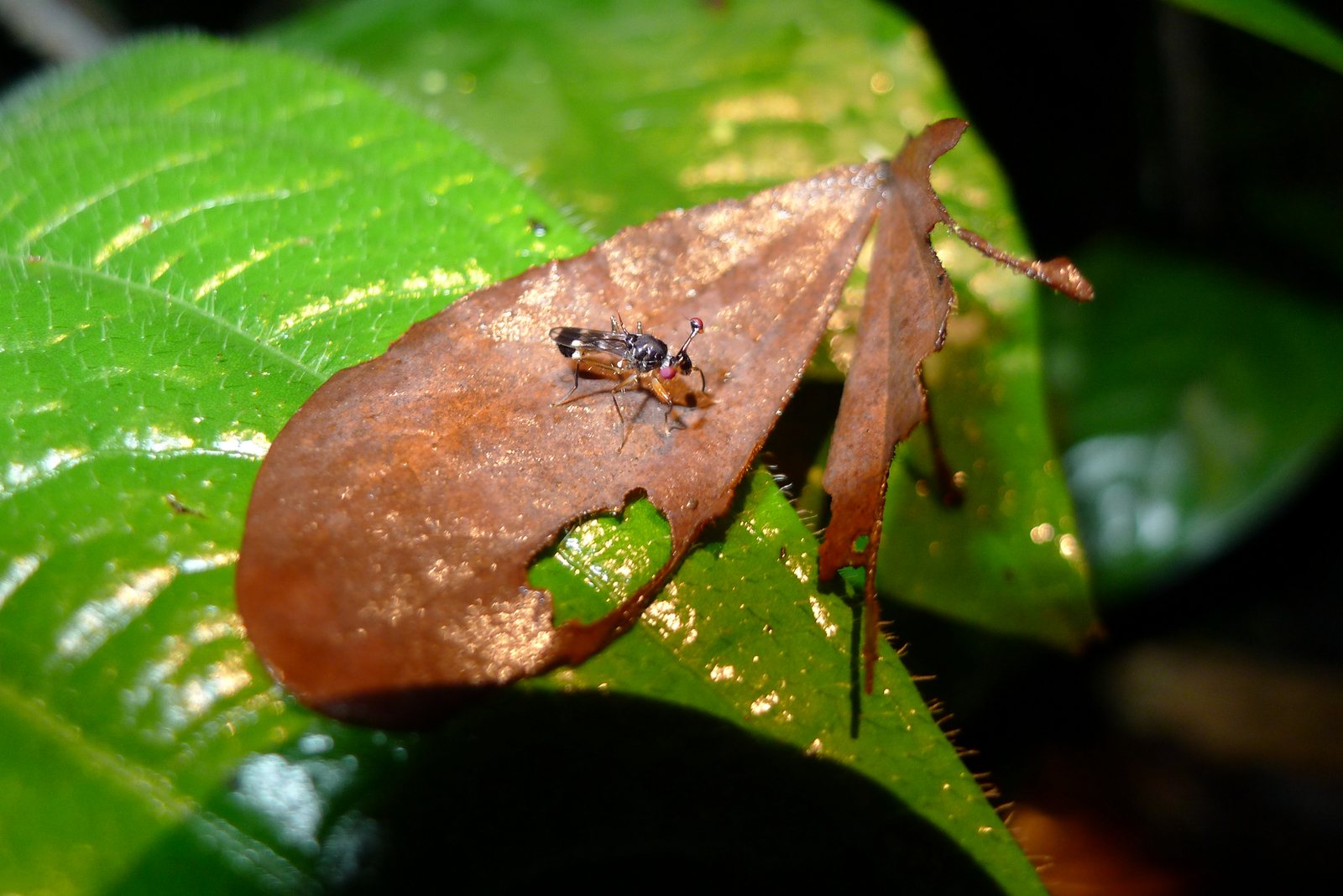
A stalk-eyed fly on a dead leaf beside the George Mais Trail at Bukit Gemok, on a hot, bright morning in July 2015
At first it looks like any small dark fly resting on a dead leaf. Then you notice the head. Instead of sitting on the face, the two red eyes are carried out to the sides on long thin stalks, like a pair of pins stuck into a cork. It stayed for a few seconds, long enough for three photographs, then flew off and was gone. Looking for it again in the bright sunlight turned up nothing.
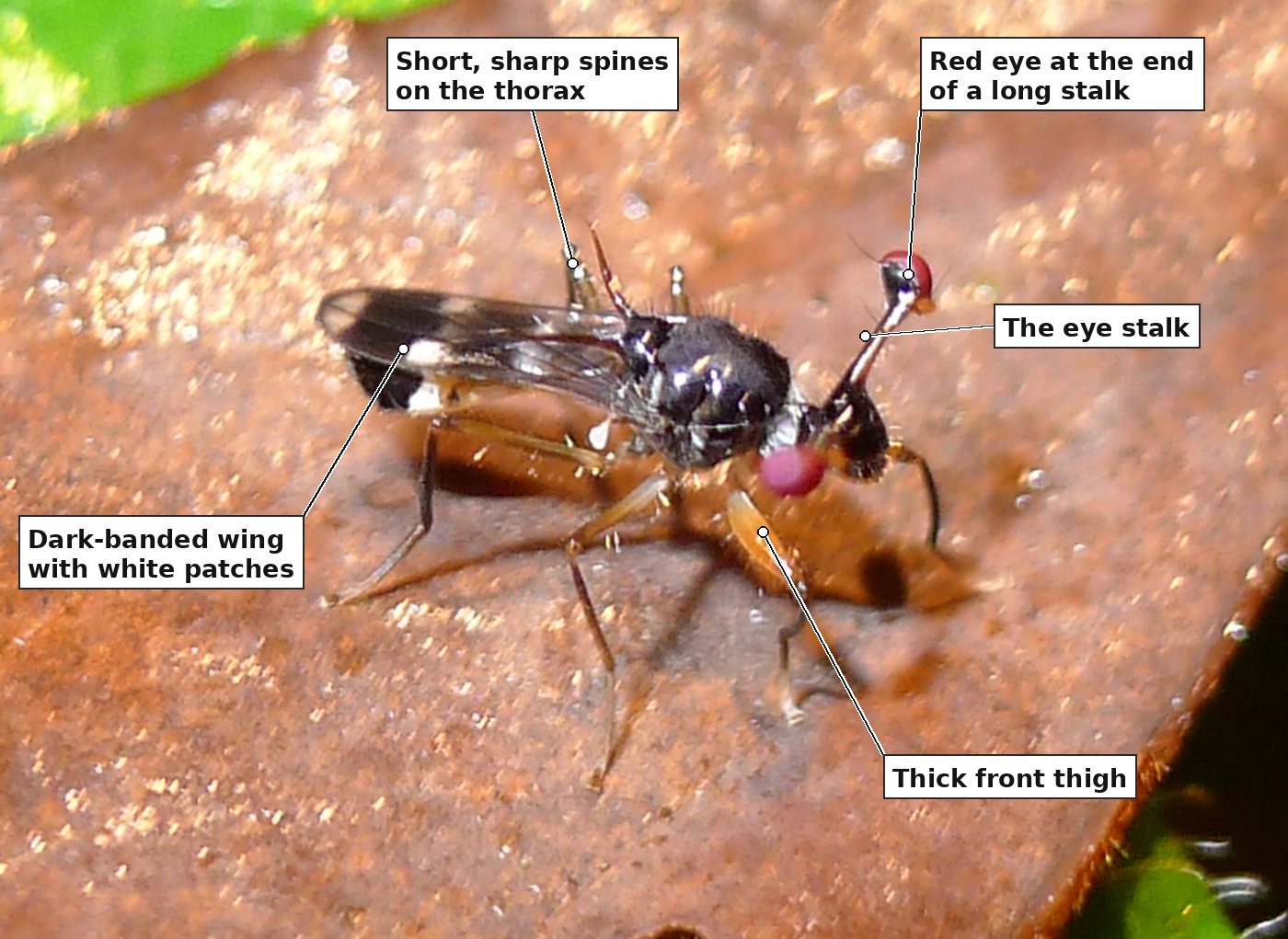
This is a stalk-eyed fly, family Diopsidae. It is a true fly: it has only one pair of wings. Several things together mark the family:
Few flies anywhere look like it. Some other flies have broad heads with the eyes set wide apart, but the diopsids are the family in which long, thin stalks with the eyes at the very end are the rule.
In many stalk-eyed flies the males have much wider eye stalks than the females, and the width matters. Two males facing each other line up their heads and compare eye spans, and the one with the narrower span usually backs down without a fight. Females, for their part, prefer to roost and mate with wide-eyed males. Some of the best-known studies of this were made on stalk-eyed flies from Malaysia. Whether this one is a male or a female cannot be told from these photographs: in some species both sexes have long stalks.
Stalk-eyed flies usually live close to water, in damp, shaded forest. They gather at dusk in small groups on hanging roots and threads over streams to spend the night, and their larvae feed in rotting plant material. Seeing one on a hot, dry morning on a hill trail, alone and quick to leave, is a reminder that the forest on Bukit Gemok is still damp and shaded enough underneath to hold them.
There was nothing in the frame to give a scale, and it flew before anything could be put beside it, so this record has no size. Stalk-eyed flies are small: most are well under a centimetre long, eye stalks included.
The George Mais Trail,
Bukit Gemok, Tawau, Sabah, 12 km from
Tawau, measured from the 0 km Tawau landmark. One fly, not measured, standing on a
dead brown leaf that had fallen onto the leaf of an unidentified plant. Red eyes on long stalks;
black, shiny, spiny thorax; dark-banded wings with white patches; orange-brown legs with thickened
front thighs. Diptera: Diopsidae — a stalk-eyed fly. Genus and species not
determined. Alone. It stayed a few seconds and flew off. Three frames, at
9:25:50, 9:25:54 and 9:26:33.
— iNaturalist observation
404467851
Thirty-four minutes later, on the same hill, the same camera photographed a thickset, spiny stick insect holding its tail up over its back. Both records were at first read as night-time finds, because the camera's clock had been set to pm instead of am; both were in fact made in the morning.
About the photographs. Three frames by Wong Fook Yee with a Panasonic DMC-LX5, 5.1 mm,
f/2.0, 1/60 s, on 13 July 2015 on the George Mais Trail at Bukit Gemok, Tawau, Sabah. The flash fired
for the first two. The camera recorded the times as 21:25:50, 21:25:54 and 21:26:33; its clock had
been set to pm instead of am, and the true times are twelve hours earlier. All three are camera
originals that had never been opened in an editor. For this page the first has been reduced, and
cropped and labelled for the close view; nothing has been sharpened, recoloured, added or removed.
All three frames are on the iNaturalist record above.
The family characters and the account of eye-span contests, roosting and larval food are from the
general entomological literature on stalk-eyed flies. The locality, date, weather and behaviour are
the photographer's own. The plant is not identified. Distances from Tawau on this site are measured
from the 0 km Tawau landmark using Google Maps. All photographs © Wong Fook Yee. Page written
29 September 2026.