
eTawau > Places of Interest in Tawau District > Bukit Gemok
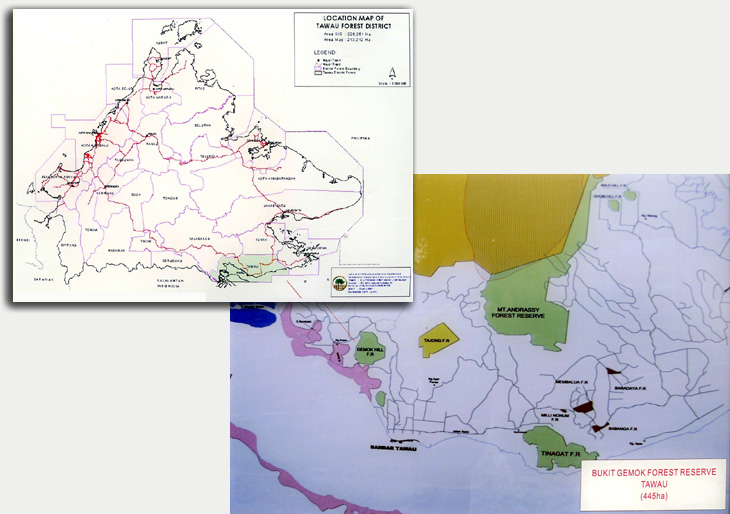
Hutan Rekreasi Bukit Gemok · Pusat Sejadi Bukit Gemok — a forested hill 12 km from Tawau town, and an island of forest in a sea of oil palm
The park is open again. It was closed for two years, in 2020 and 2021, because of Covid-19. Since reopening there are fewer visitors, and the facilities need upgrading: the piped water supply is short, which affects the cleanliness of the public toilets.
Tawau District Forestry Office
+60 89 761 833 · +60 89 761 835 · +60 89 761 863


Bukit Gemok is a small hill about 12 km from Tawau, measured from the 0 km Tawau landmark in the town centre. The Sabah Forestry Department developed it as a forest recreation area in the early 1990s, one of many forest recreation and education centres it runs across the state. Rest shelters, washrooms and trails were put in; the trails circle the hill and climb to the top, and people use them for walking, jogging and simply enjoying the forest.
The natural forest on the hill is protected. It holds commercial timber trees and wild plants such as forest orchids, and from the top there is a wide view over Tawau town. A canopy walk, Titian Silara, 231 metres long — the second longest in Sabah — hangs from tree to tree near the top.

The forest that once surrounded the hill was cleared last century for oil palm and cocoa. A privately owned plantation shares the park's boundary, and the first generation of palms is now being felled and replanted, as the photograph at the top of this page shows.

Bukit Gemok once had very rich wildlife. Last century the calls of gibbons were common here, and there were sambar deer, elephants at the foot of the hill and orangutans in the trees. As the forest around the hill was cut down for development and plantations, they disappeared, and none of them lives on Gemok Hill now.
What remains can still be seen: long-tailed and short-tailed macaques, squirrels, wild boar and barking deer, though in small numbers. Birds do better, because they can fly in from other forests. Several species of hornbill come to rest on the hill.


Each of these has its own page with the date, the time, the photographs and what the animal was doing. They are listed oldest first.
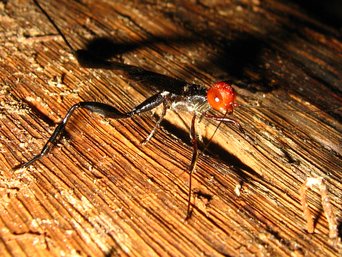
A female crown wasp (Stephanidae): a round red head on a narrow neck, swollen hind
thighs and an ovipositor longer than her body, for laying eggs through dead wood onto the grubs of
wood-boring beetles. Photographed two hours after the millipedes.
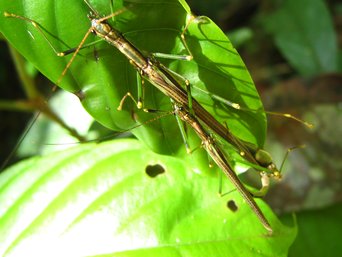
A mating pair, the smaller male on the larger female. Both are winged: the folded wings lie along
the back as a long, finely lined strip.
Polyrhachis bihamata, with the pair of hooked spines on its waist that give it its name. Photographed on the same walk as the stick insects, an hour later.
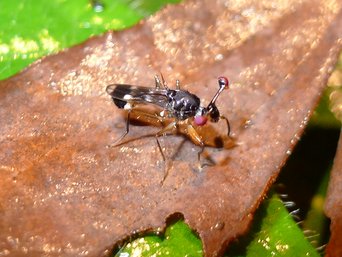
A stalk-eyed fly, family Diopsidae: red eyes at the ends of long stalks, a spiny black
thorax and banded wings. It stayed a few seconds and flew off. Photographed half an hour before the
stick insect below.
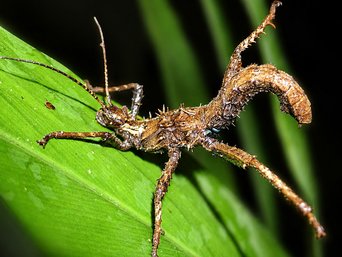
A heavily spined, wingless stick insect about 75 mm long, holding its abdomen
curled over its back like a scorpion's tail. The opposite of the slender winged pair of 2009.
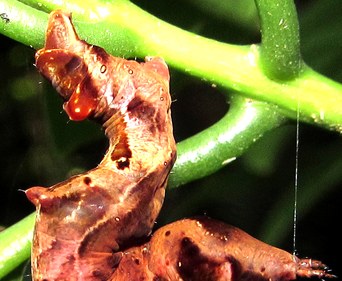
A caterpillar about 40 mm long, disguised as a dying leaf at the tip of a shrub. A lobster moth,
family Notodontidae.
All the small animals of Bukit Gemok — these records together with an older gallery of spiders, lizards, butterflies and beetles from the trail.

The climbing gourd Alsomitra macrocarpa is native to the islands of the Malay Archipelago. Its football-sized gourds hang from vines high in the forest canopy, each packed with hundreds of seeds, and each seed carries one of the largest wings of any seed: a thin, wrinkled film, with the seed set a little forward of centre so that it glides in wide, slow circles. The seeds are common at Bukit Gemok. The design is said to have inspired early gliders and aircraft.
More plants: the flora of Bukit Gemok · Alsomitra.

 Canopy walk
 Hiking trails
 Administration
 Information centre
 Picnic shelter
 House
House Camping
 Cafeteria
 BBQ
BBQ Playground
 Shower
 Toilet



In 2019 the solid waste disposal site at Bukit Gemok was being upgraded — Projek Menaiktaraf Tapak Pelupusan Sisa Pepejal di Bukit Gemok, Tawau — as the first such project on Sabah's east coast. It was due to begin operating in December 2019, handling more than 150 tonnes of the Tawau district's solid waste a day. Nearby, the 470 units of the Merotai People's Housing Project, about 9 km from Bukit Gemok, were completed in December 2018.

On 11 November 1993 four men died when a tunnel they had dug in search of buried treasure collapsed on them. The site was at the foot of a hill at Km 7, Merotai Road, on BAL Plantations land, about 1 km before the entrance to Bukit Gemok park, and it was rumoured to hold gold buried by Japanese soldiers in the Second World War.
The next day the New Straits Times reported that the Sabah Museum knew of the treasure reports and had warned residents and treasure hunters not to dig on their own. Under the Antiquities and Treasure Trove Enactment 1977 the Museum controls the excavation of such sites, and gold found buried in the ground with no known owner would count as treasure trove. Meetings the Museum arranged with residents and landowners had not taken place: the residents and landowners kept withdrawing at the last minute.
About this page. Photographs by Wong Fook Yee, 2006–2019. The 1993 account is summarised from the New Straits Times of 12 November 1993; the waste-disposal project from public tender records and news reports of September 2019. Distances from Tawau on this site are measured from the 0 km Tawau landmark, using Google Maps; older pages that give other figures used car odometers or estimates. The length of the canopy walk is as given on this site's canopy walk page. Rewritten 25 September 2026. Corrections to editor@etawau.com.