eTawau > Insects of Borneo > Beetles > A straight-snouted weevil at Bandar Sri Indah
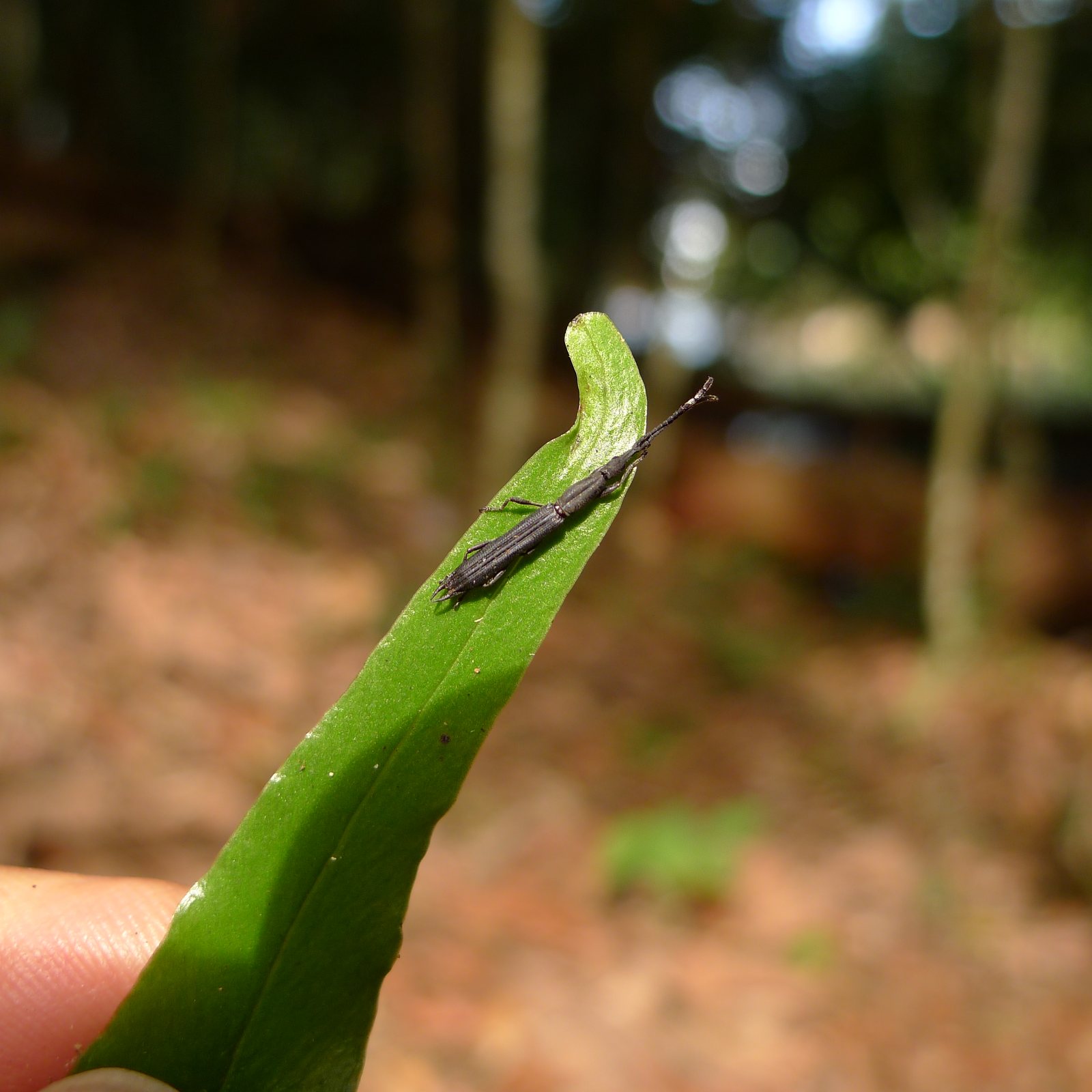
A straight-snouted weevil beside the Babanga Stream, on the River Esplanade of Bandar Sri Indah, in June 2014, when the stream still ran
It was a thin black line on a leaf, crawling slowly towards the tip and on over the end of it, as if it had no particular place to go. Up close it turned out to be one of the oddest-shaped beetles you can meet on a Tawau walk: a weevil, but long and straight as a matchstick, with its nose drawn out in front and its antennae held straight ahead of that.
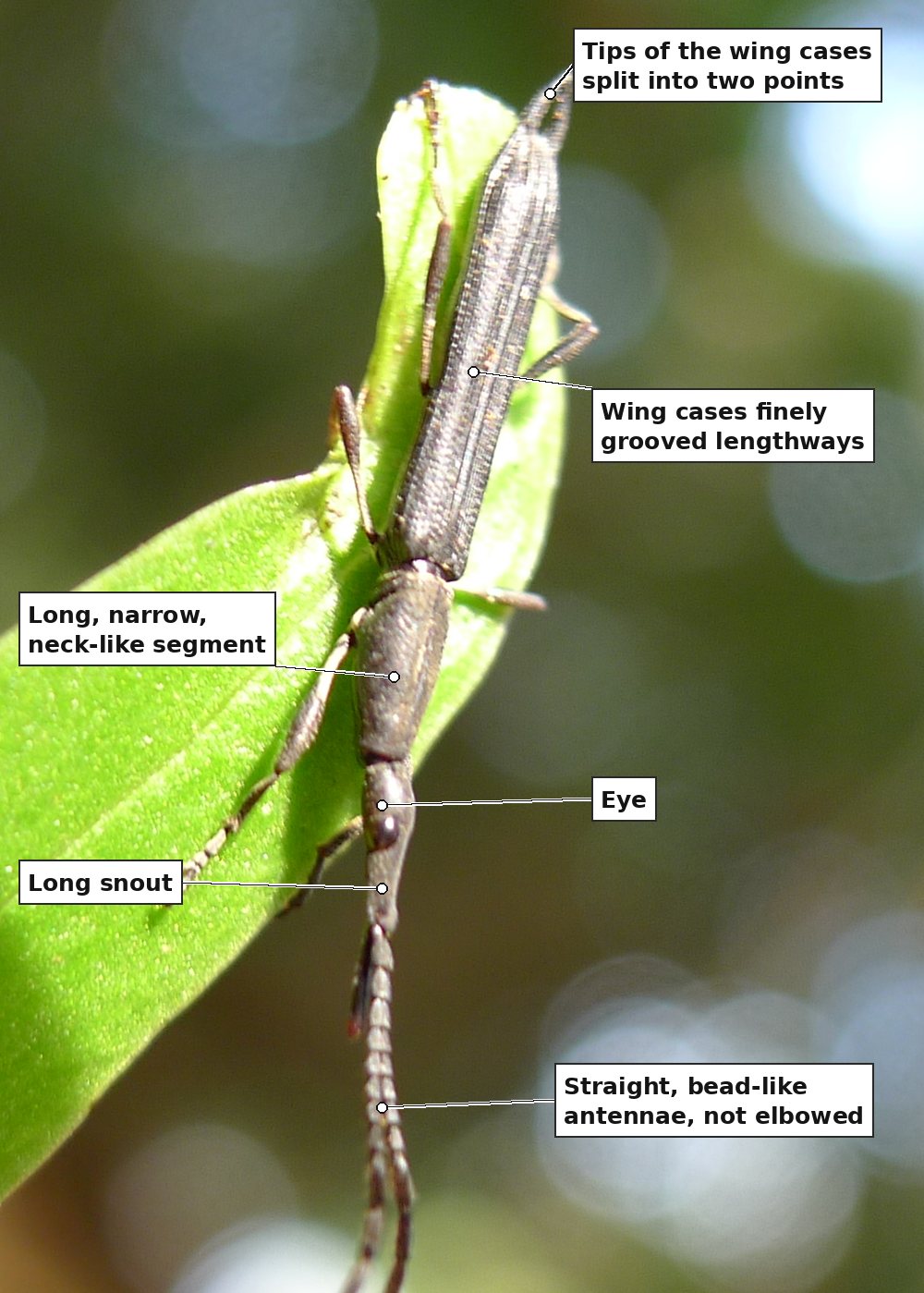
Most weevils are easy to recognise: a snout, and on the snout a pair of antennae that bend in the middle like an elbow. This beetle has the snout but not the elbow. Its antennae run straight out in a line of short, bead-like segments. Put that together with the rest of it:
That combination belongs to the straight-snouted weevils, family Brentidae. They are a mainly tropical family, and many of them live on or under the bark of dead and dying trees, where the long thin body slips easily into cracks and tunnels.
In brentids the snout is a tool. Females use theirs to bore small holes in wood, and lay their eggs in them; the larvae then feed in the wood. In many species the males' snouts are built differently from the females', and males of some species use theirs in contests over mates. Without seeing the underside, this page does not say which sex this one is.
There is nothing in the frame to give a scale, and this camera, a Panasonic DMC-LX5, does not record a focus distance, so this record has no size. The fingertip in the first photograph is not at the same distance from the lens as the beetle, so it cannot be used as a ruler either.
River Esplanade,
Bandar Sri Indah, Tawau, Sabah. Bandar Sri Indah is 17.2 km from Tawau, measured from
the 0 km Tawau landmark, and the esplanade is about another 1 km from its shopping centre. It runs
beside the Babanga Stream, which comes down from the Babanga Forest Reserve. One beetle,
black, not measured, crawling slowly and apparently aimlessly on
the leaf of an unidentified plant. Long snout; straight, bead-like antennae; long narrow neck-like
segment behind the head; wing cases finely grooved, their tips split into two points; legs slender
and dark. Coleoptera: Brentidae — a straight-snouted weevil. Genus and species
not determined. One only. Two frames, 14:49:14 and 14:50:26. The leaf was held
steady for the first; the beetle was not touched and was left where it was.
— iNaturalist observation
403223112
In 2014 the Babanga Stream was still flowing with clear water from the hills, and the strip of forest along the esplanade was full of insects, dragonflies and spiders. By 2026 the stream had dried up, and much of the life along the esplanade has gone with it.
So this beetle is a record of a place as it was. Nobody can go back to that stream bank in 2014 and photograph what lived there, and a dated photograph of an ordinary insect turns out to be one of the few kinds of evidence that survive. The story of the esplanade itself, from its opening in 2007 to its dry stream bed today, is on the River Esplanade page.
About the photographs. Two frames by Wong Fook Yee with a Panasonic DMC-LX5 in
square 1:1 mode, no flash, f/2.0, ISO 100, 5.1 mm, taken at 14:49:14 and 14:50:26 on 7 June 2014 on
the River Esplanade of Bandar Sri Indah, Tawau, Sabah. Both are camera originals that have never
been opened in an editor. For this page they have been reduced, cropped and labelled; nothing has
been sharpened, recoloured, added or removed. The unmarked full frames are on the iNaturalist record
above.
The family characters and the account of how brentids use the snout are from the general
entomological literature. The locality, date, times, behaviour and the drying of the stream are the
photographer's own observations. The plant is not identified. Distances from Tawau on this site are
measured from the 0 km Tawau landmark using Google Maps. All photographs © Wong Fook Yee. Page
written 25 September 2026.