Hunters, parasitoids and pollinators — the wasps photographed for this site, with the
date and place wherever they were recorded
Most people meet wasps as the paper wasps that build nests under the eaves and sting when disturbed.
They are a tiny part of the story. Most wasps live alone, never sting people, and spend their lives
hunting other insects to feed their young, or laying eggs inside them. Some are smaller than a grain
of rice and pollinate fig trees. Wasps belong to the order Hymenoptera, with the bees
and ants: insects with two pairs of wings, the hind pair smaller and hooked to the front pair in
flight, and a narrow waist between the thorax and the abdomen.
Field records
Dated and placed, each on its own page and on iNaturalist.
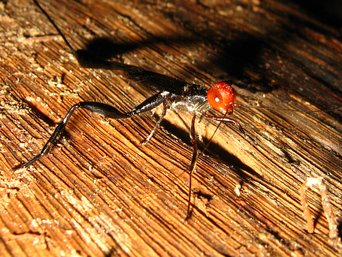
A female crown wasp (Stephanidae) on dead wood beside the George Mais Trail: round
red head on a narrow neck, swollen hind thighs, and an ovipositor longer than her body, used to lay
eggs through wood onto the grubs of wood-boring beetles.
26 June 2016 · 5.38 pm · the Semarak football fields
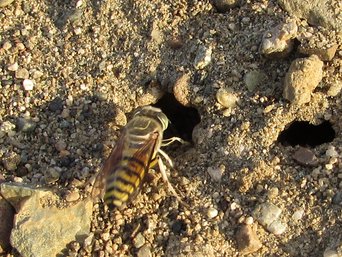
A sand wasp (Bembicini, probably Bembix) filmed digging its burrow in a heap
of building sand in the Tawau River Triangle, and flying off again and again to hunt the flies she
feeds her young on. With a short video.
Crown wasps
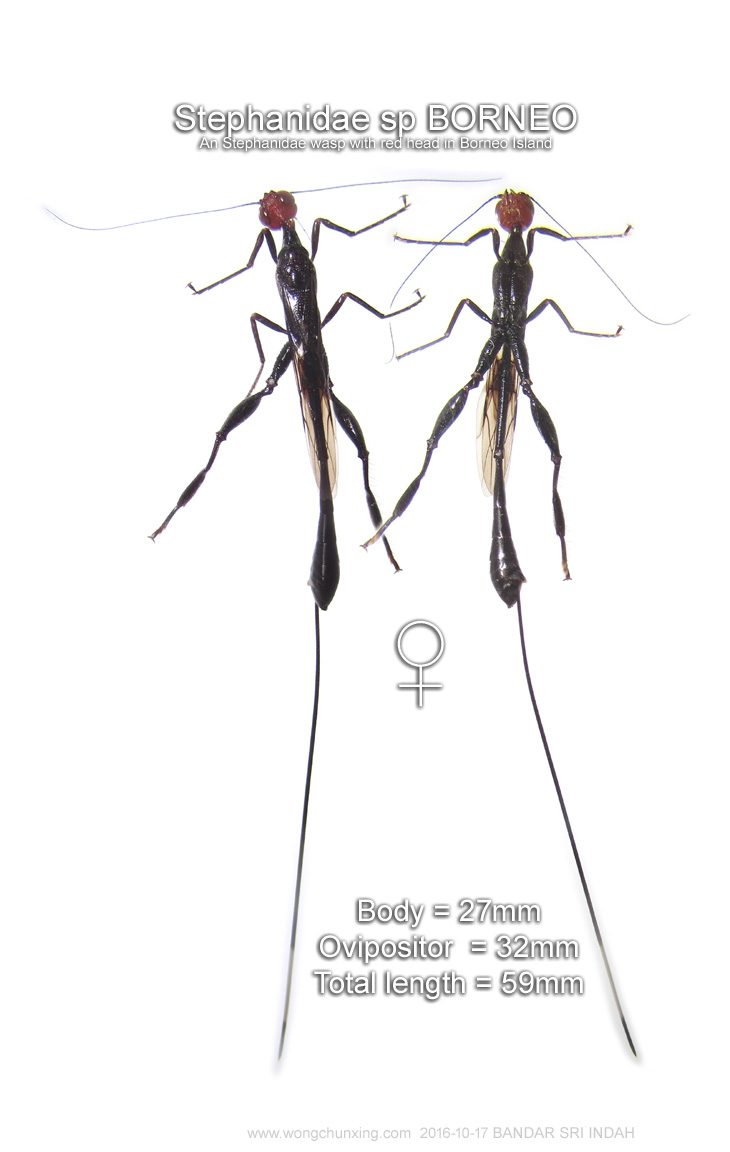
One female crown wasp (Stephanidae), photographed in 2016 from above (left) and from below
(right). Body 27 mm, ovipositor 32 mm, total 59 mm. The date and place where it was found were not
recorded.
The 2016 photograph, taken against white from above and below, shows the build of the family better
than any field photograph: the round red head, the long neck, the swollen hind thighs and the ovipositor,
here 32 mm against a body of 27 mm. The ovipositor is for laying eggs in wood, not for stinging. For a
crown wasp in the field, at work on a log, see the
Bukit Gemok record above.
Other wasp pages
Fig wasps — including
Ceratosolen fusciceps, the 2.25 mm pollinator of Ficus racemosa, and the wasps of four
other fig species.The emerald
cockroach wasp, Ampulex compressa — the jewel wasp that stings a cockroach into
obedience and leads it home by the antenna.An orange wasp from Semporna,
24 January 2013, with an ovipositor as long as its body. Not yet identified.
Waiting for a name
Photographed 31 March 2009, 6.09 pm. Place not recorded.Photographed 11 April 2006, 7.12 am. Place not recorded.
These two older photographs have no notes with them, so they stay here without a name. If the place
can be remembered, they can be posted to iNaturalist and given pages of their own.
Most wasps will not sting you. The solitary hunting and parasitic wasps on this page
are not aggressive and ignore people. Give a wide berth to paper wasp and hornet nests, which their
owners do defend, and never handle a wasp.
About this page. Photographs by Wong Fook Yee. Dates and times are from the
photographs' own camera data. Rewritten 1 October 2026; it replaces an older page of thumbnails.