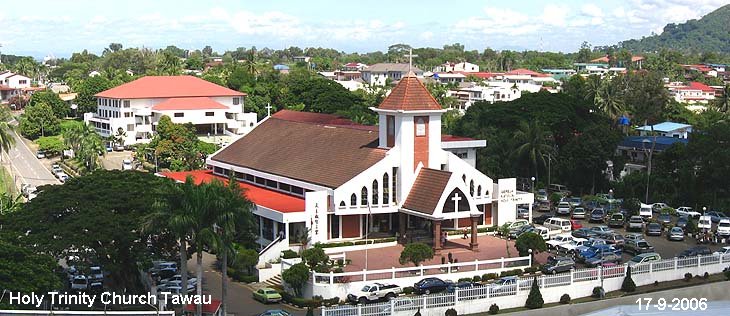

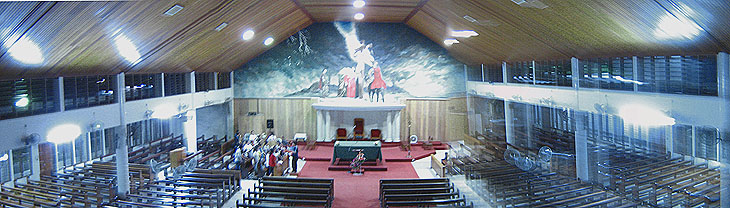
Places of worship in Tawau Division > CHRISTIANITY > CATHOLIC > Holy Trinity Catholic Church >
The History Of Holy Trinity Parish Tawau
1882-1920 The beginnings
To fully appreciate the enormous success of the Catholic Mission in Tawau,
we need to get in touch with the harsh conditions within which it was
established and eventually flourished.
What was Tawau and its immediately surroundings like before the turn of the 20th
century? The first Europeans who arrived described the coastal areas of Borneo
as low-lying, inaccessible, hot and humid, infested with ferocious pirates and
deadly tropical diseases which made any significant settlement impossible. Only
when the hold of the pirates was broken by British naval and land forces did any
settlement begin.
In 1882, a year after the establishment of the North Borneo Chartered Company,
the founder of Tawau, Pengulu Puado, a Bugis trader leading a mixed group of
Bugis, Suluks, Tidongs and Bajaus numbering 25 persons, settled near the mouth
of the Tawau River at Tawau Lama. This group was to plant coconuts, but more
importantly, to help the British gain a foothold on an area where the Dutch had
some presence and influence. A few Chinese quickly followed and even before 1900
there were three Chinese shops owned by Teo Chiews at the settlement. Planting
coconuts, collecting jungle produce and fishing were the basic economic
activities of the small community. At the time of their arrival there was
practically nothing - no road, no permanent building, no civilized amenities of
any kind.
Though theories abound as to the true origin of the name “Tawau” (“Tawao)” it is
likely to be a Tidong word to describe a fishing method in the Tawau River.
Due to the shallow waters at the estuary of the river, the authorities decided to move to Tanjong where there was deeper water for a good wharf. The move to Tanjong started in 1885. A good solid wharf was completed in 1902 and the immediate lands facing it became the focal point of further development. By 1904 there were 20 shops near the seafront mostly owned by Teo Chiews, a few by Hokkiens, Hakkas and Bugis. The natives especially the Bugis owned most of the land in town. Only later in the ensuing decades did they choose to sell their land mostly to Chinese while they themselves moved away to settle down a few kilometers from town. In 1900, there were an estimated 300 people who lived in the new town and of these 41 out of the 60 households receiving water from the Tawau River (some two miles away) were Chinese.
Many of these early settlers came and went. The economy was small and shaky. A
little earlier in 1897, Mr. Hans Petersen had experimented with Tobacco without
much success and gave it up in 1902. There were two British and one Japanese
timber companies. The economy was still based mainly on jungle produce
especially rottan. A small amount of rice and coconuts were also exported.
In the subsequent years however, the economy began to improve. The planting of
rubber began in 1909 though it was only first exported in 1916. The coal-mine at
Silimponpon (“Silimpopon”, “solimpunpun”) was started in 1905 and by 1915 was
producing 60,000 tons of coal annually and employing around 800 workers, a huge
business in those days.
Earlier in 1883 Sandakan Mission had been opened, only to be closed for 2 years
in 1885, and reopened in 1887. Progress was extremely slow. Between 1904 and
1920 priests came and went each doing their bit just to keep the mission going.
It was during this very unsettled period that the first visits to Tawau were
made probably in 1914. Though made an outstation of Sandakan in 1915, these
first visits seemed to be more exploratory in nature. In fact, the new
outstation was not visited for the next five years until Fr. A Stotter was
appointed rector of Sandakan in February 1920.
The few visits in 1914 and 1915 reported that there were very few Catholics in Tawau, which might have contributed to the spontaneous negligence. However, the progressive development of the coal mine at Silimponpon significantly raised the importance of Tawau. Among the huge Chinese and Philippino workforce were many Catholics and naturally the Mission in Sandakan could no longer overlook Tawau. In fact, a number of the workers at the mine had gone there from Sandakan including the two Domingo brothers, Crescencio and Beningo (the father and uncle of our present parishioner Mary Domingo). A good friend of the Domingo’s at Silimponpon was another Catholic, Mr. Peter Voo Kon Hoi (grandfather of our parishioner Richard Voo). Though Silimponpon does not seem to have stayed in the living memory of many a parishioner, it seems to have played a decisive role in the eventual founding of a proper mission station in Tawau.
Before the arrival of Fr. A. Stotter, there were two prominent Tawau
personalities from among the few Catholics in town: Mr. Stephen Taan and Mr.
John Wong.
John Wong, a Hakka from Pao On in China, came to Tawau in 1900. He started
working for the government in 1908 first as a dresser at the hospital and later
became the chief clerk retiring from government service in 1927. He even taught
for a while at Holy Trinity School. In 1913 when the Hakkas and had just started
moving to the Sin On area in Tawau Town, he was given 30 acres of land there by
the government to plant coconuts. Being a government official and a part time
farmer-merchant he was often asked to help settle community conflicts which were
rife especially between the Teo Chiew, Hakka, Cantonese clans.
Stephen Tann, a Teo Chiew married to Mary Rose Wong a Hakka, first worked as a
customs clerk in Sandakan and later was transferred to Tawau around 1911. The
Tanns first lived with Mr. John Wong at the government quarters. Soon Stephen
resigned from government service and bought 175 acres of land at Pasir Puteh
where he planted coconuts and rubber. He also ran a liquor store from his home
at Sin On and owned the water supply distribution since 1913. Speaking English
and a prominent businessman in town he was the unofficial Chinese community
leader.
1920-1935 Fr. A. Stotter MHM
The true founder of Tawau Catholic Mission was Fr. A. Stotter, that
remarkable rector of St. Mary’s, Sandakan. We know little about this Mill Hill
Missionary from the Tyrol. However, he seemed to be an organized and effective
leader, a man of vision, someone who knew his strengths and limits, and had a
great capacity for work. He was appointed before the turn of the century to
Sarawak and opened a mission station at Cut, a Melanau area, in 1899. Later he
opened the station at Dalat in 1906. He also founded the Kuala Belait mission in
Brunei a few years later. Before that, in 1904, he published the first Iban
prayer book “Surat Orang Christian” in Brixen (Austria). His skill as a
negotiator was also put to great use. Around 1922 a serious row broke out
between the Rajah, the Anglican Bishop and the Roman Catholic Mission at Sari
near Kapit. It was Fr. Stotter who finally brought the long misunderstanding to
a close. And soon after Mgr. Wacther was appointed Prefect in 1927 and the
division of the Sarawak and British North Borneo Mission became a reality, Fr.
Stotter, who had in the meantime been appointed to Sandakan, was sent to
negotiate a financial settlement with Kuching. In that negotiation he secured
the vast Labuan estate and a cash of $60,000.00 for the North Borneo Mission.
Already in 1923, partly realizing that the fathers in Sandakan could no longer
cope with the volume of work, partly understanding the desperate need to have
professionals heading the school in Sandakan, he contacted the La Salle brothers
to take over the school but unfortunately nothing came of it. Busy with school
and mission work among the increasing number of Catholics in Sandakan, he still
managed to visit the outstations regularly. He also founded the Kudat mision.
The head station at Sandakan and her outstations (Tawau, Marudu Bay and Kudat),
flourished under his pastoral care. We do not know how frequently he visited
Tawau or how long he stayed at each of those visits between 1920 and 1922.
However, the fruit of his initial work was spectacular considering that it all
happened within a short period of two years (February 1920 - February 1922) when
he was rector of Sandakan and residing there, and attending to Tawau only
through visits and … by boat.
Writing the 1919-1920 annual report for Sandakan on the 14th of July 1920, Fr.
Sotter remarked: “The new Rector of Sandakan, who writes this report, has only
been about five months in this part of the country, & is consequently hardly
fully qualified, to give a complete report of the state of his mission…Tawau &
Lahad-Datu, on the East Coast, were visited by me. No priest had been there even
on a visit for five years or more. In both places I found some scattered
Catholics who availed themselves of my visit to go to the Sacraments. – But of
the two places Tawau is by far the better. It is a place, where a mission ought
to have been started long ago, & where – if I had any means at my disposal – I
should start at once with school & Chinese catechists. If I can procure the
necessary means, I shall take it as duty bound to open Tawau, where we should
probably meet with real success. But any Father to work amongst these people
with fruit must learn Chinese & not try to convert natives with the English
language.”
Within the first two years, he obtained at least two pieces of land. The first, measuring 1:1:33 acre, was bought from a native for $340.00 in 1921. The second piece, N.T. No.408, measuring 2 acres, was bought in 1922 from a certain Ambang bin Tawai for $330.00. Again in 1923 he proposed buying a portion, 1:1:38 acres, of the N.T. No. 414 from a native. He also successfully applied to the government and obtained remission of all rent on the lands.
A good leader Fr Stotter delegated the responsibility of the mission to lay
people. The success of this collaboration was proven by the astonishing success
of having collected a total amount of $2,000 (not a small amount in those days)
before April 1921 for the construction of the first permanent building which we
know eventually incurred $2,500 over and above what was raised. That first
double-storey building measuring 40 by 20 feet, serving as the chapel, school
and priest quarter, was completed and blessed on the 13th February 1922. Holy
Trinity school which had an English and a Chinese department, was completely run
by the lay people until 1937 when Fr. Walsh became the first priest-principal.
The first headmaster of the school was a certain Mr. Stephen Sim Kee Hong.
Except for the name we know nothing about him. Mr. Thomas Lee Nyen Tshiang
(Chiang), Bishop John Lee’s father, was the first head-teacher for the Chinese
department. Sent in 1922 from Sandakan, he helped the Tawau mission and school
for about a year.
Referring to Tawau in the annual report of 1920-1921, Fr. Stotter entered the
following remarks on the 21st July 1921:
1) “Having now been in Sandakan for one year & five months, I am in a better
position to give a Report of the state of this mission than I was last year …
4) With regard to Chinese Catechists, I have employed one regularly throughout
the year in Sandakan and have lately obtained the services of a second one, who
has yet to prove his fitness for the task. The importance of good catechists
cannot be exaggerated, & I am trying hard to obtain more catechists for the work
in Tawao & Kudat. As the mission here has had no catechists for years before my
arrive in Sandakan, it is all uphill work for them and will take some time,
before good results can be shown.
5) I have regularly visited Tawao & Lahad-Dato, & have been once also to the
coal-mines in Silimpopon. Wherever I go, I meet with the best reception & can do
a fair amount of good. In Tawao the Catholics & heathens have generously
contributed towards the building of Church & School. 1 piece of land has been
acquired there, & the School-building with the Sanctuary of a little Church
ought to be soon a reality, though in sequence of my occupations elsewhere the
building operations are somewhat delayed. Still I have every reason to hope,
that before many months are over, the work of the school with a native teacher &
a Chinese Catechist will be a going concern there.”
A year later, on the 22nd August 1922 Fr. Stotter wrote:
“The outstations are very promising & have been regularly visited by me during the year under review. – Since February 13th 1922. our Tawau-schools, with Mr. Stephen Kee Hong as headmaster & teacher of the English Department, & an efficient Chinese as teacher of the Chinese department & Catechist among the Chinese planters, have been carried on with real success & have some sixty pupils in attendance as day-scholars only so far, although the accommodation for boarders is quite ready. – The actual number of pupils at Tawau is: English Depart: 30 boys & 2 girls; Chinese Dept. 22 boys & 11 girls, or 65 in all, a very encouraging number indeed in five months. Beside in Tawau-school nearly all pupils pay some School-fees monthly, & this with some local subscriptions helps to make the schools there nearly self-supporting. But the buildings there have cost me nearly $2,500 over & above the local subscriptions towards the building fund.”
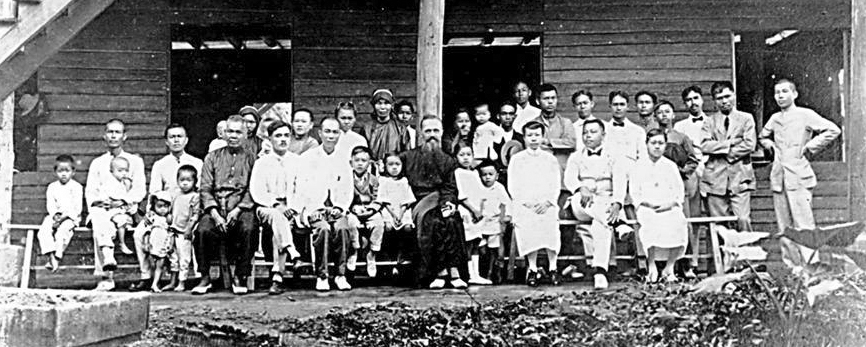
Who were the Catholics in 1922?
The above photo taken on the 13th February 1922 at the opening of the first building is most revealing. Considering that the occasion was a most significant event for the Catholic community and even for Tawau at large, one would expect that most of the Catholics would be present. We count 26 adults and 10 children. The following adults have been positively identified: Fr. Stotter, Mr and Mrs Stephen Tann and daughter, Mr. Thomas Lee Nyen Chiang, Mr Crescencio Domingo, Mr Beningo Domingo, Mr. Voo Kon Hoi, and John Wong…
Why was the mission and school named “Holy Trinity”? The name was not common or popular among Catholic missionaries in Borneo at that time. Could it just be possible that there were three tiny hills in or around the piece of land on which Fr. Stotter had intended to set up the first building? Someone mentioned about the “Trinity Hills” in some writing. Was it called so because it had already been christened with that name, or was it a straight forward description of three hills within the mission land?
Within the tight schedule of his visits, Fr. Stotter also attended to the
flock both in Tawau and in Silimponpon. According to our Baptismal records,
which are incomplete, since these records were destroyed during the Second World
War and re-entered after the war with information supplied by witnesses, Fr
Stotter baptized 4 or perhaps 5 persons:
Alice Tann on the 19th August 1920,
Annie Tann on the 20th of February 1925, both at Tawau and are daughters of
Stephen Tann and Mary Rose Wong;
Agnes Wong Nyet Ying (born on 24.8.27), daughter of John Wong and Mary Shim Ah
Tam in 1927 at Tawau (the minister is not mentioned but it could only be Fr.
Stotter);
Gertrude Domingo on the 26th of January 1926,
Adelaide Domingo on the 9th May 1930, both at Silimponpon and daughters of Mr.
Crescencio and Amelia Domingo.
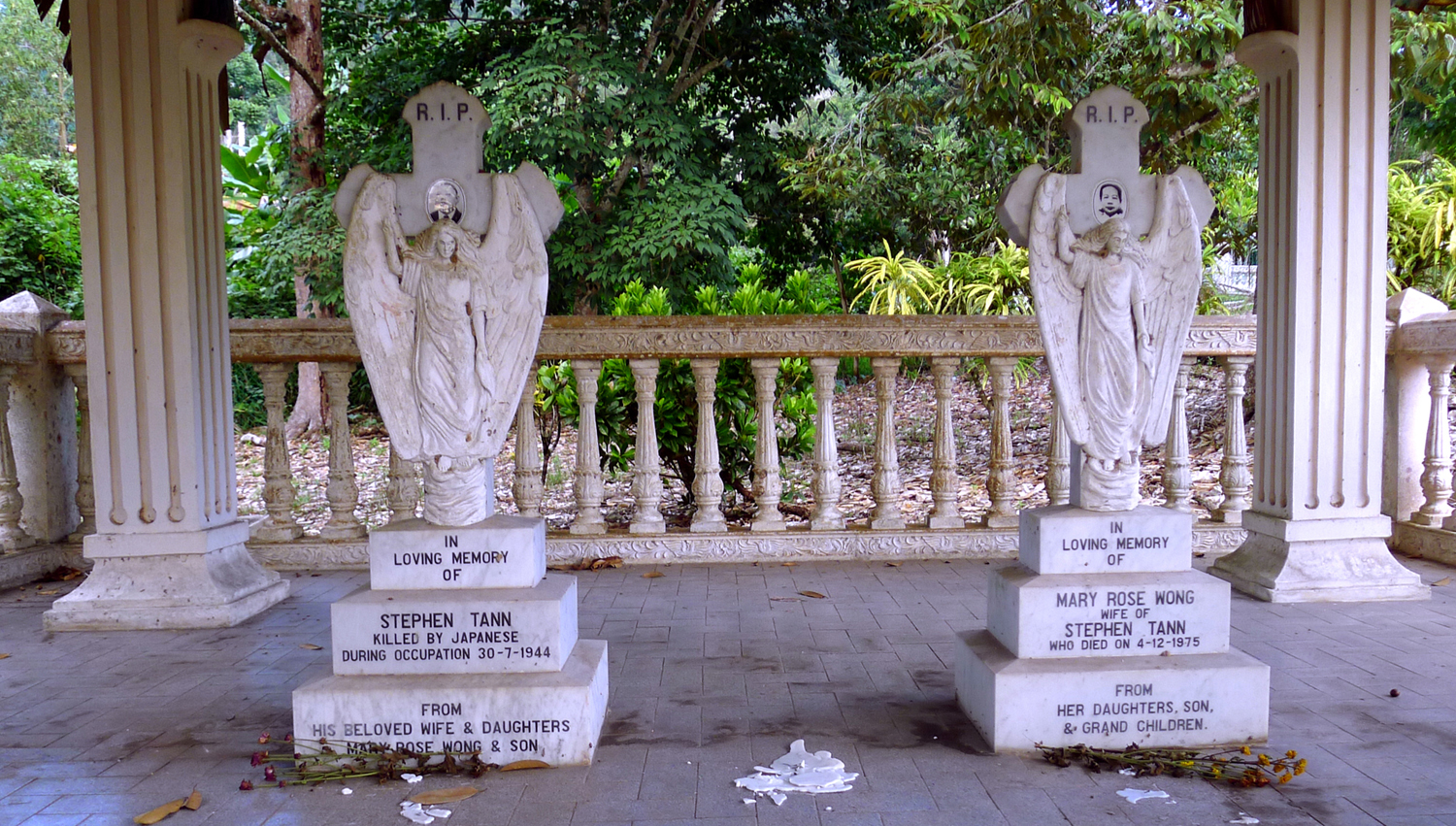
Memorial ground of Stephen Tann Kau Sai
and Mary Rose Wong in Tawau (Photo taken in 2017)
RELATED TOPICS
|
GO FURTHER ANIMALS
RELIGIONS HISTORY & CULTURE LANDSCAPING |
|
|
Places of worship in Tawau Division |