
Family Uloboridae 嫵蛛科
Genus Miagrammopes 長嫵蛛屬
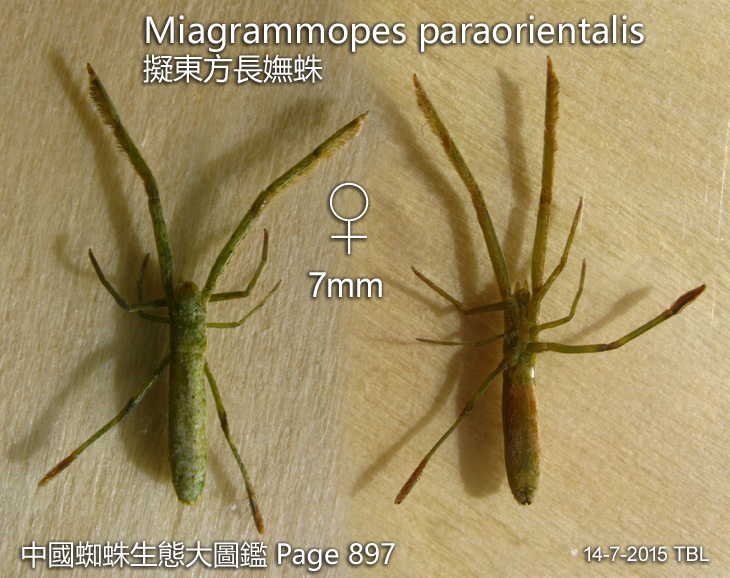
Miagrammopes paraorientalis
擬東方長嫵蛛
Last Updated on Saturday, 31 October, 2020 02:44:01 AM
Spiders of Borneo > Web Spider Families > Family Uloboridae嫵蛛科 > Genus Miagrammopes 長嫵蛛屬 > Miagrammopes paraorientalis 擬東方長嫵蛛
Family Uloboridae 嫵蛛科
Genus Miagrammopes 長嫵蛛屬
Miagrammopes paraorientalis
擬東方長嫵蛛
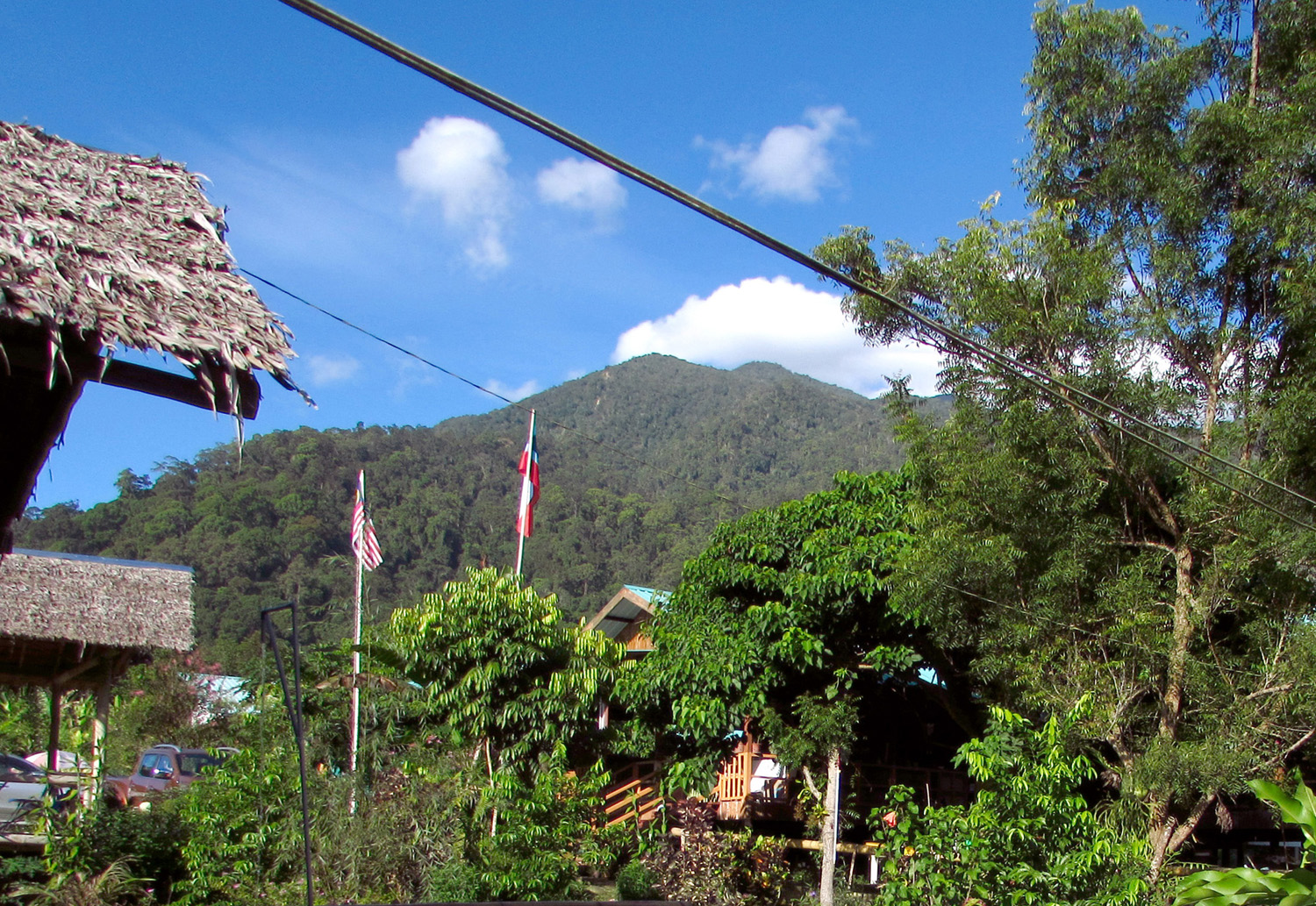
Female ♀5mm 2018-12-03 PORING VACATION LODGE
中國蜘蛛生態大圖鑑 Page 897

Uloboridae is the
only spider family
without venom. The
Miagrammopinae are
found mostly in
well-forested areas
and have only 4
eyes.

Ventral View of abdomen of a female Miagrammopes paraorientalis 擬東方長嫵蛛
Calamistrum - is a row of specialized leg bristles used to
comb out fine bands of silk. It is through the combined action of the cribellum
and calamistrum that the bluish silk characteristic of the Uloborids is
produced. The calamistrum is found on the upper margin of the metatarsus of the
hind legs. Each bristle of the calamistrum is serrated on one side and smooth on
the other.
Cribellum - is a flat plate like silk spinning organ. The
cribellum consists of one or more plates covered with thousands of tiny spigots.
Cribellum produce a band of fine silks. This Cribellate silk (hackled silk) is
feathery and rather fuzzy.
Spinneret - is a cone shaped silk-spinning organ. Spinnerets produce a single
silk thread.

Spinnerets and Cribellum
Close-up of four spinnerets, plus at the top, the cribellum.
The cribellum is an additional silk producing organ of the crebulate spiders.
The presence or absence of a cribellum is used to classify araneomorph spiders
into 2 categories:
1- the cribellate spiders
2- ecribellate (not cribellate) spiders
The distinction between presence and absence of cribellum is used to study
evolutionary relationships.
More about Cribellate
Spiders and Ecribellate Spiders.

Miagrammopes paraorientalis at rest
The first pair of legs are very much larger and longer than the others.
When this spider is at rest, all pairs of legs are pressed together or against
the sides of the spider.
The very thin and long body with first pair of legs extended forwards are
characteristic of this genus.
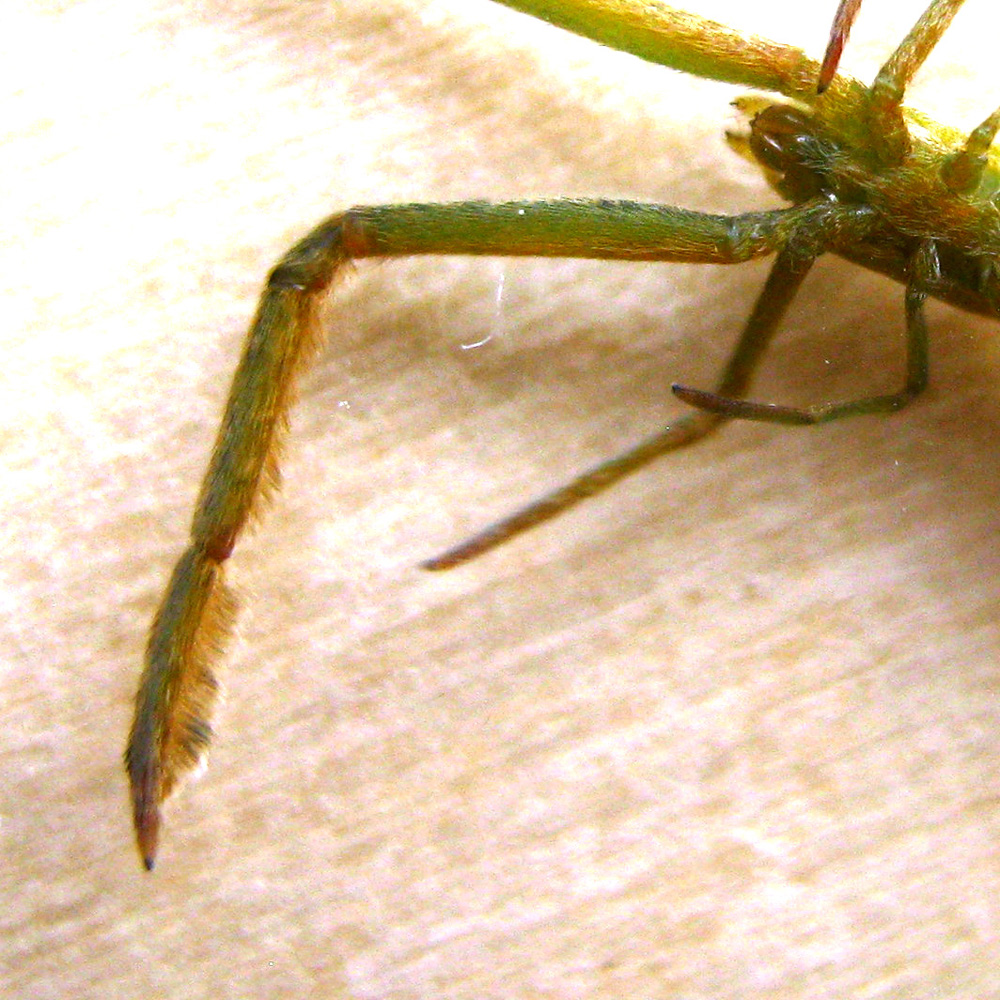
Bush on the underside of the first pair of legs
A distinctive brush on the underside of the first pair of legs but this is not a
scopula or claw tuft as is found on some other spiders.
The front legs of the Uloborids are long, often longer than the entire length of
the body.
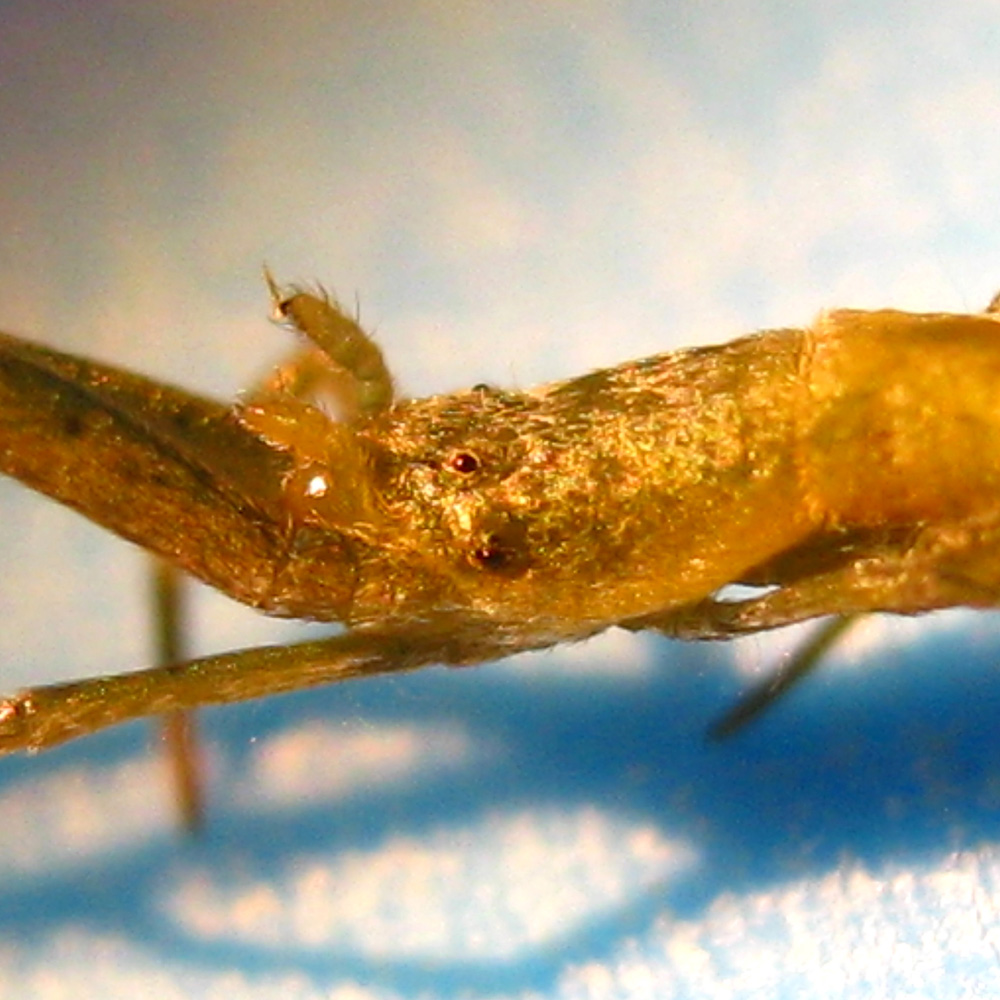
Flat Carapace
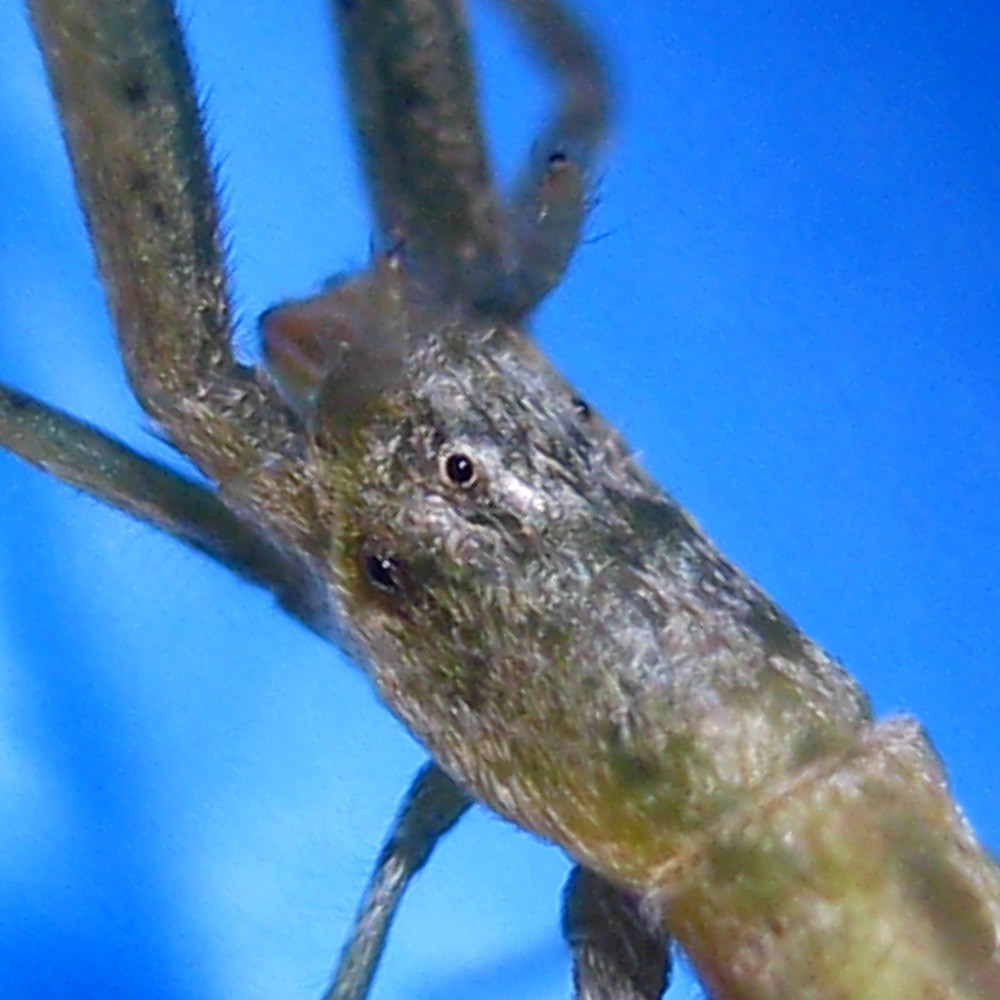
Spiders of the genus Miagrammopes have a very flat carapace
Four Eyes Spider
Diagnostically important feature of this Miagrammopes species is the presence of
only a single row of 4 eyes running across the front of the spider.
Some said the other first row may be poorly developed, thus giving the
impression that they have only four eyes.
Uloboridae is the only spider family without venom. The Miagrammopinae are
found mostly in well-forested areas and have only 4 eyes.
Miagrammopes species does not build a web. They suspended on a single strand of
silk and match itself in colour with the grass and twig making it difficult to
see.
This spider has an unusual way of catching insects. They do not spin orb-webs.
Instead, they build a single-line snare which is fastened to a twig on one end
and held taut by the first pair of legs at the other end. When an insect lands
and hits the thread, the spider releases the line which springs back and
entangles the insect.
They are usually very small, widespread, diverse and common, especially around
houses, but they can also be amongst the most numerous spiders in foliage, where
they spin small orb webs. They have air sensitive hairs, a silk producing plate
and a calamistrum, which is a comb for reefing out this silk.
The family Uloboridae is sub divided in two subfamilies:
1- Subfamily Uloborinae : build messy webs.
2- Subfamily Miagrammopinae : whose webs are reduced to a single strand.
These are cribellate spiders, meaning they have a cribellum to produce woolly
silk which they comb out with the help of the calimustrum.
Calamistrum is a row of specialized leg bristles used to comb out fine bands of
silk. It is only found on cribellate spiders that possess the spinning organ
cribellum, not spinnerate
Cribellum is a silk spinning organ found in certain spiders. Unlike normal
spinnerets, the cribellum consists of one or more plates covered in thousands of
tiny spigots.
The calamistrum and cribellum are used to form the hackled bands of silk which
are characteristic of the webs of these spiders.
Poring Vacation Lodge
RELATED TOPICS
|
|
Common Spiders of Borneo |