| ENGLISH | CHINESE | MALAY |
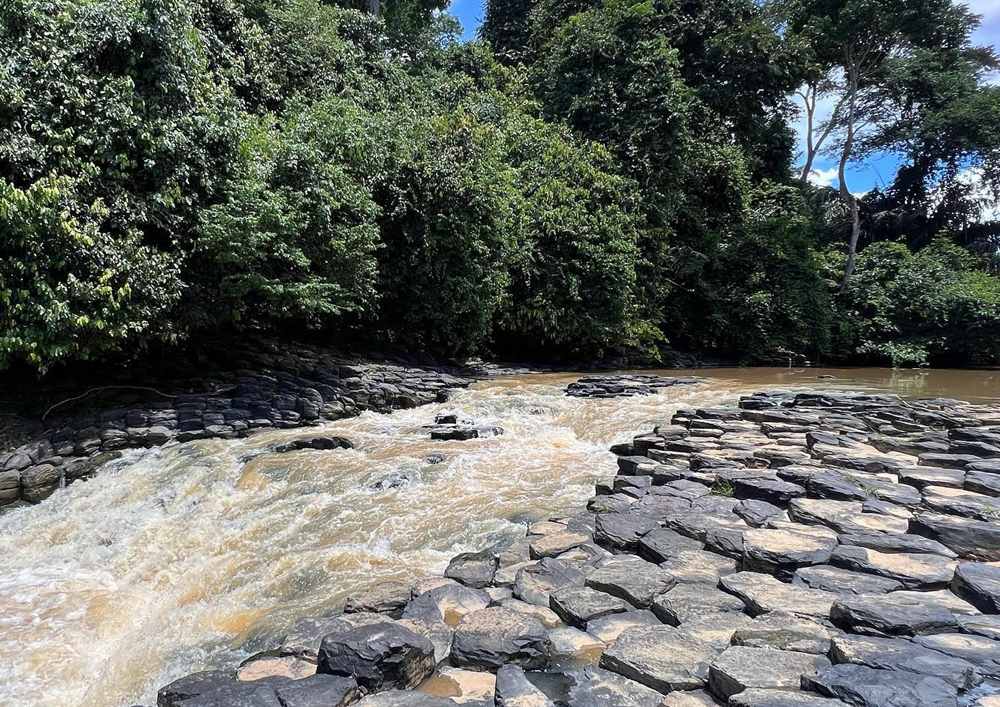
Columnar Basalt Formations at Balung Cocos
A rare geological record of Tawau’s volcanic past
Hidden within the landscape near Balung Cocos, south of Tawau, stands an unusual and striking geological feature: columnar basalt formations. These stone columns, formed long before human settlement in the area, preserve a frozen moment from a time when volcanic activity shaped much of Tawau’s land.
Unlike ordinary rock outcrops, columnar basalt forms in a distinctive pattern of tall, closely packed columns, often with polygonal shapes. Their orderly appearance is not the result of human design or erosion, but of molten lava cooling and contracting over a long period of time.
In Sabah, exposed columnar basalt formations are rare. The presence of such structures at Balung Cocos provides valuable evidence of Tawau’s ancient volcanic history, extending our understanding beyond well-known volcanic areas such as Tawau Hills Park.
Location and Geological Setting
Balung Cocos lies inland from Tawau town, within a landscape shaped by ancient volcanic processes. Today, the area is largely low-lying, with gently undulating terrain, streams, and cultivated land, offering few obvious signs of the powerful geological forces that once operated here.
Beneath the surface, however, the rocks tell a different story. The basalt columns at Balung Cocos are part of a wider volcanic system associated with Tawau’s past eruptions. These events produced lava flows that spread across the region, cooling slowly and solidifying into volcanic rock.
The exposure of columnar basalt in this location is likely the result of natural erosion over time, gradually revealing the internal structure of an ancient lava flow. What appears today as a quiet rural landscape once lay within an active volcanic environment.
What Is Columnar Basalt?
Basalt is a dark, fine-grained volcanic rock formed when molten lava cools at or near the Earth’s surface. When certain basaltic lava flows cool slowly and evenly, they can develop a remarkable internal pattern known as columnar jointing.
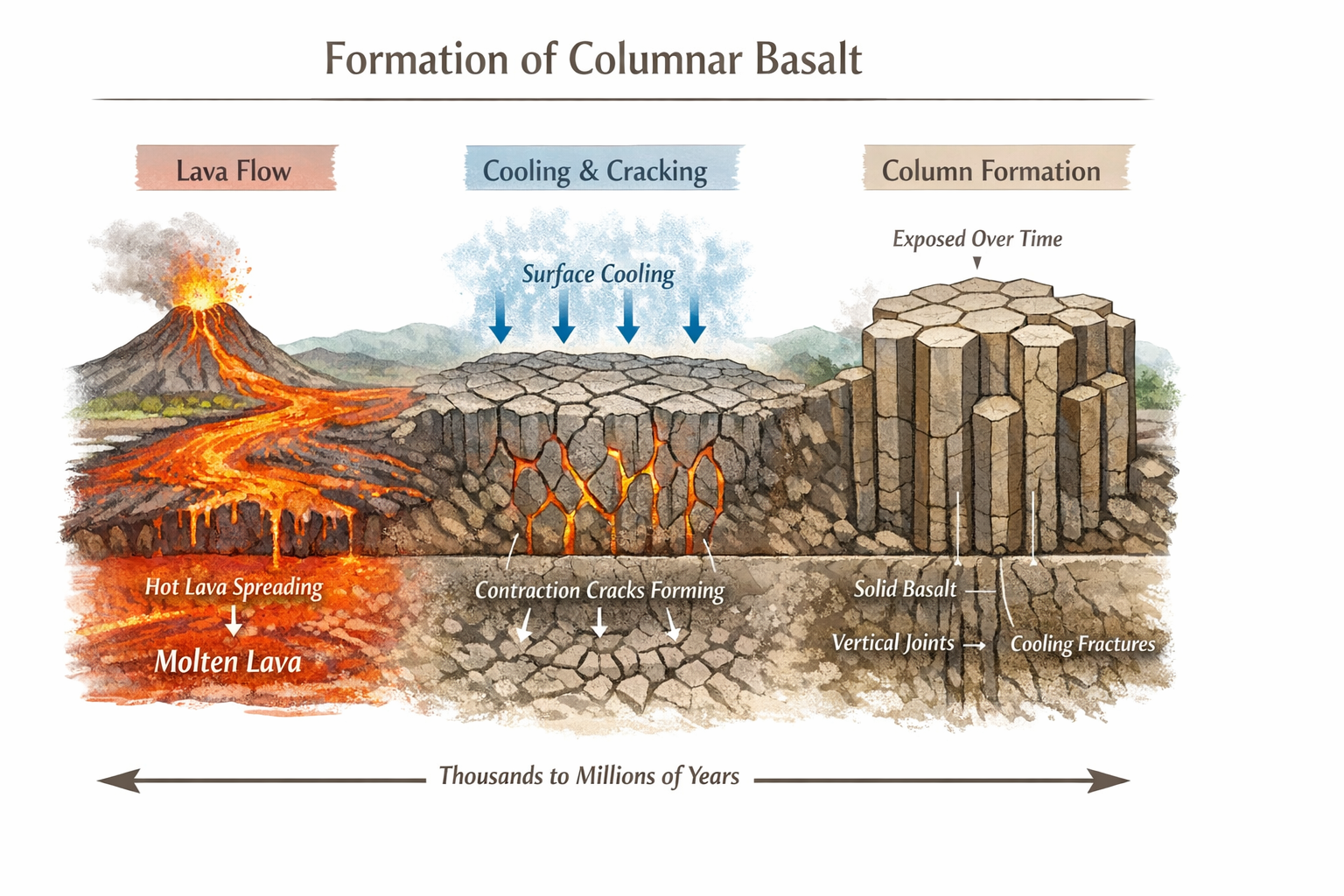
As the lava cools, it shrinks. This contraction causes cracks to form, spreading through the rock in a regular pattern. Over time, these cracks divide the solidifying lava into long, vertical columns. The columns often have six sides, though shapes with five or seven sides are also common.
The columns usually grow at right angles to the cooling surface. This means they can stand upright, lean at angles, or even form curved patterns, depending on how the lava cooled. Importantly, the column shapes form during cooling, not as a result of later erosion or weathering.
Formation of the Columnar Basalt at Balung Cocos
The columnar basalt formations at Balung Cocos were created during a period of volcanic activity that affected the wider Tawau region. At that time, molten lava flowed across the land surface or accumulated in shallow volcanic channels. As this lava began to cool, it slowly lost heat to the surrounding air and ground.
Cooling did not occur evenly throughout the lava flow. The outer surfaces cooled first, while the interior remained hot for longer. As the lava contracted, stress built up within the solidifying rock, causing it to fracture. These fractures spread inward from the cooling surfaces, dividing the basalt into long, column-like segments.
The relatively regular shape of the columns at Balung Cocos suggests a slow and stable cooling process, which allowed the cracks to develop in an organised pattern. Over long periods of time, weathering and erosion removed the softer surrounding material, gradually exposing the harder basalt columns visible today.
Geological Significance Within Sabah
Within Sabah and much of Borneo, visible columnar basalt formations are uncommon. Dense vegetation, deep weathering, and thick soil cover often hide volcanic rock structures, making well-exposed examples particularly valuable for scientific study and education.
The Balung Cocos columns provide clear physical evidence that lava flows once extended beyond the central volcanic areas of Tawau. They help geologists better understand the extent of ancient volcanic activity, the movement and thickness of lava flows, and the conditions under which these lavas cooled.
As a geological feature, the site contributes to Sabah’s geoheritage, representing natural processes that operated over thousands to millions of years. Such formations are important not only for research, but also for increasing public awareness of the region’s deep geological history.
Relationship to Tawau Hills Park and Regional Volcanism
Tawau Hills Park is widely recognised as the most prominent reminder of Tawau’s volcanic past, with features such as volcanic hills, altered rocks, and geothermal activity including hot springs.
The columnar basalt at Balung Cocos complements these features by providing structural evidence of lava cooling outside the park boundary. While Tawau Hills Park preserves volcanic landscapes and geothermal features, Balung Cocos reveals what happened after lava was emplaced, showing how it cooled, fractured, and solidified.
Together, these sites tell a more complete story of regional volcanism.
They demonstrate that ancient volcanic activity in the Tawau area was not
to a single location,
but shaped a broader landscape that continues to influence the region today.
Landscape, Soil, and Ecological Connections
Basaltic rock plays an important role in shaping the landscapes and ecosystems that develop above it. Over long periods of time, basalt weathers into mineral-rich soils that can support diverse plant growth. These soils often retain moisture well and contribute to the fertility of surrounding land.
In areas such as Balung Cocos, the interaction between volcanic rock, water, and vegetation has helped form productive landscapes used for both natural forest regeneration and agriculture. Streams flowing through basalt-rich ground may also be influenced by the rock’s structure, affecting drainage patterns and groundwater movement.
Although the columnar basalt itself appears lifeless, it forms the foundation upon which living ecosystems develop. The geology beneath the surface quietly supports the plants, animals, and human communities that depend on the land today.
Conservation and Geoheritage Value
Geological features such as the columnar basalt at Balung Cocos are non-renewable natural resources. Once damaged or removed, they cannot be replaced. Despite their scientific and educational importance, geological sites often receive less protection than biological habitats.
The Balung Cocos formations represent a valuable example of Sabah’s geological heritage. Preserving such sites helps maintain physical evidence of the Earth’s history and ensures that future generations can learn directly from natural rock records rather than relying solely on textbooks.
Responsible awareness, careful documentation, and respect for the site are essential. Columnar basalt formations should be viewed as natural classrooms rather than recreational or extractive resources.
Educational Importance
The columnar basalt at Balung Cocos provides a clear and accessible example of volcanic processes that are often difficult to visualise. For students and educators, the site offers an opportunity to observe how molten lava cools, fractures, and solidifies into rock.
Such formations support learning in Earth science, geography, and environmental studies by linking abstract concepts to real features found within the Tawau region. They also encourage greater appreciation of local landscapes and the deep time scales over which the Earth changes.
By presenting geological features in a clear and contextual way, sites like Balung Cocos help foster environmental awareness and scientific curiosity within the community.
A Frozen Chapter of Tawau’s Geological History
The columnar basalt formations at Balung Cocos preserve a rare and remarkable record of Tawau’s volcanic past. Formed as molten lava cooled and contracted, these stone columns reveal processes that occurred long before the modern landscape emerged.
Together with volcanic features found in Tawau Hills Park and surrounding areas, the Balung Cocos basalt helps complete the story of regional volcanism. It reminds us that the land beneath Tawau has been shaped by powerful natural forces operating over immense spans of time.
Understanding and respecting such geological features allows us to better appreciate the foundations upon which today’s ecosystems and communities are built.
Projects at the Columnar Basalt of Kg Balung Cocos are primarily focused on
geo-heritage recognition, conservation, and community involvement. While the
site is managed locally by the Kg Balung Cocos community on private land,
various organizations provide technical and advocacy support.
NGOs and Active Organizations
The following groups are involved in initiatives related to the site:
Geological Society of Malaysia (GSM): Conducts field visits and technical talks
to document and promote the site's geological significance as Malaysia's only
confirmed columnar basalt formation.
PACOS Trust: A community-based organization that supports indigenous communities
in Sabah; they are often cited as potential partners for community-led
conservation and empowerment initiatives at such sites.
Sabah Tourism Board (STB): Government
agency STB
works with local stakeholders to promote the site as a key geo-tourism
destination in eastern Sabah.
University Groups (e.g., UMS): Academic outreach programs use the site as an
"outdoor classroom" for earth science and university geology field studies,
contributing to ongoing scientific documentation.
Key Achievements
Current and ongoing achievements resulting from these collaborations include:
1-
Geo-heritage Awareness: Successful promotion of the site has led to its
recognition as a "geological masterpiece" and a nationally unique heritage
asset.
2-
Site Infrastructure Development: Community efforts, supported by broader tourism
frameworks, have established basic visitor facilities including staircases,
toilets, and managed access points to protect the formations from unmanaged foot
traffic.
3-
Cultural Preservation: Integration of local Cocos Malay heritage (referring to
the site as Batu Bersusun or Giram Nek Legek) into the visitor experience,
ensuring community stewardship.
4-
Sustainable Management Model: Implementation of a low-impact tourism model where
a small entrance fee (RM3–RM6) is collected by the local community to maintain
the site’s integrity.
Notable individuals who have contributed to the research, documentation, and promotion of the Columnar Basalt formations at Balung Cocos include:
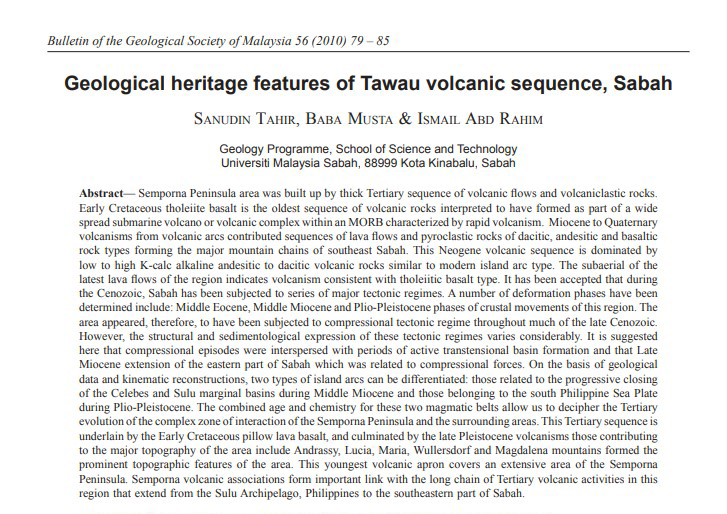
Sanudin Tahir, Baba Musta, and Ismail Abd Rahim:
Geologists who have published
research on the geological heritage features of the Tawau volcanic sequence,
which includes the Balung Cocos formations.

Felix Tongkul
A prominent geologist from Universiti Malaysia Sabah (UMS) known
for his extensive work on Sabah's volcanism and geological heritage.
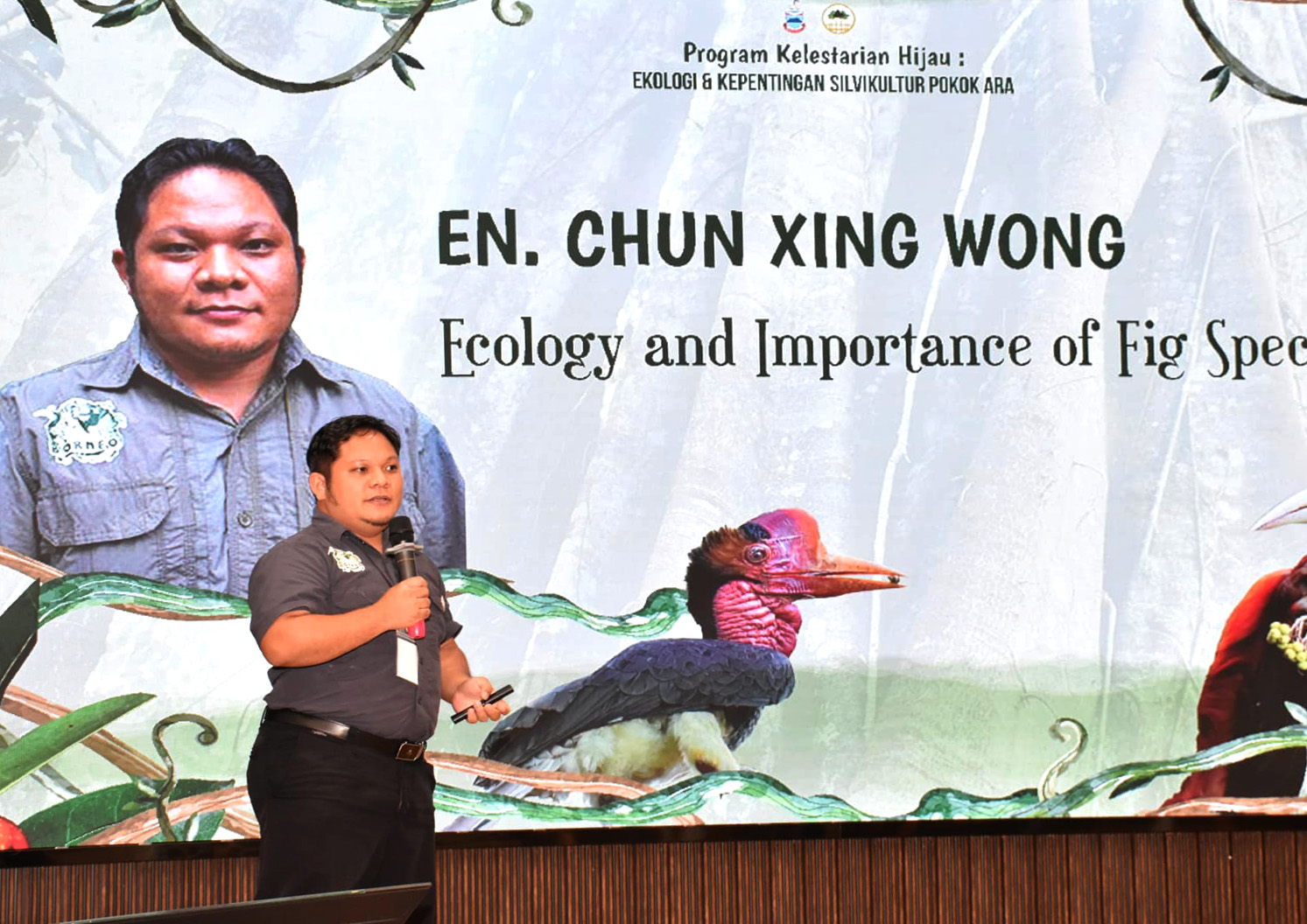
Chun Xing Wong Claveria:
A photographer credited by the Sabah Tourism Board for
capturing high-quality images of the site, which are used to promote it as a
"geological masterpiece".
Community Advocates
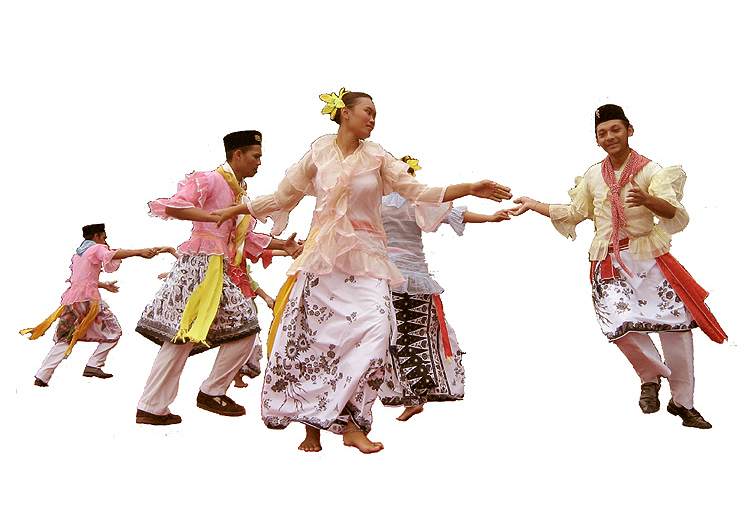
Cocos Malay Community of Kg Balung Cocos:
Local residents who serve as the
primary stewards of the site. They maintain traditional knowledge of the area,
known locally as Batu Bersusun or Giram Nek Legek, and are integral to the
sustainable management of geo-heritage tourism.