
SMK ST. PATRICK
聖 巴 特 中 學
Piti Surat. 124, 91007 Tawau, Malaysia Tel:089-712043
Assistant to Principal : Mr. Lee 089-712043
Sekolah Menengah Kebangsaan ST. Patrick Tawau
SCHOOL EDUCATION IN TAWAU > SMK ST. PATRICK
SMK ST. PATRICK
聖 巴 特 中 學
Piti Surat. 124, 91007 Tawau, Malaysia Tel:089-712043
Assistant to Principal : Mr. Lee 089-712043
Sekolah Menengah Kebangsaan ST. Patrick Tawau
The motto of the school, SERVICE RENEGARE (To serve is to rule), has always been
the guiding principle that paved the way for the progress and advancement of the
school.

St. Patrick's Secondary School was started by Rev. W. Newmarch in 1954 in the
St. Patrick's Church compound with only 90 students. In 1964, the secondary was
moved to Jalan Kuhara with 930 students. In 2004 the number of students rose to
a total of 1424 in 38 classes from bridge classes to Form 5.
From 1917 to 1965, the school was known as 'St Patrick's School'. Since 1966,
that school has become two, a primary and a secondary school.
The school gone through different stages in the development under the leadership
of different principals. Each one brought with them their unique strengths and
vision which they imparted to the school.
Since 1917, St Patrick's has continued to play an important role in the field of
education not only in Tawau but at the state and national level. Its students
have demonstrated a 'leadership through service' role as church administrators,
politicians, civil servants, business people and professionals.
From : A History of the origin and growth of St. Patrick's Secondary School,
Tawau 1st Edition July 2007
AUSTRALIAN MISSIONARIES, 1954 TO 1959
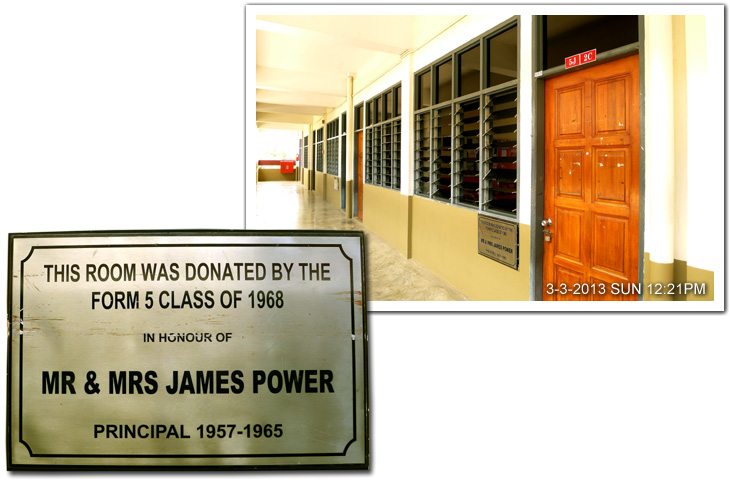
MR. JAMES POWER STARTS HIS ACCOUNT OF THIS PERIOD with the arrival of the Rev.
Walter and Mrs. Camille Newmarch : The Newmarches were sent by the Church
Missionary Society (CMS) of Australia to Tawau in 1954. Mr. Newmarch had
matriculated before serving in Borneo at Balikpapan and Tarakan at the end of
the Second World War. The experience that changed the course of his life in
Easter 1945 was when some Balikpapan people asked what Easter was about and he
had the chance to explain.
Their need made him decide to come back and work for God in Borneo if he could. After studying for the Licentiate of Theology at Moore Theological College Sydney and his Bachelor of Arts degree at Sydney University, he realized this dream. He became the school principal, along with being priest-in-charge of Tawau parish, and Mr. David Wong worked as headmaster of the Chinese Middle School.
In
1955, an English secondary 1 class was started and in 1956 secondary 2. The
school badge was conceptualized by Mr. Newmarch. Amidst his many
responsibilities in his new parish work and his visits as far a field as Lahad
Datu and Semporna, Mr. Newmarch found his time cut out in dealing with the many
needs of the school. Late that year, the colonial education authorities
inspected the school and told the principal he must get trained teachers for the
school before the beginning of 1957 or the school would be closed.
This threat alarmed Mr. Newmarch who wrote about the matter to his wife who had
gone to Kuala Lumpur early in 1956 to study the Hakka Chinese dialect. She had
been given accommodation with Miss Joyce Haire, the fiancé of my very close
friend. When Joyce heard of this problem, she immediately said she believed that
my wife Betty and I would fit the need. I had matriculated, then studied
Chemical Engineering before studying at Wagga Teacher's Training College
(1949-1950) and Sydney University where I graduated with a Bachelor of Arts
degree and taught in New South Wales (NSW) government schools.
My wife Betty was trained at the same college and had also taught in NSW government schools. Hearing all this, Camille notified Walter and he wrote to us asking us if we would come over and help. The letter reached us during the last week of August 1956. Convinced that we were called by God to do missionary work as teachers overseas, this was the last possible week before we needed to make a decision about our future for 1957 - we had earlier prayed for guidance by this date.
Taking Walter's letter as God's indication of where he wanted us to serve as
missionaries, we applied to CMS to go to Tawau. We were accepted and were told
to prepare to leave for Borneo immediately after Christmas. The two-day journey
by various planes to Tawau from Sydney ended when we were met at Tawau airport
on 6 January 1957. On our first evening in Tawau, the School Management
Committee, led by Dr Chang Yun Pin, entertained us to a welcoming feast in our
new home. It included our introduction to a whole, roast sucking pig. We were
rather overwhelmed by such a welcome.
At the beginning of 1957 there was an enrolment of just over 80 pupils in the
English section. A new classroom planned the previous year was completed in
1957. At the end of that year the Education Department took over the Chinese
Middle School, and I devoted my energies wholly to the development of English
education.
There were many challenges and changes in that first year. Small classes that
were not financially viable were amalgamated so there were four primary classes,
including two English transition classes, one taken by Mary Vun. Boys who
allowed the little fingernail to grow long in traditional scholar gentleman
fashion were ordered to cut it so that they could do the required one period a
week of manual work in order to overcome the idea that they should not dirty
their hands.
As there were over 20 linguistic groups represented in the school, there were ethnic pressures which we dealt with by making English the only language spoken in school or pain of a fine or an hour's labor. In our first half-yearly examination, not only were the questions given beforehand, but also the answers, so we prepared a totally different set of examinations at the last minute, resulting in great consternation. Examinations and high standard school work generally were taken more seriously over time.
Health was an issue, particularly spitting, which we resolved by keeping tissues
in class which had to be used. In my first week's chapel, some students refused
to attend, which I resolved by insisting upon attendance as a condition of
enrolment.
It was always my policy while I was principal that all pupils, without exception, undertook all normal activities in the school curriculum, including religious instruction. No pressure was ever put on any pupil to become a Christian. However, in time, we saw a slow but steady stream of converts. Mr. Newmarch took chapel services at times from 1957 to his leaving Tawau in 1968 and was very much involved in the spiritual life of the students. (After leaving Sabah, Mr. Newmarch taught for some years at The King's School Parramatta NSW, and worked as archdeacon in the Anglican Diocese of Sydney until his retirement, after which he spent some time relieving clergy in Sabah for short periods.)
Early in our time, we introduced the House system for competition in all aspects
of school life. I chose the names of four local rivers as the names of the
Houses - Kalabakan, Balung, Merotai and Serudong. The pupils quickly warmed to
the spirit of the competitions. On St Patrick's Day each year we held the Inter
House Athletics Carnival. Each House under the guidance of House captains and
patrons designed and built a House shelter in a corner of the playing field.
Materials were gathered for several days prior to the construction of the
shelters. It was surprising what the pupils could do with local materials.
In 1958,1 told three students from Lahad Datu they could live in a spare room in
the teachers' house but they would need to make their own arrangements about
food. This was the beginning of our boarding house. Year by year, more and more
students from Semporna and Lahad Datu and even from Sandakan became boarders.
Sometimes Tawau students who showed promise but were not succeeding were asked, sometimes ordered, to become boarders. Later, all the rooms of the former teachers' house were used by boarders and, as well, a new building was built with some money from CMS. The renting of an extra building from Hap Seng meant we had room to take in more boarders. Eventually there were fifty boarders.
Academic standards rose. In the Primary 6 exams in 1956, 3 of 14 passed; in
1957, 14 of 28; in 1958, 35 out of 36; and in 1959, 45 out of 45. This academic
success and improvements generally meant we were allowed to have a first Form 3
class that sat for the Junior Certificate in 1959. Outstanding results in this
examination led to many new students applying to study at St Patrick's the
following year. My policy of advancing pupils according to their age, background
and ability rather than requiring them to spend a year in each grade also
attracted further enrolments.
The first major change in school accommodation came when a block of new
classrooms was built during 1959. A two storeyed, wooden building comprising a
school office, a staffroom, two small storerooms, a library and six classrooms
was built from local timbers on a raised concrete platform.
The building was declared open by The Tawau Resident, Mr. Rex Blow. Money for the building was raised locally and matched by a grant from the government. We found it easy to raise the amount needed because the local businessmen who contributed generously appreciated the new standards of the school and our pupils' success in the government examinations. Some wealthy merchants each gave half of the cost of a classroom.
The arrival of a number of expatriate missionary teachers also helped to ease
our load and raise our standards of instruction. First among these was Miss
Kathleen Barwick who spent 1959 with us. Kathleen made a great impression among
many of the students in a short time.
Soon after our arrival, I saw the potential of a playing field at the back of
the mission property at the town site. Our first task was to clear the area of
the coconuts as a preliminary to making the playing field. Each class used to
spend one period per week on this task. My engineering training stood me in good
stead as I worked out levels and drainage plans.
When the playing field was completed, the school athletics carnival was held on our own field instead of the town padang. We introduced a competition for the best decorated House shelter. The Tawau branch of the Anglican Alumni Association donated trophies for the inter-House competitions.
In the late 1950s and early 1960s, we were fortunate to have the part-time help
of a number of the wives of colonial government officers and businessmen in
town. These were Mrs. Sheila Rutherford, Mrs. Pat Caiger, Mrs. Peggy Guy and
Mrs. Sheila Logan.
Near the end of our third year at St Patrick's, we were joined by Norman and
Morna Bissett, both trained teachers, and their two young children, Kathryn and
Peter, the latter a baby in arms when they arrived.
Norman was also a graduate of Wagga Teachers' College where Betty and I had
trained as teachers. Norman relieved me as principal while Betty and I took our
first leave.
From : A History of the origin and growth of St. Patrick's Secondary School,
Tawau 1st Edition July 2007

ST PATRICK'S CHURCH AND SCHOOL, 1917 TO 1954
From "A History of the origin and growth of St. Patrick's Secondary
School, Tawau" 1st Edition July 2007
DR KM GEORGE RECORDS HERE the story of the school to 1954, some of which had
been recorded earlier by the Rev. Walter Newmarch. The first mention of a
possible Church of England work in Tawau is this entry from the diary of the
Church's first British North Borneo priest Father William Elton, who had been
working in Sandakan since 1888:
On 10th December 1896, Mr. Elton went down to Tawao (now Tawau) with a view to
choose a mission site and open a school there. Mr. A. R. Dunlop the Resident
pointed out the various available sites and on his return to Sandakan wrote to
Mr. Cowie the Managing Director of the Company to ask if the Court of Directors
would grant a $30 a month for a master's salary. The Court replied that they
were unable to do so, and so no mission was started at Tawao much to the
disappointment of the inhabitants.
The Church of England Society for the Propagation of the Gospel (SPG) mission
had a school functioning by March 1917 on the formerly chosen site on Dunlop
Street near the Kuhara Road corner. St Patrick's Primary School had as its first
schoolmaster Hiew Nyuk Yin, the catechist. According to The State Annual Report
on Education in 1917, it was a mixed school in the Chinese medium with 36 boys
and 10 girls on the rolls. Mr. Hiew worked as a teacher for two years. In 1919,
Lim Nyet Fun took charge of the school and ran an English and Chinese Primary
School, assisted by a catechist, Mr. Chin Hen Tat.
In 1927, Rev. Vun Nen Vun was appointed priest in Tawau, and he ran the school
single-handedly for two years; after which he was assisted by another teacher.
Rev. Chin Phu Yin who took over the school in 1931 and ran it for two years.
Rev. Vun Nen Vun was the first priest of the Anglican Church in Tawau. As he had
been a teacher in St James School in Kudat before entering the ministry of the
church, he showed a keen interest in the school.
The church, which was erected in 1929, largely through his efforts, was also used as a classroom for many years. When he moved to other work in 1931, there was no one to take his place in Tawau. St Patrick's was without a resident minister until 20 years later, when he returned to the scene of his early work.
Rev. Vun Nen Vun, first priest-in-charge, St. Patrick's Church Tawau. He was
headmaster of St. Patrick's School Tawau from 1927 to 1931 and from 1951 to
1954. His faithful work in enabling the school to survive through a difficult
period is greatly appreciated.
The school was temporarily closed down prior to June 1932. From 1933 to 1941,
the school was run by catechist Ngui Yin Liong, and by Lim Piang Kong. It was
still a primary school and had three wooden and atap buildings for classrooms.
During the period of the Japanese Occupation, the school had to be closed, both
church and school buildings being used by the Japanese for manufacturing salt.
Owing to this, the planks of the building became rotten. When the Japanese left,
the roof was leaking badly. Some planks had been removed and no furniture was in
existence.
The school was re-established only in 1951 when Rev. Vun Nen Vun was again sent
to Tawau. He found St Patrick's operating as Yuk Chin and, after negotiations,
Yuk Chin moved to a site in ice-box and Mr. Vun opened the school in English and
Chinese. Those who had been deprived of education during the war wanted to join
the school and over-age pupils were a major problem in the ensuing years. Mr.
David Wong came as Headmaster in 1952 and he set up a Chinese Junior Middle
School, which resulted in 126 pupils qualifying in 1955.
Although he moved away again in 1954, Mr. Vun had a permanent link with Tawau
through members of his family.
One of his children. Madam Mary Vun, who had been educated at St Mary's School in Kuching, joined the staff of St Patrick's in 1951. She said that students paid $7 a month and she was paid $10 a month. She served the school for over three decades, teaching hundreds of students in Primary 1 until her retirement in 1990.
Mr. Vun retired from the ministry in 1962 and lived for a time in Labuan. In May 1962 he returned to Tawau, but his health deteriorated rapidly and he died on 30th June. At the funeral service in the church the following day, the school was represented by the senior classes. A group of senior boys carried the coffin from the church and also stood around the grave as the body of Mr. Vun was laid to rest.
St Patrick's school and church are named after Saint Patrick (c.389-461), the
patron saint of Ireland. The Irish celebrate his day on 17 March. The most
familiar legend about St Patrick is his use of the shamrock to illustrate the
doctrine of the Trinity, and his driving the snakes from Ireland. The shamrock
is a plant with three leaflets that are used as the Irish emblem.
The school has celebrated its patronal festival on 17 March when students
have sung the famous song 'St. Patrick's Breastplate' at important functions.
From A History of the origin and growth of St. Patrick's Secondary School, Tawau
1st Edition July 2007


1917 - 2012
CELEBRATING 95 YEARS OF EXCELLENCE
SM ST. PATRICK TAWAU
St Patrick's has achieved the status of a premier school with excellent academic
results year after year.
Regardless of changes in education policies and the limited resources available
over the years, the standard has not diminished.


Football Field of SMK St. Patrick Tawau
2006 PMR Results of SM St. Patrick, Tawau
|
ANIMALS
ENVIRONMENT HISTORY & CULTURE
TRAVEL |
RELATED TOPICS
|
|
Malaysian Schools Education |


