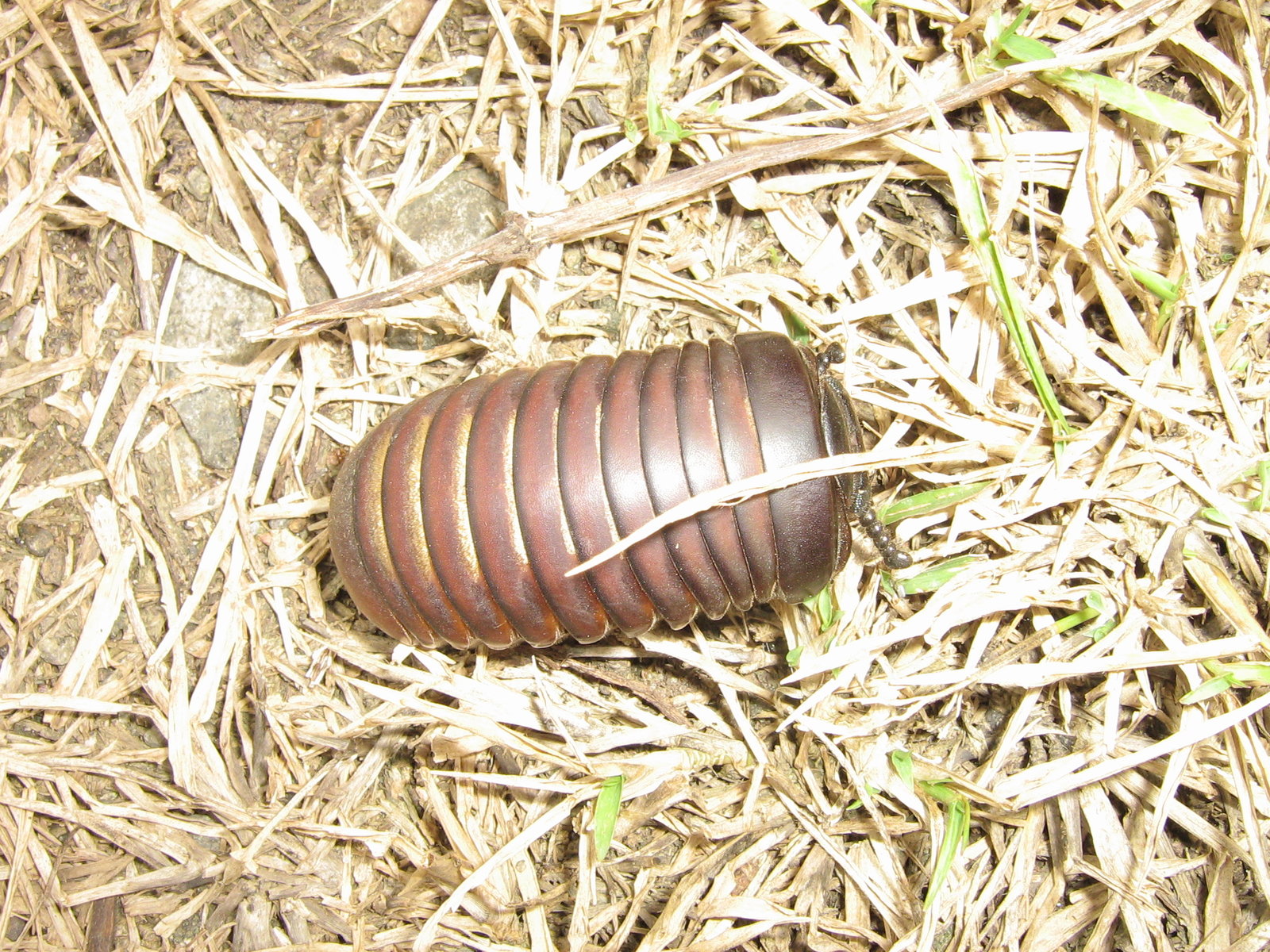
Provisional record. The order is established. The family is a strong expectation rather than a determination, and genus and species are not attempted.
Class Diplopoda — the millipedes — order Sphaerotheriida, the giant pill millipedes. Not a woodlouse, and not an insect. Family, genus and species not determined.
Photographed by Wong Fook Yee between 14:35 and 14:37 on 24 August 2007, on the ground at Ikutmaju Saw Mill, Merotai, about 30 km from Tawau, Sabah. This is the same working saw mill that produced the ladybird beetle larva of 2011.
It was found on the ground among dry grass litter. A light touch and it rolled up at once — which is the whole of this animal's answer to being disturbed, and the reason every photograph here shows a sealed ball rather than a walking millipede. It was photographed where it lay, then picked up and photographed in the palm, where it stayed shut. The ball was roughly 30 to 35 mm across: between a large cherry and a golf ball.
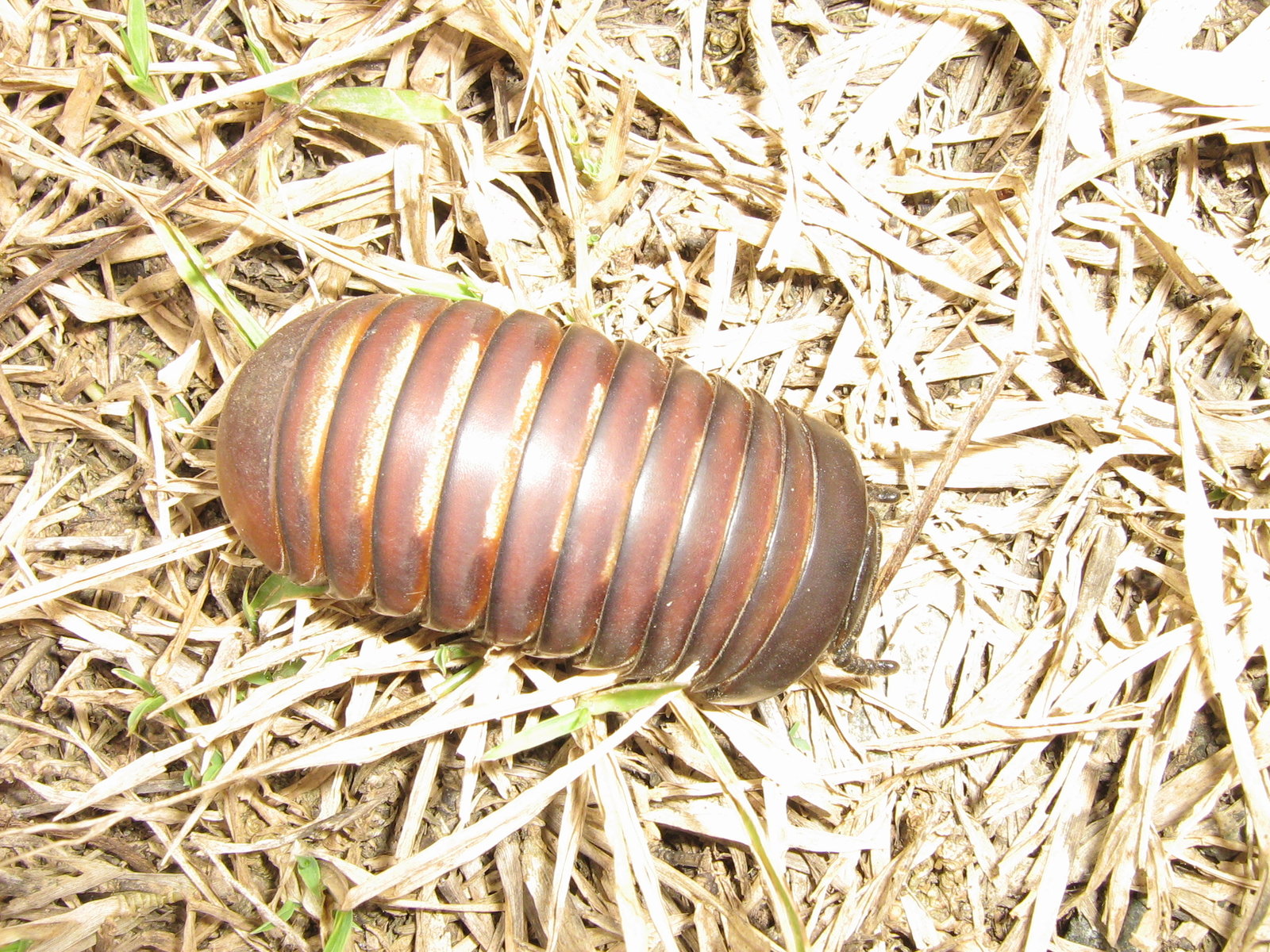
The third photograph is the one worth looking at closely, because it shows the mechanism.
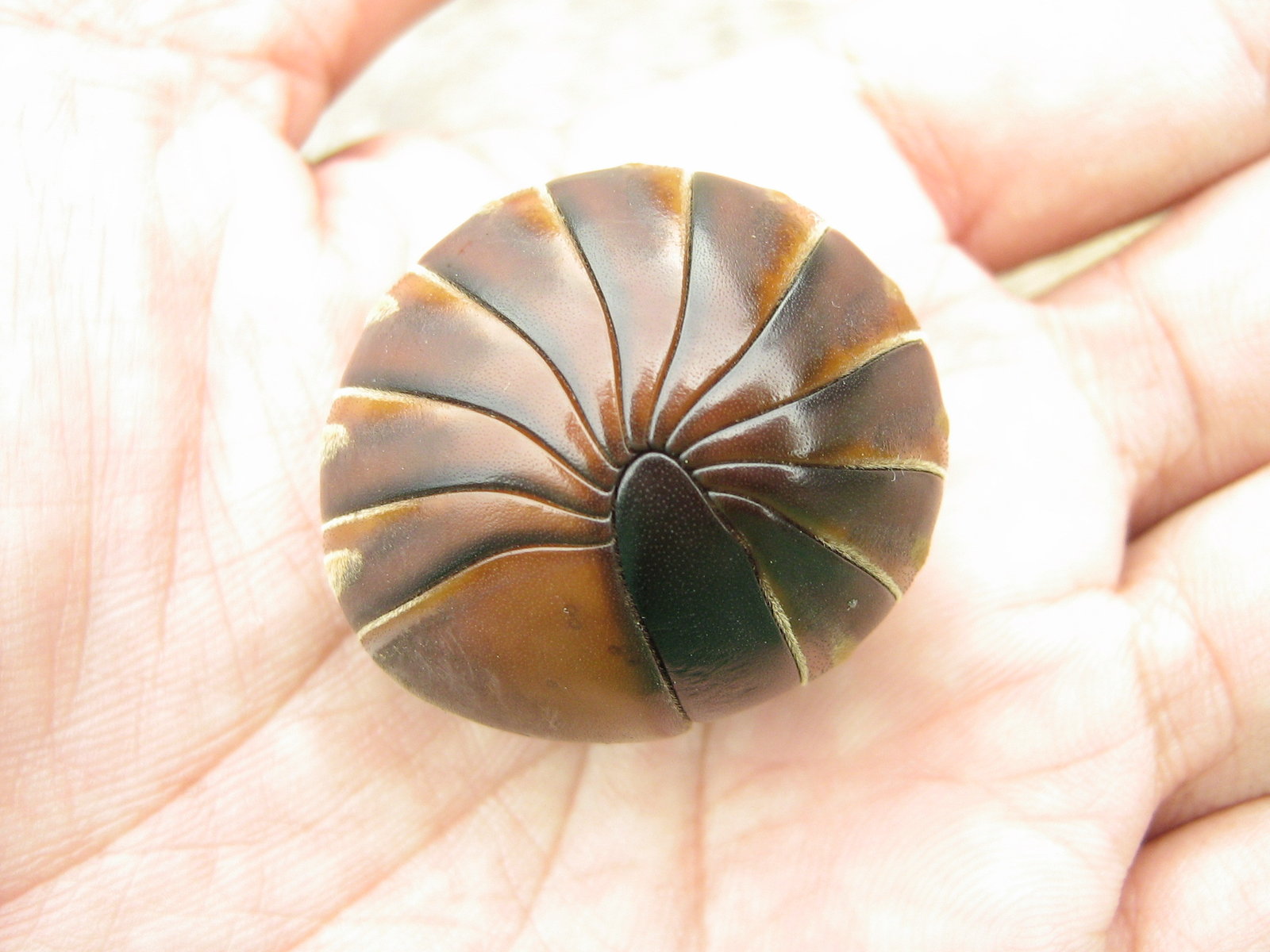
The large smooth dark plate at the middle of the disc is the anal shield — the last plate of the body. When the animal rolls, that shield closes the opening the way a stopper closes a jar, and the head end tucks in beneath it.
The rest is precision joinery. An adult has twelve body tergites plus that shield, and the tips of tergites 3 to 12 fit into a groove on the thoracic shield, so the ball closes exactly rather than approximately. In many species there are locking ridges as well, which hold the ball shut passively — the animal does not have to keep squeezing to stay closed. It can simply wait.
For anyone counting legs: females have twenty-one pairs, males the same plus two further pairs modified into telopods used in mating. None of them are visible here, and that is the point.
This record and the flat-backed millipedes at Bukit Gemok are both Diplopoda, both from the Tawau district, and they solve the same problem in opposite ways.
That is why this one could be picked up and turned over in the hand without incident, and it is also the reason it should go back where it was found rather than be carried about. Its only defence is to be a sealed ball, and being a sealed ball in somebody's pocket is not a defence against anything.
One further curiosity: in some species of this order the male stridulates — makes sound — using enlarged plates beneath the anal shield. Nothing was heard on this occasion, and no attempt was made to provoke it.
Established: order Sphaerotheriida. The size, the twelve tergites converging on a large plug-like anal shield, and the perfectly closing ball are the characters of the group. At 30 to 35 mm rolled, this sits comfortably inside the order's range of 20 to 80 mm in outstretched body length.
Expected, not determined: the family Zephroniidae. The five families of this order have non-overlapping ranges, and Zephroniidae is the one found in Southeast Asia. That makes it the expectation for a Bornean animal, but geography is not a determination and it is not recorded here as one.
Not attempted: genus and species.
Two animals are commonly confused with this one, and the difference is countable:
Ikutmaju Saw Mill is now the source of three records here — this pill millipede of 2007, a centipede in 2009 (record in preparation), and the ladybird larva of 2011. It is a working industrial site rather than a park or a reserve, which is exactly what makes it interesting: timber arrives there from across Sabah carrying its own bark fauna, the night lighting draws insects in from the surrounding country, and the ground around the yard accumulates the damp litter that detritivores live in.
A giant pill millipede is a leaf-litter animal. Finding one on open ground beside a saw mill says something about what persists in working landscapes, and it is the kind of observation that only comes from someone who goes to the same places repeatedly with a camera.
Page reviewed: 6 September 2026.