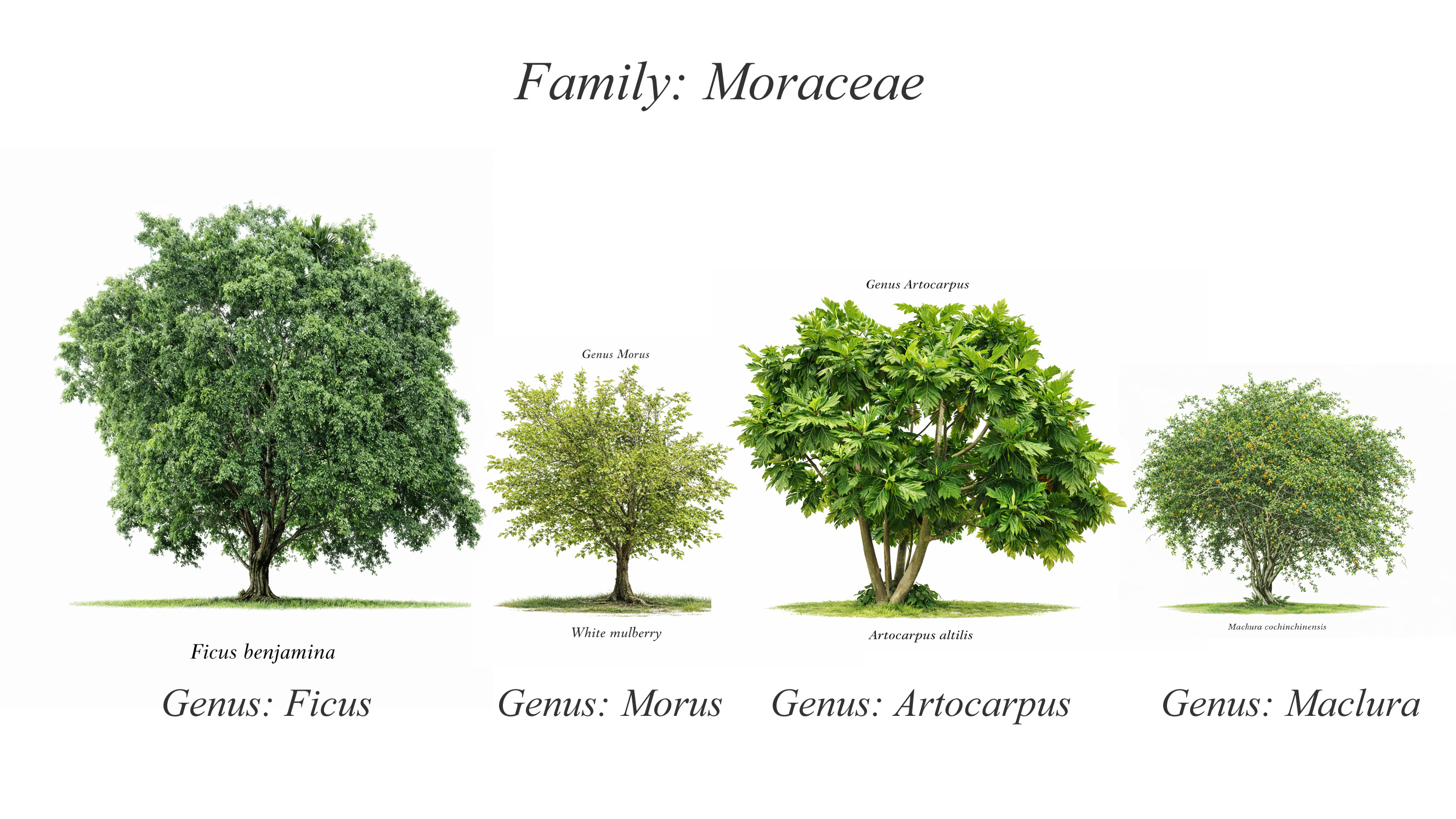
Family: Moraceae
The Moraceae family, commonly known as the mulberry or fig family, is a
diverse group of flowering plants within the order Rosales. As of 2026, it is
recognized for its significant economic, cultural, and ecological importance
across tropical and subtropical regions.
Key Characteristics
Milky Sap: Nearly all members produce a white or creamy latex when cut or
damaged.
Diverse Growth Forms: The family includes roughly 38–40 genera and over 1,100
species, ranging from massive trees and shrubs to lianas (vines) and rare herbs.
Leaves: Typically alternate and simple, often with prominent stipules that leave
a scar on the stem when they fall.
Inflorescence & Fruit: Flowers are unisexual and often tiny, clustered into
complex structures. Many species produce multiple fruits (syncarps), where
individual fruits from multiple flowers fuse into a single fleshy mass.
Major Genera in the Family: Moraceae
Major Genera and Species
Genus: Ficus (Figs): The largest genus (~750–800 species), including the common edible
fig (Ficus carica), sacred bo tree (F. religiosa), and various "strangler figs"
like the banyan.
Genus: Morus (Mulberries): Known for edible fruits and as the primary food source
for silkworms (Morus alba).
Genus: Artocarpus: Includes massive tropical fruits like jackfruit (A. heterophyllus)
and breadfruit (A. altilis).
Genus: Maclura: Contains the Osage orange, valued for its extremely hard wood used
historically for bows and fence posts.
|
Genus: Ficus (Figs):
Borneo is a global hotspot for Ficus (figs), harboring over 150 species
that are essential keystone species for rainforest biodiversity. These
plants range from small epiphytic shrubs, such as Ficus deltoidea, to
massive strangler figs like Ficus annulata, which start as epiphytes and
crush their host trees. They provide a year-round food source for over
1,200 species, including orangutans, hornbills, and various insects. |
Economic and Cultural Importance
Food Source: Provides globally important staples and fruits like figs,
mulberries, jackfruit, and breadfruit.
Materials: Historically significant for timber, bark cloth (from paper
mulberry), and natural rubber (from the Indian rubber plant, Ficus elastica).
Medicinal & Scientific Use: Many species contain bioactive compounds like
flavonoids and phenolic acids being researched for antioxidant and potential
anti-cancer properties.
Sacred Status: Species like the Bo tree hold deep religious significance in
Hinduism and Buddhism, associated with the enlightenment of Gautama Buddha.