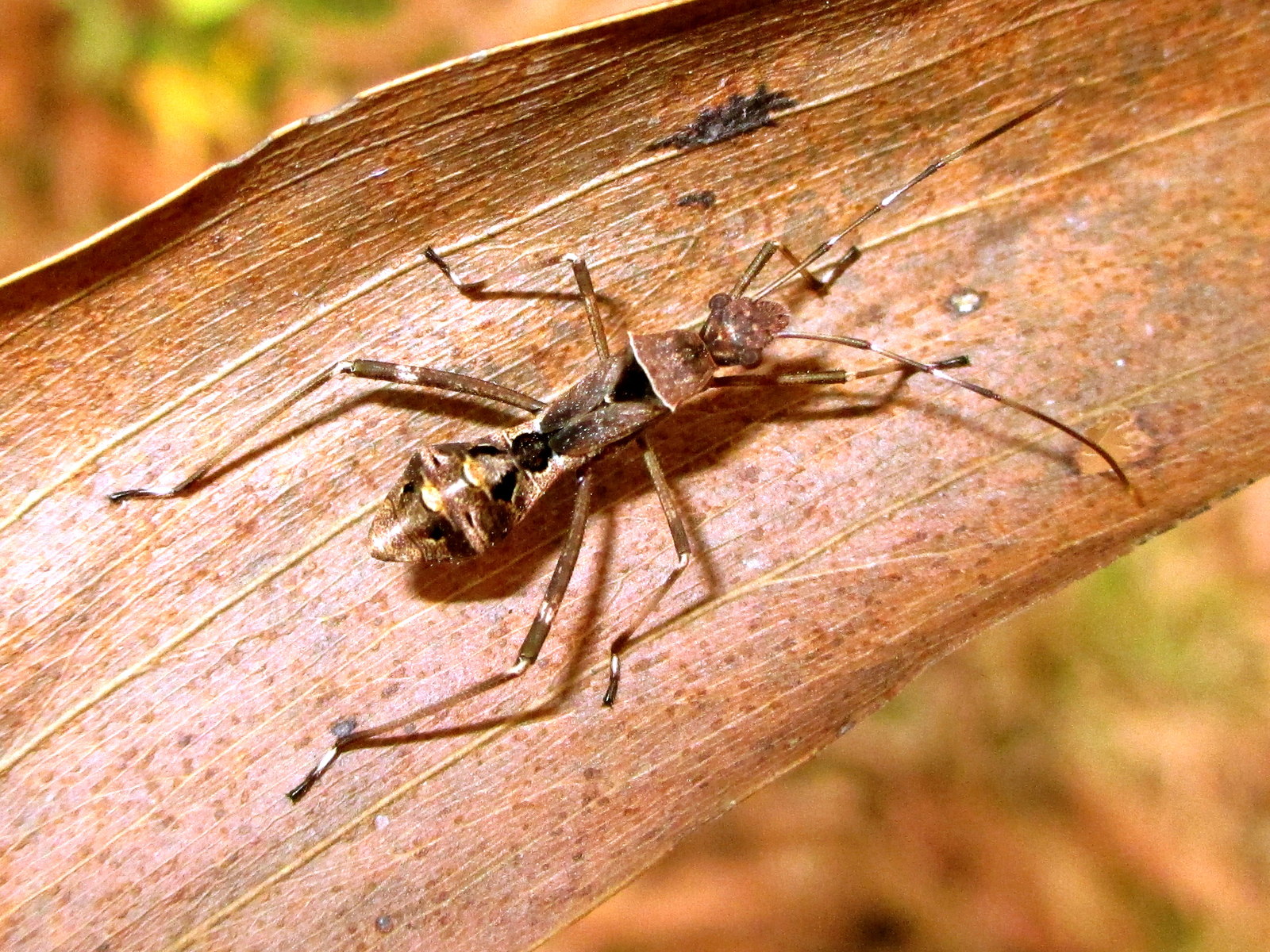
Provisional record. Order and suborder are established. The family is not determined, and whether this is a nymph or an adult is not settled either. Both questions are discussed below rather than answered.
Class Insecta, order Hemiptera, suborder Heteroptera — the true bugs. Family, genus and species not determined.
Photographed by Wong Fook Yee at 14:02 on 23 October 2014, on open ground in the log yard of Ikutmaju Saw Mill, Merotai, about 30 km from Tawau, Sabah.
About 10 mm long, chocolate brown, with long banded legs and long antennae. It was alone, on a dead fallen leaf on bare ground, and crawling steadily forward — not resting, not feeding, simply travelling.
The photographer's field note recorded the animal as having "two segments — the head and body".
That is wrong, and the fact that it was written down is the most interesting thing about this record. Every insect has three body regions — head, thorax, abdomen — and so does this one. What makes it look like it has an ant's narrow waist is a pair of pale markings, one at the back of the thorax and one at the front of the abdomen, which from above read as a gap where there is no gap at all.
The waist is painted on. It is a documented device — the same trick is described in ant-mimicking plant bugs, whose white markings at the back of the thorax and the front of the abdomen make them look ant-waisted. Here it worked on an experienced observer, at close range, with a camera in his hand, and it survived into the written notes.
A record of a mimic is worth more when it also records the mimicry succeeding. That is what this page has, and it is why the field note is quoted rather than quietly corrected.
Looking like an ant is expensive — it means changing the shape of your body, the way you carry your legs and often the way you walk. It is worth it because ants are worth avoiding. They are aggressive, or unpalatable, or both, and predators that hunt by sight — birds, wasps, jumping spiders — learn to leave them alone. An animal that resembles one closely enough gets the protection without having to pay for the sting.
The arithmetic says how well it works. Mimicry of ants — myrmecomorphy — has evolved independently more than seventy times. It is found in roughly two thousand species of terrestrial arthropod in more than two hundred genera, including about fifteen separate lineages of spiders, ten of plant-sucking bugs, and seven of rove beetles. This animal belongs to one of those ten.
Not every ant mimic is hiding from predators. The distinction is worth keeping straight:
Nothing in a single photograph of an animal crossing a dead leaf distinguishes the two, and this page does not try to.
Ant mimics have to solve the same three problems, and it is worth knowing what to look for:
Established: order Hemiptera, suborder Heteroptera. The long antennae with a thickened, curved final segment, and the general build, place it there.
Not determined: the family. The two characters that would settle it — the form of the rostrum, the piercing beak all hemipterans carry, and the shape of the hind femora — are not resolved in this photograph, taken on a compact camera at ISO 500. Two families are the obvious candidates for an ant-like bug of this size and build in Borneo, and this page names neither, because a photograph that cannot separate them is not evidence for either.
An alternative that was considered and set aside: the ant-like flower beetles, already on this site, solve exactly the same problem in a different order — beetles with a narrow neck and an ant-like outline. The antennae rule them out here: this animal has few, long antennal segments ending in a curved thickened tip, not the many-segmented thread of a beetle.
The abdomen appears exposed behind small wing pads rather than covered by full forewings reaching its tip. If that reading is right the animal is immature. It is not certain, and in this order the young are considerably harder to name than the adults — which is the nymph caution set out on the Hemiptera index, met here in practice.
This site files insects by wing count, and this record sits in 0_Wing/ — which will look
wrong to anyone who knows that adult true bugs have two pairs of wings.
The key describes what was seen, not what the animal is. No functional wings are
visible in this photograph; if the nymph reading is correct, none had grown yet. The
Hemiptera index states the rule plainly — a hemipteran nymph
photographed in the field belongs, on this site's key, under 0_Wing/ — and that index
sits above the wing-count folders precisely so that a group split across them can still be read as a
group. If a determination later shows this to be a winged adult, the record moves and this paragraph
is what will explain the move.
Ikutmaju Saw Mill is now the source of three records on this site, spread over seven years:
It is a working industrial site, not a park and not a reserve, and that is what makes it worth recording. Timber arrives there from across Sabah carrying its own bark fauna, the night lighting draws insects in from the surrounding country, and the ground round the yard keeps enough damp litter for the animals that live in it. Three records from three very different groups, all found by walking the same yard with a camera.
Page reviewed: 7 September 2026.