eTawau > Insects of Borneo > Caterpillars > A nymphalid at the Tawau River Triangle
A butterfly caterpillar in a papaya garden — and a record that stopped short of what it could have been
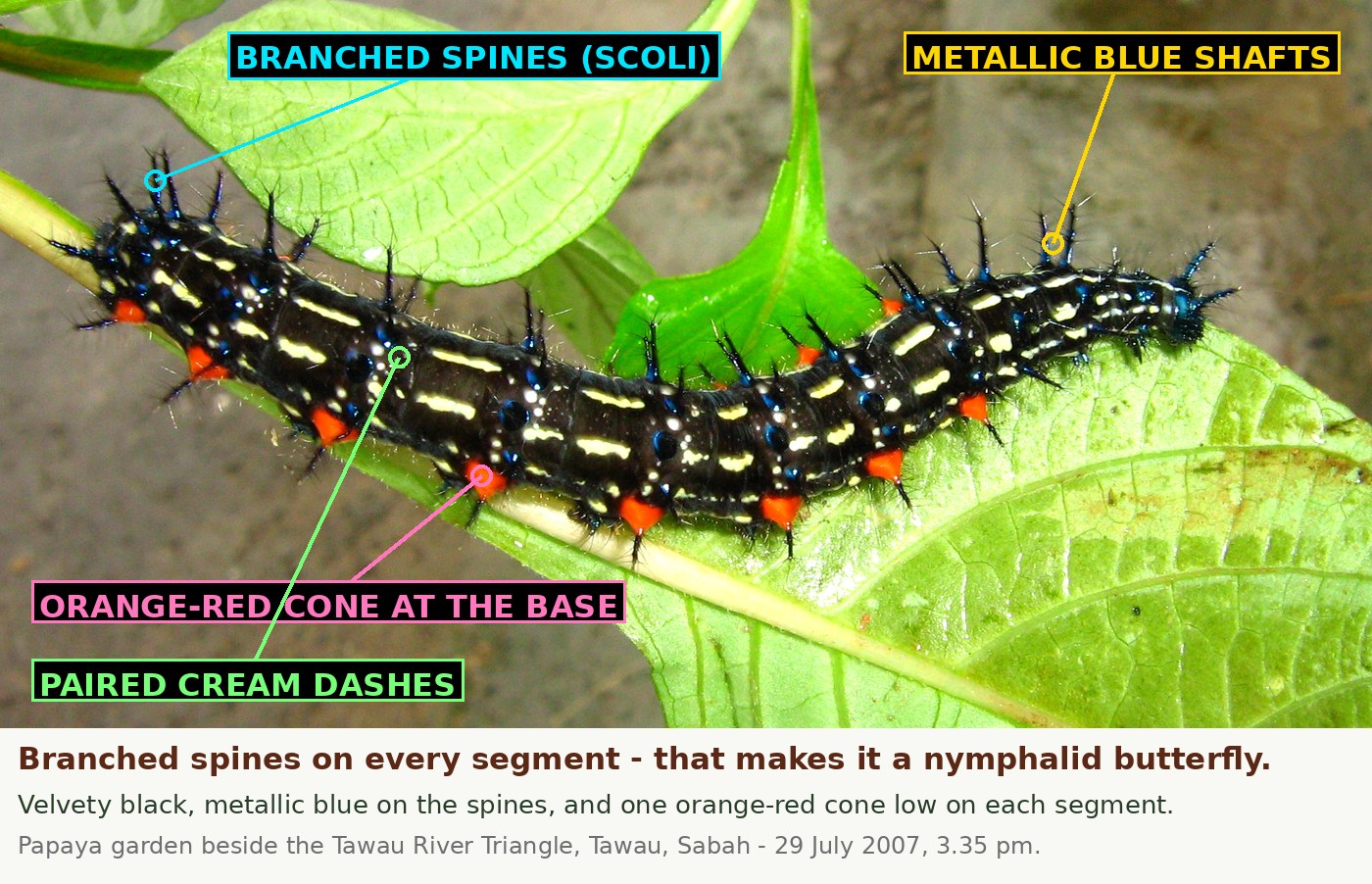
This is the handsomest caterpillar on this site and the one with the least name attached to it. Velvety black, speckled with white, carrying a row of branched spines whose shafts flare iridescent blue where the light catches them, two broken lines of cream-yellow dashes down the back, and one bright orange-red cone low on each side of every segment.
Look at one spine closely and you see it is not a simple bristle. It has a stout base, a shaft, and short spinelets radiating from the shaft like a bottle brush. A spine built that way is called a scolus, and among Bornean caterpillars it is close to diagnostic for one family: the Nymphalidae, the brush-footed butterflies.
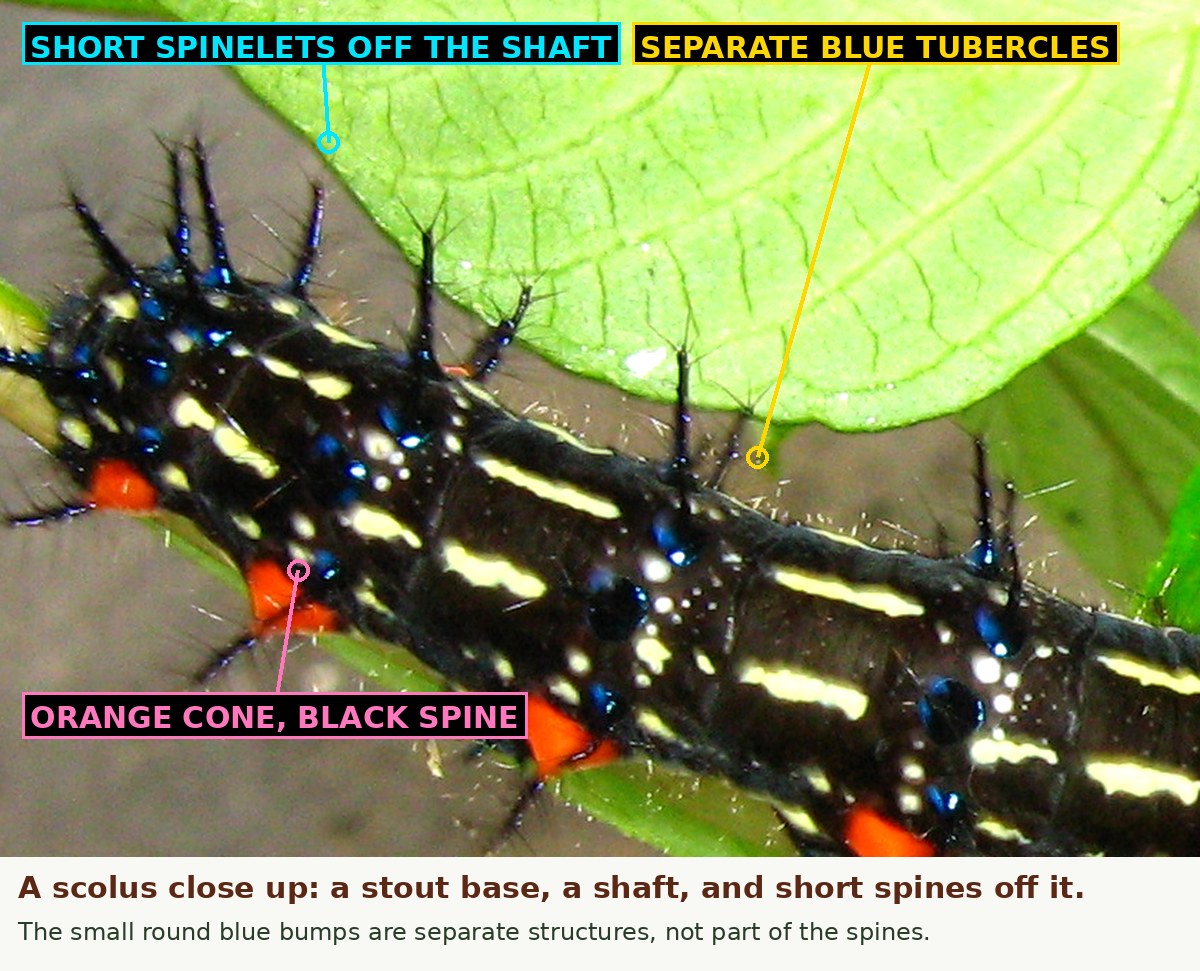
So the animal on this page is a butterfly caterpillar, not a moth's. That is worth saying plainly, because most people assume any hairy or spiny caterpillar is a moth. On this site the tussock and the lappet moths are moths; this one is not.
The record stops at family, and I am not going to push it further. Two things would settle the genus and neither of them is in the picture.
This is the earliest record on this site from the Tawau River Triangle, and the photographer is straightforward about what it is:
"Those days I was just a hobby photographer taking snap shots. Only years later I became a field observer, and began to learn to take a series of photos including measuring sizes."
The papaya garden is still there, ten minutes from the photographer's house, and the shrub may still be growing in it. A single photograph of that plant would finish a nineteen-year-old record, and would very likely carry this animal from family to genus.
Papaya garden beside the
Tawau River Triangle, Km 7 Jalan Kuhara,
Tawau, Sabah. Across Jalan Kuhara from the Triangle itself, so outside it.
One caterpillar, not measured — there was no scale object in the frame and none can
be recovered. Velvety black with fine white speckling; two broken rows of short cream-yellow dashes
along the back; scattered small round metallic blue tubercles; branched spines (scoli) black with
iridescent blue shafts; one orange-red cone low on each side per segment, each carrying a black
spine. Head not visible.
Lepidoptera: Nymphalidae — a brush-footed butterfly. Subfamily and genus not
determined. On an unidentified shrub with opposite, ovate, softly hairy leaves. Moving slowly along a
stem. One only. Photographed and returned to the bush; nothing collected. Mosquitoes numerous in the
garden.
— iNaturalist observation
401359228
The Tawau River Triangle is a block of abandoned fifty-year-old oil palm between the Merotai Road roundabout, Jalan Kuhara and Jalan Utara Baru, at Km 7 of Jalan Kuhara, about 7 km from Tawau town. This caterpillar was outside it, in the papaya garden across the road — the same garden that produced another caterpillar in 2008, a weaver ant queen in 2009 and a tussock moth caterpillar in 2011.
About the photograph. One frame by Wong Fook Yee with a Canon PowerShot A430 at
15:35:34 on Sunday 29 July 2007, f/5.6 at 1/60 s, 5.4 mm, flash fired — fill-flash in afternoon
shade, which is why the blue on the spines shows so strongly. It is a camera original that has never
been opened in an editor. For this page it has been cropped, brightened and labelled; nothing has
been sharpened, recoloured, added or removed. The unmarked full frame is attached to the iNaturalist
record above.
The family character — branched scoli — and the account of what would be needed to go further are
from the general entomological literature; the locality, the date, the time, the behaviour and the
circumstances of the find are the photographer's own field observations, made on one of his Sunday
walks. The animal was not measured and the host plant is not identified. All photographs
© Wong Fook Yee. Page written 18 September 2026.