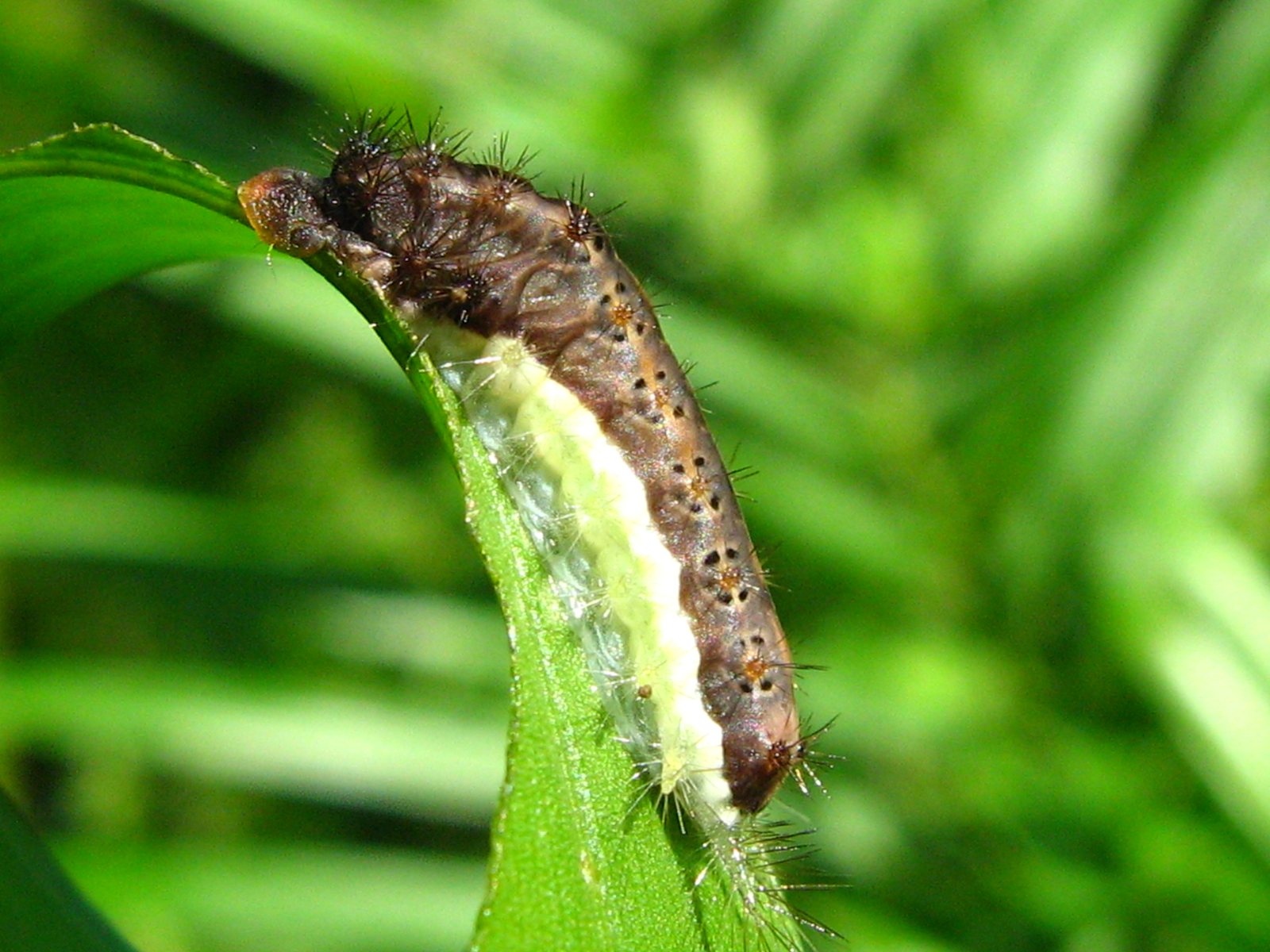
eTawau > Insects of Borneo > Caterpillars > A caterpillar on a leaf edge, Tawau River Triangle
A caterpillar resting on a leaf edge in the papaya garden beside the Tawau River Triangle. The five-second test can say what it is not, but not what it is.
It was lying along the edge of a leaf, doing nothing at all, on an afternoon walk along the farm path. I took one photograph and walked on. That was how I photographed in 2008. Eighteen years later the one frame still shows enough to say what kind of animal this is, and it shows exactly where the name has to stop.
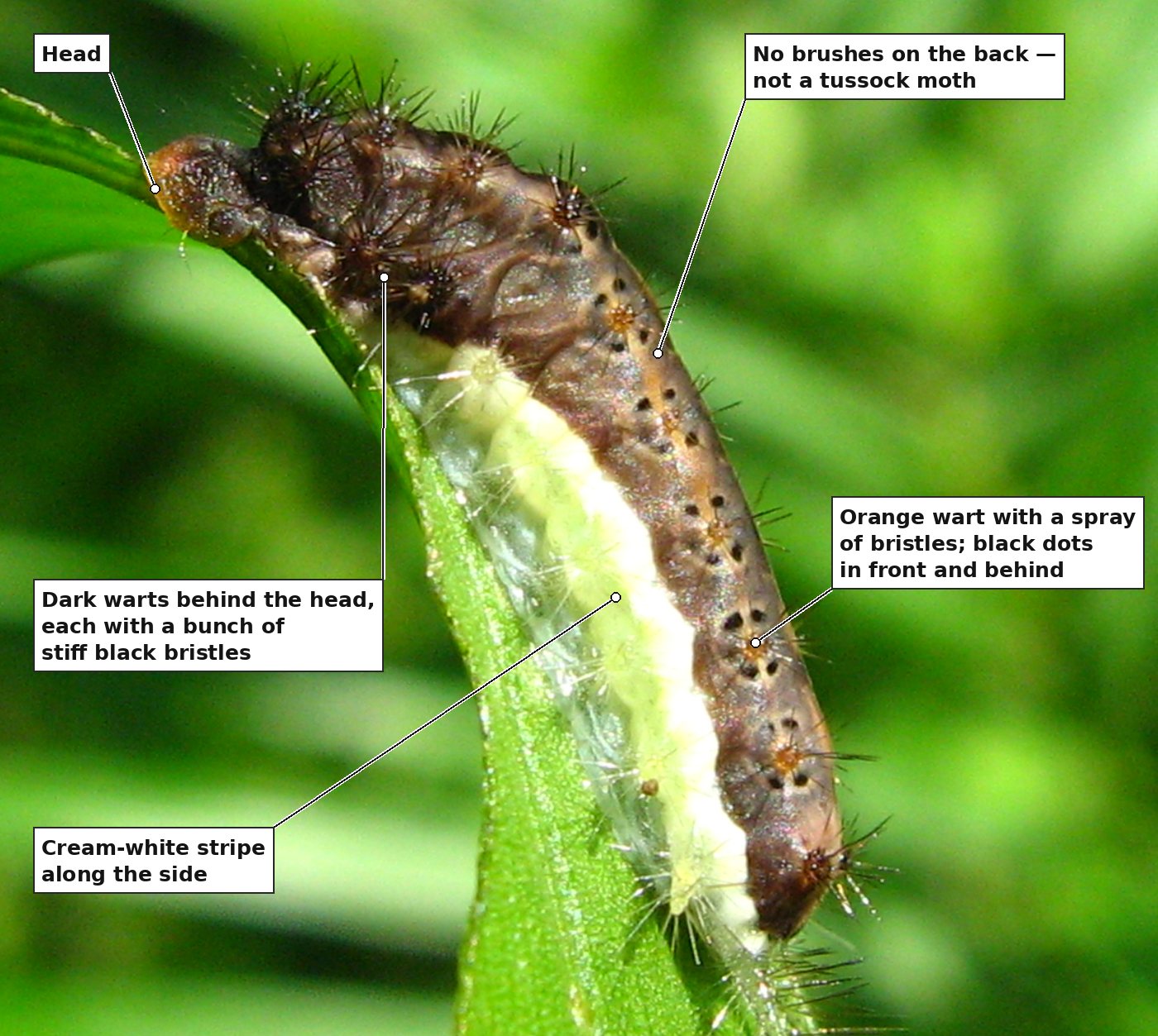
Most caterpillars carry their bristles one at a time, each from its own small spot. This one does not. Behind the head the bristles stand up in stiff black bunches, several from each dark wart. Along the back, each orange-based wart throws out a spray of finer bristles, with a pair of black dots in front of it and a pair behind.
A wart carrying a bunch of bristles is called a verruca. They are typical of the Erebidae, the family that holds the tiger moths and the tussock moths. That is the direction this record points, and it is as far as I will take it.
This site already teaches one quick field test for hairy caterpillars around Tawau: look at the back. A tussock moth has four short dense brushes standing up on it. A lappet moth has a bare back, with its long hair in a skirt low on each side. Both halves are on the site: the tussock moth from this same garden and the lappet moth on a gate post at Ikutmaju.
This caterpillar is neither. It has no brushes standing on its back, so it is not a typical tussock. Its bristles are not a skirt of long hair, so it is not a lappet either.
I did not measure it. There is no ruler, pin or finger in the frame.
But this camera, a Canon PowerShot A460, writes the focus distance into the file, and for this frame it says about 9 cm, in macro mode. With the focal length and the size of the sensor, that turns into a scale on the picture. The answer is a body length of roughly 35 to 55 mm.
Compare the 2011 tussock moth from the same garden. It was taken with a Panasonic that records no focus distance at all, so that record has no size and cannot have one. The older camera left the better trail.
Two things would move it:
Neither can be had now for this animal. That is why the Tawau River Triangle records made after this one carry more frames.
Papaya garden beside the
Tawau River Triangle, on the Jalan Kuhara
side, Tawau, Sabah. Across Jalan Kuhara from the Triangle itself, so
outside it. Found on an afternoon walk along the farm path. One caterpillar,
lying still along the edge of a leaf of an unidentified plant. Not measured; about
35–55 mm estimated from the camera's recorded focus distance. Head smooth, orange-brown, held
low. Back purplish-brown; on each abdominal segment an orange-based wart carrying a spray of
bristles, with a pair of black dots in front and a pair behind. Dark warts behind the head, each
with a bunch of stiff black bristles. A broad cream-white stripe along the side; the underside
translucent pale green. No dense brushes on the back.
Lepidoptera: family not determined; the bristles growing in bunches from warts
point towards Erebidae. One only. A single photograph; not touched, and left where it was.
— iNaturalist observation
402703797
The papaya garden is across Jalan Kuhara from the Tawau River Triangle, the block of abandoned oil palm I have been recording for years. It keeps turning up records: a butterfly caterpillar in 2007, this caterpillar in 2008, a weaver ant queen in 2009 and a tussock moth caterpillar in 2011.
My field note gave one reason for that:
"The drain near by keep small insects population thriving."
A drain beside cultivated ground means water all year and soft growth along its banks. In a garden that also has papaya and weeds, that is a lot of food within a few steps.
About the photograph. One frame by Wong Fook Yee with a Canon PowerShot A460 in
macro mode, no flash, f/8 at 1/125 s, ISO 100, 5.4 mm, taken at 15:41:57 on 1 October 2008 in the
papaya garden beside the Tawau River Triangle, Tawau, Sabah. A camera original, never opened in an
editor. For this page it has been reduced, cropped and labelled; nothing has been sharpened,
recoloured, added or removed. The unmarked full frame is on the iNaturalist record above.
The size range is calculated from the focus distance, focal length and sensor size recorded by the
camera, and is an estimate. The meaning of verrucae and the families in which they occur are from
the general entomological literature. The locality, date, time, behaviour and the drain are the
photographer's own field observations. The plant is not identified. All photographs © Wong
Fook Yee. Page written 23 September 2026.