Thursday, 20 August, 2020 08:54:09 AM


Family: Salticidae
Subfamily: Heliophaninae

A family of Asian spiders found in Asia

Genus Carrhotus
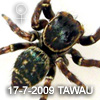
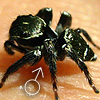
The male and female of this genus are so differently colored that they were denoted as different species. The male has a black head while the female's head has yellow-orange spots. Her body is beautifully colored with orange and yellow hairs.
The spider can be spotted in bushes. The species is very rare.

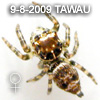
Carrhotus TAWAU Female

Carrhotus sp TAWAU

Female 5.5mm

2009-8-9 TAWAU

CarrhotusTANAHMERAH Female

Carrhotus sp TANAHMERAH
Female 4mm
2009-7-17 TAWAU
 

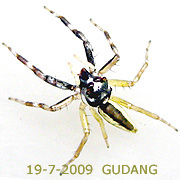
Carrhotus Sannio 角貓跳蛛

2008-09-16 GUDANG 4
 
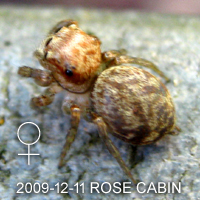
Carrhotus sp ROSE CABIN 貓跳蛛新種於婆羅洲島

Carrhotus sp ROSE CABIN
貓跳蛛新種於婆羅洲島

2009-12-11 FRI 08:22 ROSE CABIN, BORNEO
中國蜘蛛生態大圖鑑 Page 595

Carrhotus MEROTAI Female

Carrhotus sp MEROTAI
Female
2009-10-25 MEROTAI


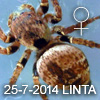
Carrhotus sp.BATU LINTANG
Female 7mm
Male Unknown


2014-7-25 BATU LINTANG


Menemerus fulvus is often confused with 3 other wall jumper species because their body shape structure and grey colour patent. Male and female among these 4 species are inter-misidentified as each other's.

Here are the 4 species of grey wall jumpers :

Subfamily Heliophaninae
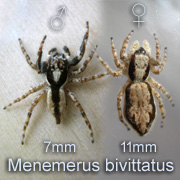
Menemerus bivittatus
Subfamily Heliophaninae
Menemerus fulvus
Subfamily Plexippinae
Plexippus paykulli
Subfamily Plexippinae
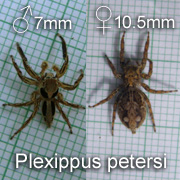
Plexippus petersi
Plexippus paykulli (Plexippus setipes?) 蠅虎之一

Family: Salticidae
Subfamily: Heliophaninae
Genus: Phintella

Genus Phintella has 39 species, the following are common Borneo species :


Phintella suavis (Simon, 1885) — Nepal to Malaysia
Phintella versicolor (C. L. Koch, 1846) — China, Korea, Taiwan, Sumatra, Malaysia.
Phintella vittata (C. L. Koch, 1846) — India to Philippines
Phintella debilis (Thorell, 1891) — India to Taiwan, Java


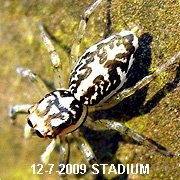
 Phintella versicolor 

Male  6mm


Phintella versicolor 

Phintella versicolor

Chrysilla versicolor

Female 雌蛛

12-7-2009 STADIUM


Phintella debilis

Female

29-6-2014 Balung Eco Resort, Sabah


Phintella debilis

Female 4mm

1-6-2015
Nanga Tau, Sarawak


Phintella sp GEMOK

30-6-2009 Bukit Gemok, Sabah

Phintella sp BOMBALAI

22-6-2014 BOMBALAI, Sabah


Phintella vittata

MALE

2008


Genus Chrysilla

Family: Salticidae

Subfamily: Heliophaninae

Genus: Chrysilla

6 Species
Chrysilla albens Dyal, 1935 — Pakistan
Chrysilla delicata Thorell, 1892 — Myanmar
Chrysilla doriai Thorell, 1890 — Sumatra
Chrysilla kolosvaryi Caporiacco, 1947 — East Africa
Chrysilla lauta Thorell, 1887 — Myanmar to China, Vietnam
Chrysilla pilosa (Karsch, 1878) — New South Wales


Chrysilla Lauta

South East Asia


Genus Pseudicius

Family: Salticidae
Subfamily: Heliophaninae
Genus: Pseudicius
 

It resembles to Marpissa muscosa but it is only half the size. It can be found in woodland, amongst leaf-litter and moss as well on the bark of trees. It size varies between 4.5 and 5.5 mm.


Pseudicius sp MEROTAI


 Pseudicius PORING

Pseudicius PORING

14-12-2009 PORING

Icius TAWAU

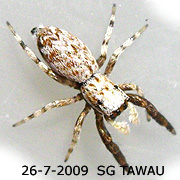
Pseudicius sp SG TAWAU

Male 4.5 mm

26-7-2009 SUNGAI TAWAU 

Pseudicius encarpatus


Genus Heliophanus


The female spider is easily recognized by the white stripe of hairs around the front of the abdomen. Their size varies between 3 and 6 mm. The majority of the species can be found on low vegetation.


Heliophanus SABAH

16-12-2009 Kinabalu National Park

Heliophanus SABAH

Heliophanus SABAH

Female 7mm

27-11-2009 Tawau, Sabah

Heliophanus tribulosis female


Heliophanus cupreus female


Heliophanus cupreus male


Heliophanus kochii male


Heliophanus kochii female


扁蠅虎屬
Genus Menemerus

Their length varies between 7 and 9 mm.

Males have strinking white haired pedipalps.
The spiders can be found on sunny walls and rocks often in the surroundings of houses.

Menemerus bivittatus (Dufour, 1831) — Pantropical
Menemerus fulvus (L. Koch, 1878) — India to Japan


Smart and furry salticids. Found in warm, stony or bare areas. General remarks: Spiders in this group are associated with stones, rocks or bare areas in the open with dead leaves, twigs or litter provided these habitats are warmed by the sun. They are sturdy and can be strong jumpers.

It is similar in size and shape to Marpissa, except that the abdomen is more square shouldered. The male carapace is brown with the eye field black, and there is a characteristic white marginal band. Overall the abdomen is whitish-brown with a broad, dark brown, median band running the length of the abdomen. The legs are dark brown with some light brown patches and rings. The female is overall brown with a very broad whitish-brown band that runs from the front eyes to the spinnerets. The legs are whitish-brown with brown marks and annulations.

Menemerus is a worldwide genus with most species occurring in the warmer regions.
 

  • abdomen is more square shouldered compared with Genus Marpissa

  • The male carapace is brown with the eye field black,

  • There is a characteristic white marginal band.

  • Overall the abdomen is whitish-brown with a broad, dark brown, median band running the length of the abdomen.

  • The legs are dark brown with some light brown patches and rings.

  • The female is overall brown with a very broad whitish-brown band that runs from the front eyes to the spinnerets.

  • The legs are whitish-brown with brown marks and annulations.


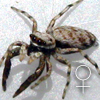
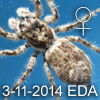
    Menemerus fulvus
Menemerus fulvus


3-11-2014 EDA
 

Menemerus fulvus

Juvenile Female

MEROTAI


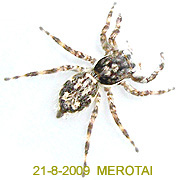
Menemerus MEROTAI

Menemerus MEROTAI

Female 7mm

Common

21-8-2009 WAREHOUSE


found at toilet ikutmaju

Menemerus bivittatus (Dufour)

http://entnemdept.ufl.edu


Menemerus PUI YUK

FEMALE

2014 PUI YUK


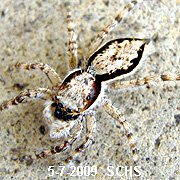
Menemerus fulvus

 白鬚扁蠅虎 

Menemerus fulvus??????

Female Very Common

5-7-2009 SCHS


Family: Salticidae
Subfamily: Heliophaninae
Genus: Cosmophasis

http://arachne.org.au/01_cms/details.asp?ID=2296
http://www.arachne.org.au/01_cms/details.asp?ID=2544


A genus of the spider family Salticidae (jumping spiders). Some species occur in Africa, while most are found in Southeast Asia, down to Australia. Although most species more or less mimic ants, there are also colorful species that follow a different strategy.

A genus of the spider family Salticidae (jumping spiders). Some species occur in Africa, while most are found in Southeast Asia, down to Australia. Although most species more or less mimic ants, there are also colorful species that follow a different strategy.


Species of Cosmophasis common in Bornao :

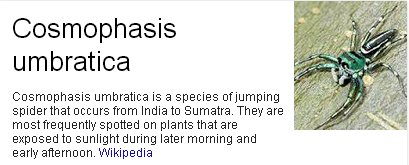
Cosmophasis umbratica Simon, 1903 — India to Sumatra
Cosmophasis thalassina (C. L. Koch, 1846) — Malaysia to Australia
Cosmophasis quadricincta (Simon, 1885) — Singapore
Cosmophasis estrellaensis Barrion & Litsinger, 1995 — Philippines
Cosmophasis cypria (Thorell, 1890) — Java
Cosmophasis laticlavia (Thorell, 1892) — Sumatra
Cosmophasis masarangi Merian, 1911 — Sulawesi
Cosmophasis gemmans (Thorell, 1890) — Sumatra
Cosmophasis parangpilota Barrion & Litsinger, 1995 — Philippines
Cosmophasis weyersi (Simon, 1899) — Sumatra


Cosmophasis thalassina


Cosmophasis MEROTAI

Female

21-9-2008 MEROTAI
 

Cosmophasis thalassina

FEMALE

27-9-2014 PRAWN FARM


Cosmophasis sp.

South East Asia 

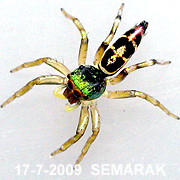
Cosmophasis umbratica

Cosmophasis umbratica
FEMALE 4.5mm

17-7-2009 SEMARAK

Cosmophasis umbratica

Singapore

Cosmophasis umbratica

South East Asia

Cosmophasis umbratica

South East Asia

Cosmophasis umbratica

MALE 6mm

23-7-2009 SEMARAK

Silerella sp SEMARAK

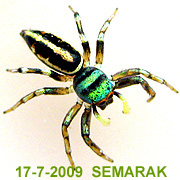
Cosmophasis umbratica

MALE  6.5mm

17-7-2009 SEMARAK

Cosmophasis umbratica, male

Singapore


Family: Salticidae
Subfamily: Heliophaninae
Genus: Epocilla

Family: Salticidae
Subfamily: Heliophaninae
Genus: Epocilla

Genus Epocilla has 10 species :
Epocilla aurantiaca (Simon, 1885) — India to Malaysia
Epocilla blairei Zabka, 1985 — China, Vietnam
Epocilla calcarata (Karsch, 1880) — China to Sulawesi, Seychelles, Hawai'i
Epocilla chimakothiensis Jastrzebski, 2007 — Bhutan
Epocilla femoralis Simon, 1901 — Sumatra
Epocilla innotata Thorell, 1895 — Myanmar
Epocilla mauriciana Simon, 1901 — Mauritius
Epocilla picturata Simon, 1901 — China
Epocilla praetextata Thorell, 1887 — Myanmar to Java
Epocilla xylina Simon, 1906 — India


Epocilla calcarata

Male

Phintella versicolor 

Epocilla calcarata


Phintella versicolor 

Male 6mm


Epocilla calcarata
Female

found at sungai tawau 21-9-2014


Epocilla sp.
 

Epocilla calcarata

Male

South East Asia

Epocilla calcarata

Female

South East Asia

Epocilla calcarata

Female

South East Asia


Not much reference information on this Subfamily of Helophaninae.

Heliophaninae is a grouping, clade or subfamily of Salticidae including many tropical spiders, notably Cosmophasis in Australia and the cosmopolitan Menemerus.

The Heliophaninae form a sub-family of jumping spiders which includes thirty genera distributed in all continents.

Characteristics of Subfamily Heliophaninae is delimited by two characters (Maddison, 1987):

1- a stridulatory apparatus consisting of seta-bearing tubercles on the first leg femur and rugose carapace-sides
2- a bump on the tegulum


Common genus of Heliophaninae in Bornao :

1- Heliophanus
2- Icius
3- Pseudicius
4-
Phintella
5- Epocilla
6- Carrhotus
7- Orsima
8- Chrysilla
9- Cosmophasis

10- Festucula
11- Marchena
12- Helvetia
13- Yepoella
14- Menemerus


Genus Icius

伊蛛屬跳蛛

Icius is a genus of the spider family Salticidae (jumping spiders). There are 29 species world wide.

Icius abnormis Denis, 1958 — Afghanistan
Icius bilobus Yang & Tang, 1996 — China
Icius brunellii Caporiacco, 1940 — Ethiopia
Icius cervinus Simon, 1878 — Russia
Icius congener Simon, 1871 — Western Mediterranean
Icius crassipes (Simon, 1868) — Spain, Algeria, Tunisia
Icius daisetsuzanus Saito, 1934 — Japan
Icius dendryphantoides Strand, 1909 — South Africa
Icius desertorum Simon, 1901 — South Africa
Icius glaucochirus (Thorell, 1890) — Sumatra
Icius gyirongensis Hu, 2001 — China
Icius hamatus (C. L. Koch, 1846) — Palearctic
Icius hongkong Song et al., 1997 — Hong Kong
Icius ildefonsus Chamberlin, 1924 — Mexico
Icius inhonestus Keyserling, 1878 — Uruguay
Icius insolitus Alicata & Cantarella, 1994 — Spain
Icius minimus Wesolowska & Tomasiewicz, 2008 — Ethiopia
Icius nebulosus (Simon, 1868) — Western Mediterranean
Icius ocellatus Pavesi, 1883 — East Africa
Icius pallidulus Nakatsudi, 1943 — Micronesia
Icius peculiaris Wesolowska & Tomasiewicz, 2008 — Ethiopia
Icius pseudocellatus Strand, 1907 — South Africa
Icius separatus Banks, 1903 — Hispaniola
Icius simoni Alicata & Cantarella, 1994 — Algeria
Icius steelae Logunov, 2004 — Sudan
Icius subinermis Simon, 1937 — Mediterranean
Icius testaceolineatus (Lucas, 1846) — Algeria
Icius yadongensis Hu, 2001 — China


Icius subinermis

Europe

Icius hamatus

Europe


Web
Analytics

Email us at :  wongchunxing@yahoo.com