Sensing the world with hairs and pits
All spiders are hairy. Spider hairs are part of
the hard outer cuticle (the spider's 'skin'). Spiders use their hairs
to perform a variety of tasks -:
1) for sensing their
world,
2) in courtship displays,
3) for moving around,
4) and in
defence and prey capture.
Sight is our most important sense. However, most spiders
have very poor eyesight and many are active during the
dark night hours. With a few notable exceptions, their
sense of the world is obtained through specialised sensory
hairs and pit-like sense organs in the cuticle. These hair
and pit sensillae are especially associated with the
spider's limbs and mouthparts. Connected at their bases to
sensory nerves, they provide spiders with the sensory
experience and feedback needed to survive and function in
their world.
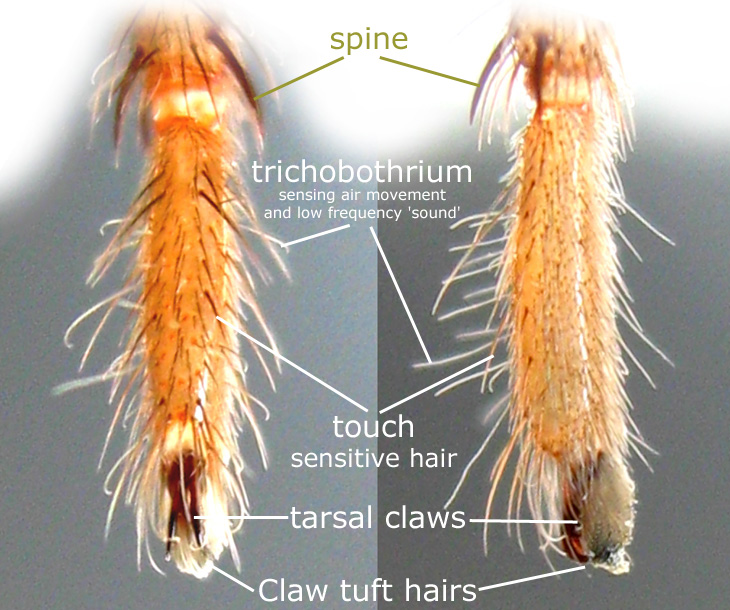
Hinged, touch-sensitive hairs on the legs help the spider
to move freely about its terrain and are important in
interactions ranging from mating to prey capture.
Chemically sensitive, hollow-tipped hairs found at the
ends of the limbs and on the mouthparts are the spider's
tasting organs - those on the pedipalps are used to sense
the chemicals associated with mate recognition.
Another stimulus to which spiders are incredibly sensitive
is vibration. Vibrations transmitted through air,
substrate surfaces and even water can be sensed by
spiders.
Air vibrations and currents are detected by slender,
vertical hairs called trichobothria, usually found on the
upper surface of the three outermost limb segments. These
hairs are easily deflected and their 'ball and socket'
basal hinge allows them to respond to air movements coming
from any direction. This high sensitivity to air-borne
vibrations can alert the spider to the wing beats of an
approaching moth or fly, or the presence of a wasp
predator.
Substrate vibrations, induced in web, leaf , ground or
water surfaces by nearby disturbances (such as prey, mate
or predator movement), cause slight movements in a waiting
spider's limbs. These movements can be directionally
sensed by tiny 'strain gauges' in the cuticle called slit
organs (or lyriform organs when several are grouped
together, as at the tarsal-metatarsal joint) that react to
any slight deformation of the cuticle. The sensitivity is
such that spiders can readily distinguish prey movement
vibrations from those of a courting male or the background
noise of wind.
Slit organs are also somehow involved in the spider's
ability to 'memorise' directions, for example, the return
route to its burrow after a hunting trip. A number of tiny
'slit organs' placed around the bases of the silk spinning
spigots on the spinnerets appear to be involved in the
sensory monitoring of the movements of the spigots and the
emission of silk during spinning, the control of which is
still poorly understood.
Near the end of each limb is a tiny pit, dome or peg-like
structure called the tarsal organ. They appear to function
primarily as moisture and temperature detectors.
Internally placed joint receptors and external sensory
hairs (usually short hairs adjacent to joint membranes or
longer hairs that span joints) keep the spider informed of
its limb positions (proprioception) during movement. This
ensures that the spider moves in a coordinated way.
Protection, aggression and grip
Barbed hairs
American tarantulas use the barbed irritant hairs
(urticating hairs) on the abdomen to protect themselves
against predators like lizards and mammals. When
threatened, these spiders brush their back legs rapidly
across the back of the abdomen. This sends clouds of
loosely attached barbed hairs into the eyes, nose or mouth
of the predator chasing them. The spider escapes while its
pursuer is distracted by the highly irritant hairs.
Spiny legs
Most spiders have strong, thick modified hairs called
spines on the limbs. Spines are often more numerous and
larger on the front legs. They assist in capturing and
holding prey or in helping males hold females during
mating.
Getting a grip
Spiders like tarantulas, huntsman and jumping spiders have
densely packed hairs called scopulae on their feet (tarsal
and metatarsal leg segments). Scopulae give the legs lots
of clinging power and allow the spiders to walk easily on
smooth surfaces like tree trunks, leaves, ceilings and
window glass. They also help these spiders to hold on to
struggling prey.
There are two types of scopulae - brushes and claw tufts.
Both may have hundreds of scopulate hairs. Each scopulate
hair may have hundreds of little branches or 'end feet'.
As a result, there can be more than a million of these
tiny 'end feet' in contact with a surface, providing
enormous frictional clinging power. This effect is aided
by the capillary forces of an extremely thin layer of
water on most surfaces. |