Wedding PhotosWong Family Album  | Wong Syak Kee and Liew Soon Tshing's Children |


Church Wedding of
Wong Syak Kee and Liew Soon Tshing

Basel Church, Jesselton (now Kota Kinabalu) -  Saturday 08-11-1952


PART 1/3

A Wedding Day in Jesselton, 1952

It was Saturday, 8 November 1952, and Jesselton stirred with anticipation. On this day, two young lives — Wong Syak Kee Willson 黃錫基 (1921-2008) and Liew Soon Tshing 劉順清 (1930-2003) — were about to be joined in marriage, in what was considered a modern wedding for its time.

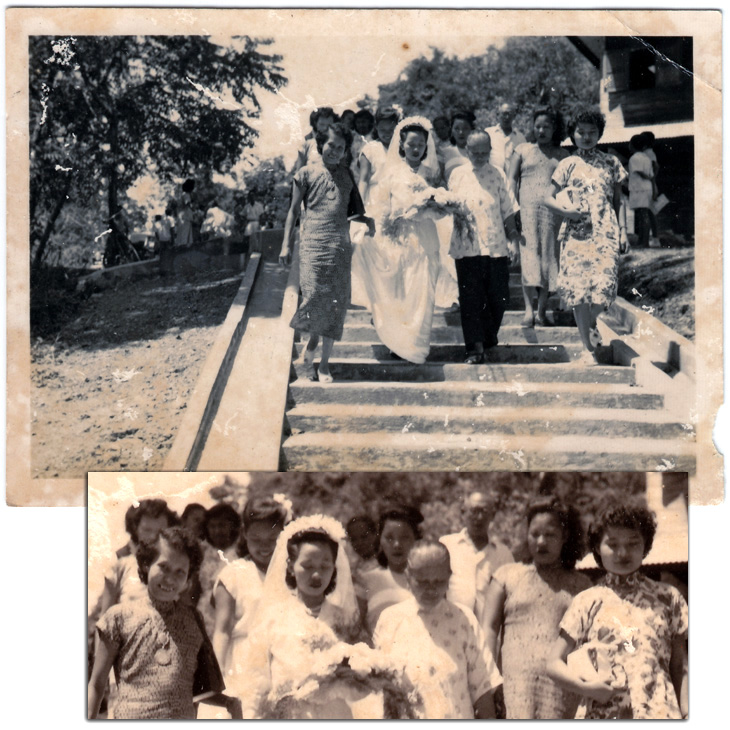
The bride, dressed in a flowing white gown with a delicate veil, began her walk down the broad concrete steps leading toward the Basel Church chapel, where her groom waited at the aisle. Around her gathered family members and friends, guiding her carefully down the slope. The mid-morning sun filtered through the trees, casting dappled light over the procession, and the moment carried both solemnity and quiet joy.


Lok Yuk School and the Church Grounds

The photograph captures not only a wedding but also a glimpse of Jesselton in the 1950s. To the left of the scene stood the Lok Yuk Chinese Primary School, a landmark closely associated with the Basel Christian Church Missionary. At that time, the Mission operated two schools in Sabah: Lok Yuk Chinese Primary School and Lok Yuk English Secondary School.


The Primary School consisted of two wooden double-storey blocks, separated by the very concrete staircase seen in the photo.

The first block, at the top of the stairs, housed Primary 1 and 2 classrooms on the ground floor. The upper floor served as the residence of Pastor Lee Wok Syn, who would conduct the marriage that day. A corner of this building is visible in the photograph.

The second block, situated below the staircase (not visible in the photo), contained four classrooms for Primary 3 to 6.


Just beyond this second block, a few more concrete steps led down to the wooden Basel Church chapel — the destination of the bride and her party, and the place where vows would soon be exchanged.

By the 1990s, these wooden structures were replaced with modern concrete buildings. The area that once served as school and chapel has since been transformed into the Theology Training Center of Sabah, marking the shift from the wooden era to the concrete era.


Family legacy with Lok Yuk School

For the Wong family, Lok Yuk Chinese Primary School was more than just a place of learning — it became a family institution across generations. From the early years, children of the family walked through its wooden classrooms, among them Wong Nyuk Lan, Wong Syak Choi, Wong Fook Tong, and Wong Siew Kah etc.  Each generation carried forward the bond with the school, making its history inseparable from their own.

This connection grew even deeper in the years following the 1952 wedding, when Foo Kim Lan, the Wong family’s third daughter-in-law, joined the school as a teacher till 1965 when the government education department transfer to another primary school in Talipok Town when she taught until retirement.

She devoted her career to educating new generations of students and remained as a teacher until her retirement.


The Basel Christian Church Mission in the 1950s

The Basel Christian Church Missionary of Borneo, rooted in the work of Basel Missionaries from Switzerland in the 1800s, played a central role in education and faith in North Borneo during the 1950s. Mission schools, such as Lok Yuk, provided both Chinese- and English-medium education, while village chapels fostered spiritual life for local communities. The church emphasized not only Christian teaching but also literacy, discipline, and service — leaving a lasting mark on the cultural and educational landscape of Sabah.


Faces in the Photograph

In the wedding procession, certain figures stand out. On the bride’s right-hand side walks Au Pit Nyuk 歐碧玉 (1910s - 1960s), smiling warmly toward the camera. As the wife of Wong Syak On 黃錫安 (1911-1950), she was the first daughter-in-law of the Wong family. On this day, she carried with honor the role of guiding the bride who, in a few moments, would become the second daughter-in-law of the family.

On the bride’s left is an elderly lady, accompanying her closely. Though her identity remains uncertain, family memory recalls her as a senior relative from Papar who offered her service and presence to the Wong family on that special occasion.


A Lasting Memory

Seventy years later, this single image endures — a snapshot of a community, a family, and a promise. The smiling faces, the graceful steps, the wooden school buildings, and the humble church in the story — all are captured in one frame.

What might once have seemed an ordinary photograph of a wedding procession now speaks across generations: a story of beginnings, of heritage, and of the enduring strength of memory.


Sources:
- Liew Soon Tshing : Who’s photo album preserved pictures each worth a thousand words
- Wong Fook Nyen : Who remembered the name of Pastor Lee

Written by Wong Fook Yee
Drafted on 2012-06-30  Last Updated on Monday, September 22, 2025
P:\HTML_Wong\wongfookyee\HTML\Wong\HistoryYear\WongShinChiang\4-WongSyakKee\Marriage\Church Wedding 1.DOC


PART 3/3

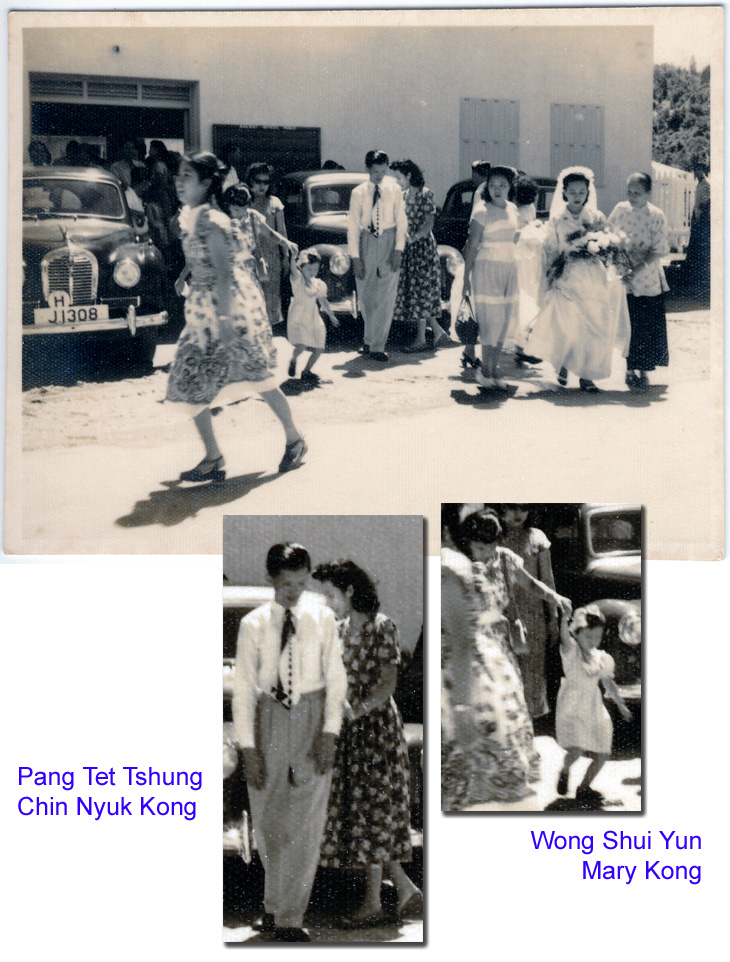
“Arrival of bride Liew Soon Tshing at Jesselton Railway Station, 8 November 1952, welcomed by members of the Wong and Phang families.”


This was a rare sight in 1950s Papar — bride in a full Western white gown boarding the train in Papar to Jesselton, blending Hakka tradition with colonial Christian influence.


It was a clear Saturday morning, 8 November 1952, when the first train of the day from Papar steamed into Jesselton Railway Station. From its carriages stepped a young bride, Liew Soon Tshing, just 23 years old, her heart full of anticipation. This was her wedding day. Waiting on the platform were members of the Wong family, gathered with excitement to welcome her into their lives. From the station, Phang Tet Tshung drove her in his car the short distance of 5 km up the hill to the Basel Church, where her husband-to-be, Wong Syak Kee, stood waiting with relatives and friends.

Yet, in the context of post-war North Borneo, this journey was far from simple. Though the chapel lay only about 50 km from her village home on the map, there was no direct road connection in the 1950s—only the railway line that linked Papar and Jesselton. For the young bride, this meant a long, unhurried journey of nearly two hours by steam train, followed by the final car ride up to the church on the hill.


A New Sight in Papar — A Bride in White on the Train

The journey itself was unforgettable. At dawn, Papar Railway Station came alive with its usual bustle—villagers balancing baskets of fruit, bundles of rubber sheets, and even chickens in woven cages. Yet that morning, among the everyday travelers, there was an astonishing sight: a young bride, dressed in a full Western white wedding gown and veil, stepping aboard the train. To fellow passengers, it was a moment of wonder, for such a vision was rare in a small colonial town still rooted in its Asian traditions. To many, the white gown symbolized modernity and elegance, a fashion often associated with English colonial officers and their families.


The Liew family, to which the bride belonged, were not Christians and had always lived as a traditional Hakka clan, their roots stretching back to the mountain villages of southern Canton (廣州). Yet on this day, their daughter appeared in the attire of the West—her choice of dress reflecting the growing influence of colonial society and Christian customs among overseas Chinese in North Borneo.


Indeed, in 1950s Papar and Jesselton, wedding clothing was a blend of traditions. A bride might don the red ceremonial robe or an embroidered cheongsam/qipao for the family rites, while also embracing the white wedding gown for the church ceremony. Often, both traditions appeared side by side on the same day: the white gown for the vows at the church, followed later by the red dress for the tea ceremony, symbolizing continuity with Chinese heritage.

----------------------------------------

The steam locomotive hissed and puffed, its whistle echoing across the paddy fields. As the train pulled out, the landscape rolled by in slow rhythm: neat rows of coconut palms, small wooden houses with thatched roofs, and stretches of green countryside dotted with grazing buffalo. Inside the carriage, the wooden benches creaked as passengers shifted, fanning themselves in the humid morning air. Children peered curiously at the bride in her carefully prepared attire, while elderly women whispered blessings.

The train wound its way northward, hugging the coastline where glimpses of the South China Sea shimmered between trees. Each stop along the way brought a bustle of movement—passengers boarding with market goods, traders hopping off with their wares. The smell of coal smoke mixed with the salt breeze, leaving an impression that lingered on clothes and hair.

Among the baskets and bundles that filled the train everyday were also tobacco leaves, a common commodity of daily life in 1950s North Borneo. At the time, tobacco was widely consumed—rolled into hand-made cigarettes, chewed with betel nut, or used in traditional pipes by both local natives and immigrant communities. Markets across Papar, Jesselton, and the coastal towns often carried its sharp scent, and its trade formed an important part of the rural economy.

For the bride, tobacco was not only a familiar smell of the marketplace, but also a reminder of her own family’s prosperity. Her father, Liew Yik Nam 劉奕南 (c.1900?–1949?), had built his livelihood by trading tobacco with local people. Through this trade he earned a modest fortune, enough to provide his family with comfort and stability. In later years, his daughter—this young bride of 1952—would often remind her own children that she had come from a well-to-do household, sustained by the enterprise of her father’s business (without mentioning that it was tobacco.)


The Faces of Family


At last, after nearly two hours, the train steamed into Jesselton Railway Station, set beside the town’s central Padang (today Merdeka Square). Here, amid the lively colonial capital, her new family awaited. There, on the crowded platform at the Padang, the bride was received warmly. Phang Tet Tshung, the second son of the Phang family, and his wife Chin Nyuk Kong stepped forward to greet her. It was also Phang Tet Tshung’s car that served as the bridal car, driving her the uphill road to the Basel Church at Jalan Pinggir (today the Sabah Theological Seminary), where family and friends were gathered.

Among those waiting at the Jesselton railway station was Wong Shui Yun Lucy 黃瑞雲 (1926–2022), the youngest sister of the groom. She had come to welcome her new sister-in-law, and by her side stood her little daughter, Mary Kong, her small hand nestled safely in her mother’s. The photograph captures them together—a quiet, tender moment preserved in time.


Decades later, Auntie Shui Yun was still remembered for her sharp wit and her thoughtful reflections on life. When I visited her in 2012 and again in 2022, she was still lively, her spirit undimmed by age. She passed away that 2022 year, lovingly cared for in her final bedridden days by her eldest daughter—the very same child once seen in the 1952 photograph, holding her mother’s hand at the railway station.


That little girl, Mary, grew into a woman of strength and accomplishment. She built a long career with the Japanese Consulate in Kota Kinabalu, and in time became a grandmother herself, blessed with three granddaughters.


A Family’s Resilience and Transformation

This photograph captured more than just the arrival of a bride. It revealed the strength of family bonds. With the passing of Wong Shin Chiang 黃承青 (1887–1939) and Wong Syak On 黃錫安 (1911–1950), there was no senior male relative in the Wong family to serve as host. Yet the gap was filled by Grand Uncle Phang Vui Chau’s family, who stepped in without hesitation, ensuring that traditions were honored and the bride was welcomed with dignity.

Despite early losses and hardships, the day was made whole by the unity of uncles, aunts, cousins, and kin. Together they ensured that love, duty, and tradition prevailed—making this wedding not just a union of two individuals, but a story of resilience, continuity, and ............. transformation.


The Hakka Transformation

For the young bride, Liew Soon Tshing, the moment carried even greater symbolism. Dressed in a white Western gown, she represented both the continuity of a Hakka clan with a thousand-year heritage and the opening of a new chapter shaped by modern Western influences. What had never before been seen in her family—Western wedding attire—became a marker of change, signaling the blending of East and West in a new cultural identity.

This transformation was profound. The Hakka people, once rooted in the mountain villages of Canton, carried their ancient traditions across oceans to Borneo. Yet here, in colonial Jesselton of the 1950s, those traditions began to weave with Western customs. The bride, admired by onlookers on the train for her dazzling gown, stood as a living bridge between old and new, embodying the global shift of her time.

Over the next 70 years, transformation continued to ripple through her family. She raised seven children—five sons and two daughters—who grew up at the crossroads of Hakka tradition and Western modernity. Through them, and later through grandchildren and great-grandchildren, the family moved ever further into the new world that Hakka tradition alone unable to lead them to.


This photograph, frozen in time, invites us not only to remember the past but to marvel at the unfolding story of the future.


Written by Wong Fook Yee
First drafted 2008-06-29 · Last edited 2025-09-20

P:\HTML_Wong\wongfookyee\HTML\Wong\HistoryYear\WongShinChiang\4-WongSyakKee\Marriage\Church Wedding 3.DOC


Church Wedding of
Wong Syak Kee and Liew Soon Tshing

Basel Church, Jesselton (now Kota Kinabalu) -  Saturday 08-11-1952


PART 2/3


“Wedding of Wong Syak Kee and Liew Soon Tshing Basel Church Jesselton – 8 November 1952. A joyful gathering of family and friends to celebrate their union.”


WEDDING DAY

On a bright Saturday morning, 8 November 1952, the Basel Church in Jesselton became the backdrop for a cherished moment in family history. Standing proudly at the church entrance, the newlyweds—Wong Syak Kee Willson 黃錫基 (1921-2008) and Liew Soon Tshing 劉順清 (1930-2003)—were surrounded by their loved ones, capturing the spirit of unity and joy that defined their wedding day. Wong, the groom, in a neatly pressed light-colored suit with a boutonnière, stood with quiet confidence beside his bride. Liew, the bride, radiant in a flowing white gown and delicate veil, carried a bouquet of flowers that symbolized purity and new beginnings.


Beside her, a bridesmaid in matching attire added a sense of harmony to the scene. Her name is yet to be identified. And the groomsman(best man) was the young brother of the groom Wong Syak Choi 黃錫財 (Born 1927)


Around them, family and friends filled the frame: children in their best dresses and short pants, some proudly clutching little handbags; women in elegant cheongsams (旗袍and floral-patterned dresses, their smiles warm and proud; and men in crisp suits or traditional attire, standing tall as pillars of the community. At the back, the pastor in black robes looked on, a reminder of the solemn vows exchanged only moments earlier.


THE MATCHMAKER - WONG KEE NAM  1900s -1956

In this wedding photograph, standing in the back row just behind the bridesmaid, was a man whose unusual posture makes him easy to single out. Instead of facing the camera squarely, he leaned slightly sideways, his left arm turned toward the lens rather than his full body. This was not a one-time stance—on at least three other known photographs of him, the same posture appears, almost as if it were his signature. This man was none other than Wong Kee Nam, the matchmaker who played the most crucial role in bringing about this wedding day. It was he who arranged and finalized the union of the bride and groom, quietly shaping the course of Wong family history.

Much about him remains wrapped in mystery. Just as one wonders why he always presented his left arm to the camera, so too does his life story carry unanswered questions—where exactly he came from, and why he lived the way he did. He was known to have only one close friend in Papar, a man named Liew Jun Chin 劉俊卿 1850s - 1940s, whom he often visited. And fatefully, it was this very friend’s only granddaughter, Liew Soon Tshing, whom Wong Kee Nam matched three years earlier with Wong Syak Kee, the groom walking to the church on this wedding day.

Wong Kee Nam left behind little in worldly possessions—no house, no land, no wife, no relatives, and not even left behind a sewing machine from his trade as a tailor. Yet he left behind something far more enduring: the bond between the Wong and Liew families. Among their children, Christopher Wong would later wrote about him with acknowledgement, ensuring that his name did not fade into silence. In recognition of the quiet but pivotal role he played, Christopher dedicated a page to him in the family history.

Further details of Wong Kee Nam can be found in:
P:\HTML_Wong\wongfookyee\HTML\Wong\HistoryYear\WongKeeNam\WongKeeNam.DOC


This black-and-white photograph freezes a moment of togetherness—a community gathered not just to celebrate a union of two individuals, but to witness the joining of two families. In the early 1950s, Jesselton was still a small town recovering from the war years, and such gatherings were precious occasions of joy, hope, and continuity. Today, this wedding portrait stands as a treasured record of love, tradition, and family heritage.


P:\HTML_Wong\wongfookyee\HTML\Wong\HistoryYear\WongShinChiang\4-WongSyakKee\Marriage\Church Wedding of Wong Syak Kee and Liew Soon Tshi.DOC

Written by Wong Fook Yee 2008-06-29 Last edited on 2025-09-19