
eTawau > Insects of Borneo > Caterpillars > The dead leaf that was holding on
A caterpillar at the tip of a shrub on the Bukit Gemok trail — and not, after all, turning into anything
I was walking the trail at Bukit Gemok Recreational Forest Park alone on the afternoon of 29 July 2017, and I stopped at a shrub beside the path because something at the tip of it was the wrong colour. A brown, crumpled, angular thing, hanging at the fork where two leaves and a side shoot meet. A dying leaf, I thought — the sort a plant sheds and a spider's thread catches on the way down.
Then I looked again, and it was gripping.
My first note on this photograph says "seems in the process of transformation" and "from the outer skin, it is probably a butterfly." Both of those are wrong, and the way they are wrong is worth a page of its own, because the animal is built to be misread and I read it exactly as it intends.
It is not turning into anything. It is a full-grown caterpillar, sitting the way this kind of caterpillar sits, and it will sit like that all day.
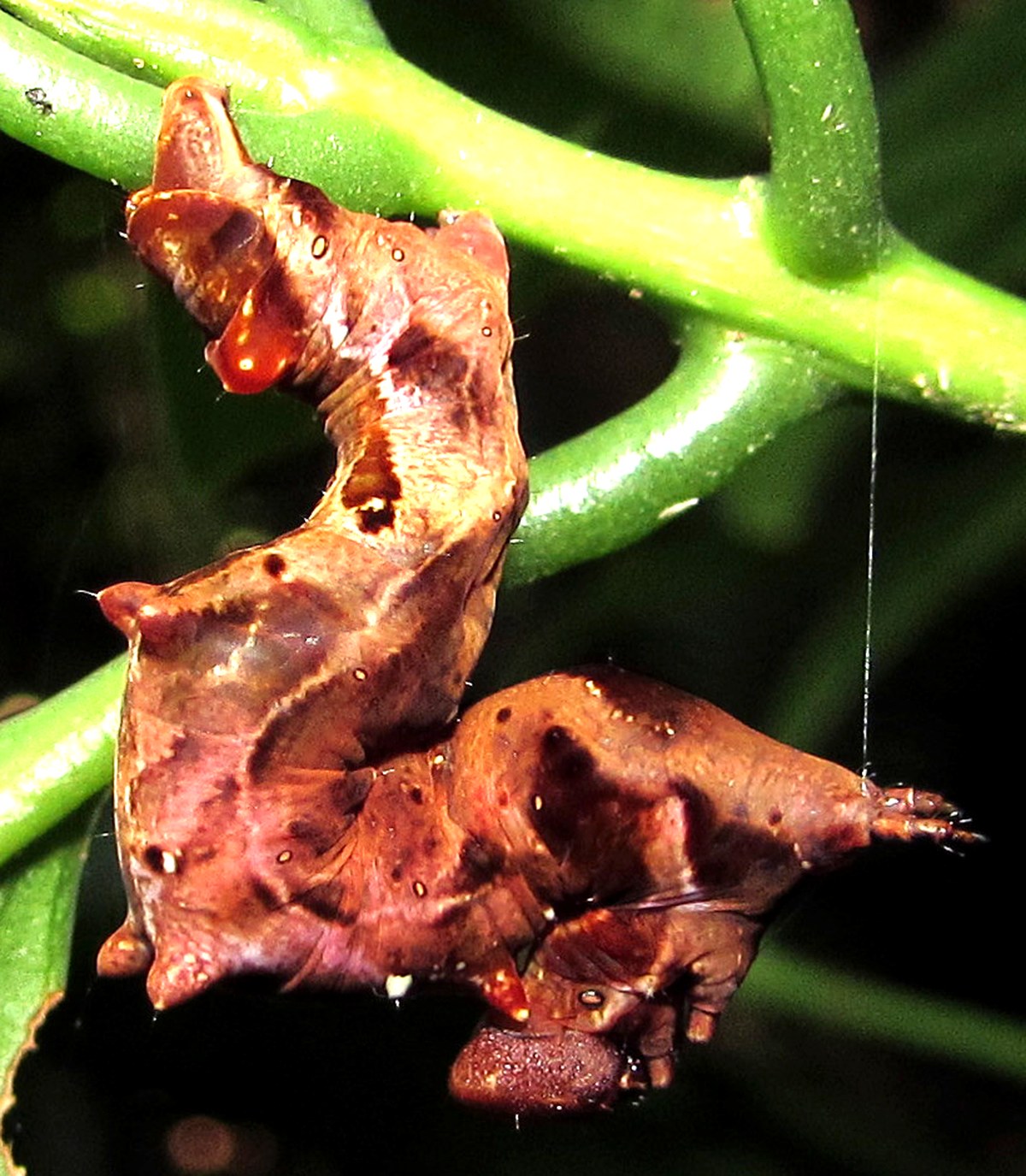
This is worth learning, because "is it changing?" is the question almost everybody asks about a strange brown lump on a twig, and it has a quick answer. Do not look for the things a caterpillar should have — a poor photograph hides those. Look for the things a pupa cannot have.
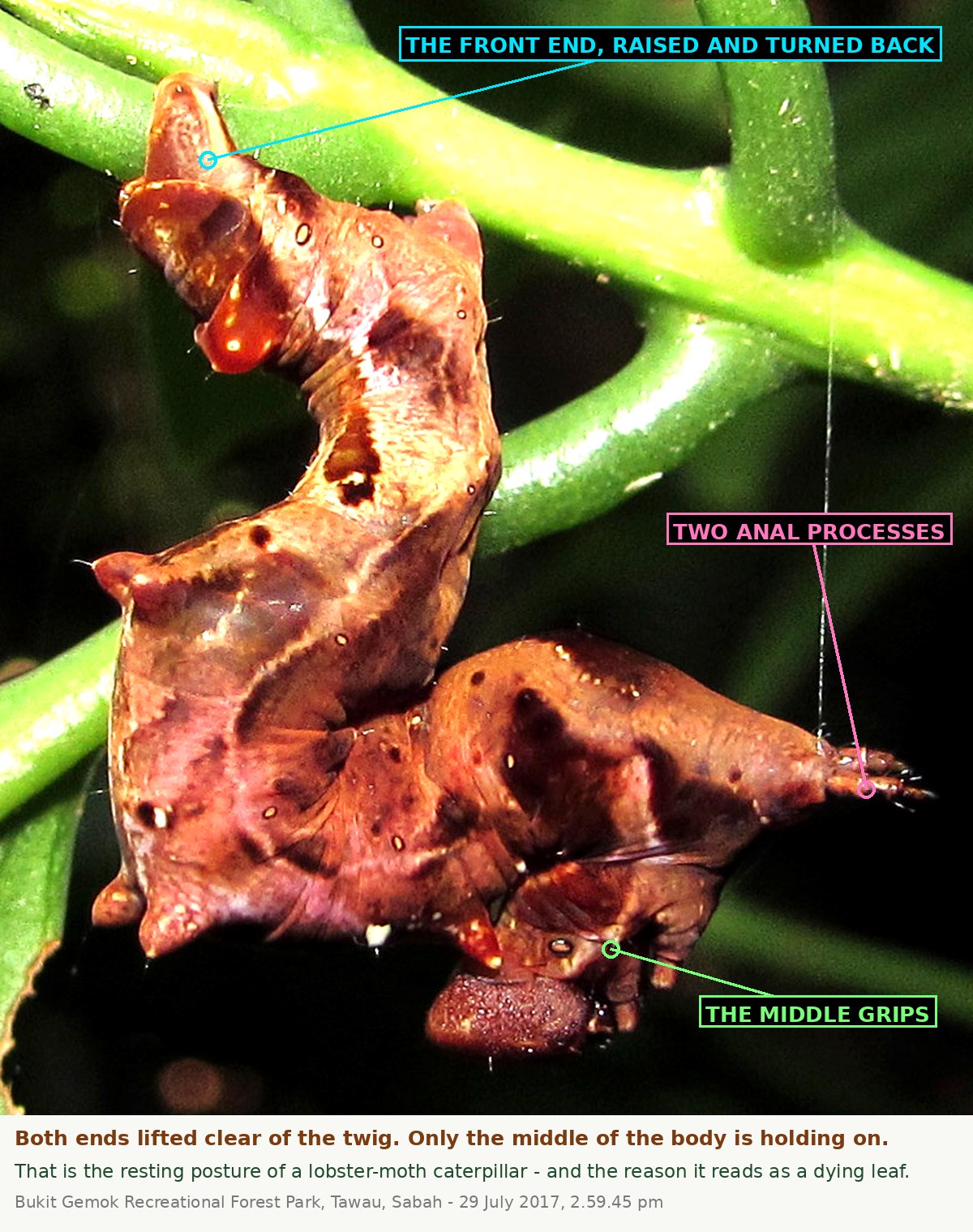
The rear end is the part that gives the family away, and it takes a magnifying glass or an enlarged photograph to see it.
The last segment is swollen, and it is carried up and over the back rather than lying along the twig. At the end of it are two slender processes, each tipped with dark bristles, held out and apart. They are not a forked tail and they are not decoration: they are the animal's last pair of claspers — the gripping legs that most caterpillars use to hold on at the back — remade into a pair of raised spikes and no longer used for holding anything.

That pair puts the animal in the Notodontidae — the prominent moths — and, within that family, in the group known in English as the lobster moths, for the way the caterpillars fold themselves up into something that looks more like a small crustacean than a grub.
Caterpillars in this group are known to rear up when they are disturbed, throwing head and tail into the air to look larger and stranger than they are. So the obvious reading of these pictures is that I frightened it.
I do not think I did. It was already in this attitude when I first saw it, before I was close. And there is better evidence than my memory: I took two photographs thirty seconds apart, the flash fired for both, and between them nothing changed. Nothing was dropped and nothing new was thrown up.
A threat display is a response. It begins when something alarms the animal and it subsides when the alarm passes. This one neither began nor ended. So it is not an alarm — it is simply how the animal sits, all day, every day, until dark.
The family is as far as this record goes, and it goes there on good evidence. The genus does not.
The Bornean lobster moth that answers to this description is Neostauropus alternus (Walker), also written Stauropus alternus — a polyphagous species whose larvae are recorded on tea, coffee, rambutan, mango and a range of legumes. Its published larval description fits what is in these photographs: dark brown with pale patches and fine lines, paired conical bumps along the back, the eighth segment widened at the sides, and the claspers raised as processes.
But Holloway's Moths of Borneo lists Bornean material of that species only from Brunei and Sarawak, and calls it rarely taken. Not from Sabah. So a Sabah larva would be a genuine addition to the record — and that is exactly the reason not to claim it here. It is posted on iNaturalist at family level, with the genus named as a suggestion, for anyone who knows these larvae to accept or reject.
I did not measure it, and my hand in the first photograph cannot be used as a ruler, because it was holding a leaf aside from the left and was not the same distance from the lens as the animal. Anything measured in finger-widths off that picture would be wrong.
The camera answers it instead. The file records the sensor size, the focal length and the distance the lens was focused at, and those three together give the scale of the picture: about 22 pixels to the millimetre at the animal. On that scale it measures about 34 mm as it sits, front tip to the ends of the processes, and about 43 mm followed along the curve of the body. Call it 40 mm, and say somewhere between 30 and 50. It is a large caterpillar either way.
Bukit Gemok Recreational Forest Park, Tawau, Sabah. One caterpillar, alone, about
40 mm, at the tip of an unidentified shrub with opposite elliptic leaves, at the
node where two leaves and a side shoot meet. Dark reddish-brown blotched with purple-black; paired
conical bumps along the back; the swollen last segment carried over the back and ending in two
slender bristle-tipped processes. Gripping with the middle of the body only, both ends raised, and
motionless. Lepidoptera — Notodontidae, the lobster-moth group. Genus and species
not determined. Two frames, 14:59:15 and 14:59:45, flash fired for both. Not
touched; photographed where it sat and left there.
— iNaturalist observation
400202493
The hill stands about 428 metres (1,404 feet). A trail runs 1.7 kilometres from the park entrance to a canopy walk 231 metres long — the second longest in Sabah, after the 300-metre walkway at Danum Valley. The climb to the canopy is where most of the animals on this site from Bukit Gemok have been found.
It is worth knowing that this forest is an island. The Bukit Gemok Forest Reserve covers about 445 hectares, and it is cut off from the larger forest of Tawau Hills Park by the plantations and settlements between them, which is why the Sabah Ficus Germplasm Centre at Tawau Hills exists — it is an attempt to plant a corridor of figs back towards it. An isolated hill forest keeps what it has and gains nothing new, so what is recorded there is worth recording carefully.
Other animals photographed on this hill and published here:
About the photographs. Taken by Wong Fook Yee with a Canon PowerShot SX510 HS at
Bukit Gemok Recreational Forest Park, Tawau, Sabah, on 29 July 2017 at 14:59:15 and 14:59:45. The
flash fired for both, which is why the close views have a black background in the middle of the
afternoon — and why the hairs and the breathing pore are visible at all. For this page the pictures
have been reduced and brightened, and two of them labelled, because a visitor wants to be shown what
to look at. The unmarked originals are attached to the iNaturalist record above, which is where
anyone working on the identification should start.
The family characters, the larval description and the Bornean distribution follow J. D. Holloway,
The Moths of Borneo, and the published larval diagnosis of the Notodontidae. The date, the
time, the camera settings and the scale of the photographs are taken from the files themselves. The
locality, the altitude, the trail figures and the circumstances of the find are the photographer's
own field observations. All photographs © Wong Fook Yee. Page written 14 September 2026.