Ficus subgelderi (Golden Leaf Fig)
淡金榕 / 金葉榕 - The Dioecious Golden Strangler of Southeast Asia
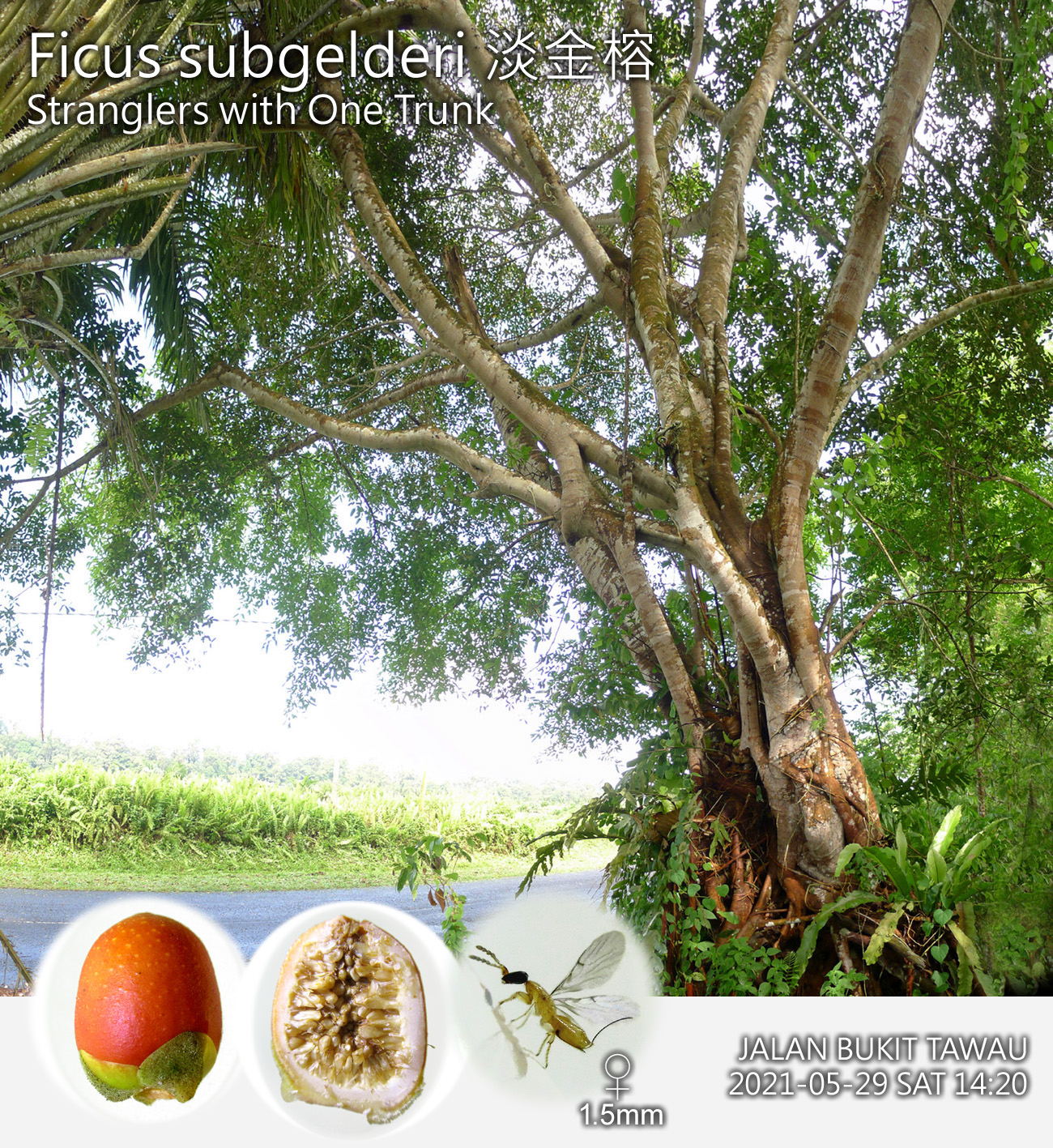
Mature Ficus subgelderi strangler fig showing the unique lattice trunk structure
Introduction
Ficus subgelderi, commonly known as the Golden Leaf Fig, is a remarkable dioecious strangler fig native to the tropical forests of Borneo and surrounding regions. This species is notable for its unique sexual system (dioecious) and the distinctive golden-yellow undersides of its leaves that give it both its scientific and common names.
As a dioecious species (雌雄異株), male and female flowers are produced on separate trees, creating a fascinating reproductive strategy that requires specific pollinators and spatial distribution for successful reproduction. The tree begins its life as an epiphyte in the forest canopy before sending down aerial roots that eventually envelop and replace its host.
Understanding Dioecious Reproduction
Unlike most strangler figs in its group which are monoecious (having both male and female flowers on the same tree), Ficus subgelderi has separate male and female trees. This means:
- Only female trees produce edible figs
- Pollination requires wasps to travel between male and female trees
- Reproductive success depends on proximity of male and female trees
- This system increases genetic diversity in the population
Taxonomic Classification
| Kingdom | Plantae |
| Clade | Tracheophytes |
| Clade | Angiosperms |
| Clade | Eudicots |
| Clade | Rosids |
| Order | Rosales |
| Family | Moraceae |
| Tribe | Ficeae |
| Genus | Ficus |
| Subgenus | Urostigma |
| Section | Conosycea |
| Species | Ficus subgelderi |
Botanical Description
Morphological Features
Growth Habit
Strangler fig growing up to 25-30m tall, beginning as epiphyte and developing into independent tree.
Leaves
Distinctive golden-yellow undersides, elliptic to ovate shape, 8-16 cm long, leathery texture.
Fruits (Figs)
Small syconia, axillary or cauliflorous, yellow to orange when ripe, 1-1.5 cm diameter.
Bark & Trunk
Smooth greyish bark developing into characteristic lattice structure as it envelops host tree.
Unique Characteristics
Dioecious System: Separate male and female trees - a rare characteristic among strangler figs in this group.
Leaf Identification: The golden-yellow leaf undersides are the most reliable field identification feature.
Growth Pattern: Exhibits classic strangler fig development with initial epiphytic phase followed by root descent and host envelopment.
The Strangler Process
Seed Dispersal
Seeds deposited by birds in host tree canopy crevices
Epiphytic Growth
Seed germinates and grows as epiphyte on host
Root Descent
Aerial roots grow downward toward soil
Independence
Roots fuse, host decomposes, fig stands alone
Pollinator Spotlight: Fig Wasp Relationship
Female wasp: Approximately 1.5mm in length (documented)
Male wasp: Not yet formally documented (requires further research)
Pollination Strategy: Due to its dioecious nature, the fig-wasp mutualism in F. subgelderi is particularly complex. Wasps must locate both male trees (for reproduction) and female trees (for pollination) to complete their life cycle.
Distribution and Habitat
Ficus subgelderi is primarily found in Borneo with scattered occurrences in surrounding regions, preferring lowland tropical rainforests with high humidity.
Geographic Range
- Borneo: Primary distribution across Sabah, Sarawak, and Kalimantan
- Malaysia: Scattered locations in Peninsular Malaysia
- Indonesia: Sumatra (limited distribution)
- Specific Locations: Documented in Tawau (Gudang 4), Maliau Basin, Danum Valley
Preferred Habitats
- Lowland tropical rainforests (0-800m elevation)
- Undisturbed primary forests
- Riparian zones and areas with consistent moisture
- Forests with diverse tree species for host options
- Areas with intact pollinator communities
Cultural Significance
Traditional Uses
While not as widely documented as some other Ficus species, F. subgelderi has traditional significance in some Bornean communities:
- Medicinal: Latex used in traditional remedies for skin conditions
- Cultural Marker: Presence indicates healthy, mature forest ecosystems
- Ecological Indicator: Used by indigenous trackers as sign of forest age and stability
Ecocultural Importance
The dioecious nature of F. subgelderi makes it ecologically significant:
- Serves as year-round food source for forest fauna
- Creates unique microhabitats within its lattice trunk
- Important component of traditional ecological knowledge systems
- Subject of local folklore regarding its "golden" leaves
Ecological Role & Wildlife Interactions
As a keystone species in its habitat, Ficus subgelderi supports extensive ecological networks through its unique characteristics.
Dioecious Pollination System
The separate male and female trees create a specialized pollination ecology. Fig wasps must navigate between trees, making population distribution critical for reproductive success. This system:
- Promotes genetic diversity through outcrossing
- Creates spatial pollination networks in the forest
- May be more vulnerable to habitat fragmentation than monoecious species
- Requires specific wasp species adaptations
Wildlife Support
- Frugivores: Birds (hornbills, pigeons, barbets) and mammals (flying foxes, civets) feed on fruits
- Insect Communities: Supports diverse insect populations beyond pollinator wasps
- Epiphyte Host: Lattice trunk structure provides ideal substrate for orchids, ferns, and mosses
- Nesting Sites: Cavities in mature trees provide nesting for birds and mammals
Comparison with Related Strangler Figs
Ficus subgelderi is unique among "Stranglers with One Trunk" due to its dioecious reproductive system. Here's how it compares:
| Species | Common Name | Key Distinguishing Features | Sexual System | Leaf Characteristics |
|---|---|---|---|---|
| Ficus subgelderi | Golden Leaf Fig | Golden leaf undersides, dioecious system | Dioecious | Golden-yellow undersides |
| Ficus dubia | Deep Red Fruit Fig | Scrambling habit, deep red fruits | Monoecious | Dark green, uniform color |
| Ficus callophylla | 美葉榕 | Beautiful leaves, less aggressive strangling | Monoecious | Attractive, decorative leaves |
| Ficus cucurbitina | 南瓜榕 | Gourd-shaped fruits, prominent basal bracts | Monoecious | Standard green coloration |
| Ficus subcordata | 近心葉榕 | Heart-shaped leaf bases, smaller fruits | Monoecious | Distinct heart-shaped base |
Identification Tip: The combination of golden-yellow leaf undersides and dioecious reproductive system makes Ficus subgelderi unique among Bornean strangler figs. Always check multiple trees in a population to confirm dioecious nature.
Image Gallery

Leave of MALE Ficus subgelderi at Gudang 4, Tawau - Note the characteristic leaf shape and venation
Did You Know?
Rare Reproductive Strategy
Among the 5 species in the "Stranglers with One Trunk" group, F. subgelderi is the only dioecious species, making it reproductively unique.
Golden Signature
The golden-yellow leaf undersides are not just decorative - they may help in light reflection in the dim understory or serve as a deterrent to herbivores.
Pollinator Mystery
While the female fig wasp has been documented (1.5mm), the male wasp remains unrecorded, presenting an opportunity for entomological discovery.
Conservation Indicator
As a dioecious species, F. subgelderi may be more vulnerable to habitat fragmentation than monoecious figs, making it an important conservation indicator.
Test Your Knowledge
Conservation Status
Data Deficient / Potentially Vulnerable
Ficus subgelderi has not been formally assessed on the IUCN Red List, but its specialized reproductive system and habitat requirements make it potentially vulnerable to forest loss and fragmentation.
Conservation Importance: As the only dioecious species in its group and with its unique pollination requirements, F. subgelderi represents an important component of Bornean forest biodiversity. Its conservation helps maintain complex ecological networks.
Threats and Conservation Actions
Primary Threats
- Deforestation for palm oil and timber plantations
- Habitat fragmentation disrupting pollination between male/female trees
- Climate change affecting forest microclimates
- Loss of specific pollinator wasp populations
- Limited distribution range compared to more widespread Ficus species
Conservation Actions
- Formal assessment of conservation status on IUCN Red List
- Protection of known populations in conservation areas
- Research on specific pollinator requirements and ecology
- Maintenance of forest corridors to connect fragmented populations
- Education about the importance of dioecious species in forest ecosystems
Educational Takeaway
Ficus subgelderi provides important lessons in plant reproductive diversity and ecological specialization:
Reproductive Diversity
Demonstrates the ecological implications of dioecious vs. monoecious reproductive systems.
Ecological Networks
Highlights the complexity of pollination networks in tropical forests.
Scientific Discovery
Shows that even in well-studied groups like figs, there are still mysteries (like the male wasp) to be solved.
Studying species like F. subgelderi helps students appreciate the diversity of life history strategies in tropical ecosystems and the importance of conserving specialized ecological relationships.