Ficus cucurbitina (Southern Gourd Fig)
南瓜榕 - The Spiny-Fruited Strangler Fig of Southeast Asia
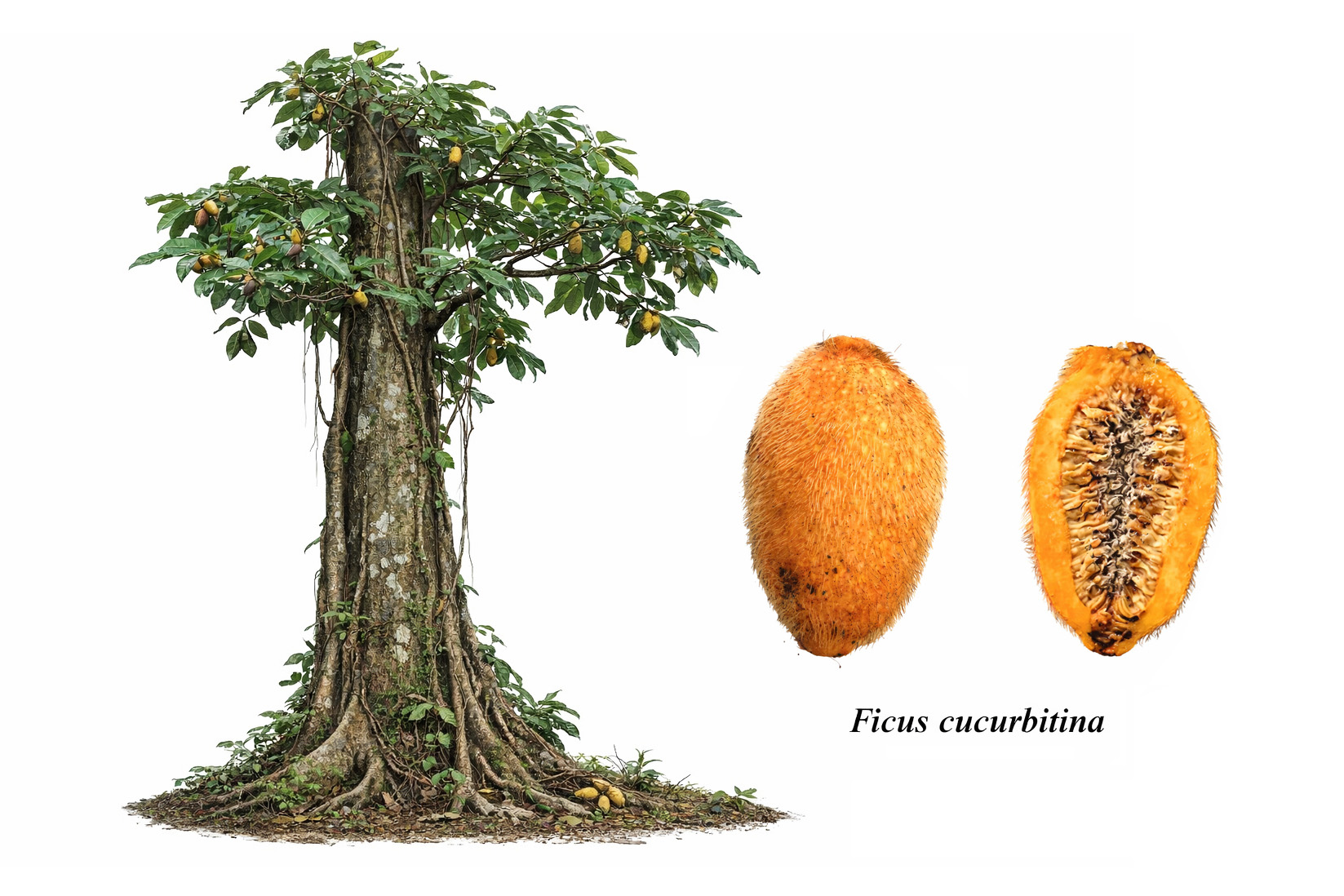
Mature Ficus cucurbitina strangler fig showing characteristic large, spiny fruits
Introduction
Ficus cucurbitina, commonly known as the Southern Gourd Fig or Spiny Fig, is an uncommon but widespread tropical strangler fig species distinguished by its remarkable cucumber-shaped fruits covered in sharp, irritating spines. Unlike more aggressive stranglers, this species typically sends down only a single large root to the ground, often allowing its host tree to survive longer.
As a hemi-epiphyte, it begins life in the canopy of a host tree and can develop into a massive liana or free-standing tree reaching 15-40 meters in height. Its unique spiny fruits represent an extraordinary evolutionary adaptation for specialized seed dispersal by large hornbills while deterring smaller fruit predators.
Taxonomic Classification
| Kingdom | Plantae |
| Clade | Tracheophytes |
| Clade | Angiosperms |
| Clade | Eudicots |
| Clade | Rosids |
| Order | Rosales |
| Family | Moraceae |
| Tribe | Ficeae |
| Genus | Ficus |
| Subgenus | Urostigma |
| Species | Ficus cucurbitina |
Botanical Description
Morphological Features
Growth Habit
Hemi-epiphytic strangler beginning life in host canopy, developing as large liana or tree up to 40m tall.
Leaves
Large, leathery, oblong leaves adapted to tropical rainforest conditions, typically 15-25 cm long.
Fruits (Figs)
Distinctive large, oblong, cucumber-shaped syconia up to 5 cm long, covered with sharp, irritating spines.
Bark & Roots
Smooth grey bark; typically develops single massive aerial root rather than multiple roots like other stranglers.
The Spiny Fruit: An Evolutionary Marvel
The most distinctive feature of Ficus cucurbitina is its remarkable spiny fruits. These spines serve multiple evolutionary purposes:
Deterrence
Spines deter smaller fruit predators like green pigeons and squirrels
Specialization
Allows selective feeding by large hornbills with long, protected bills
Dispersal
Hornbill digestion enhances seed germination and dispersal to new locations
Fruit Development: Figs ripen from green to orange-red, with spines pointing away from the base. This orientation may facilitate handling by hornbills while protecting the fruit's attachment point.
Distribution and Habitat
Ficus cucurbitina has a scattered but widespread distribution across Southeast Asia's tropical rainforests, with specific habitat preferences for its unique ecological niche.
Geographic Range
- Southern Thailand: Tropical rainforests
- Peninsular Malaysia: Lowland and hill forests
- The Philippines: Selected islands with suitable habitat
- Borneo: Throughout the island, especially Sabah
Notable Locations
- Tawau Hills Park, Sabah: Locally common population
- Danum Valley, Sabah: Protected population in conservation area
- Endau-Rompin National Park, Malaysia: Protected lowland forests
Preferred Habitats
- Primary tropical rainforests
- Undisturbed forest ecosystems with mature trees
- Lowland to lower montane forests (0-1,200m elevation)
- Areas with healthy hornbill populations for seed dispersal
- Locations with specific host tree species suitable for epiphytic establishment
Habitat Requirements
The species requires specific conditions for successful establishment:
- Mature host trees with suitable bark texture for seed germination
- Presence of hornbill species for effective seed dispersal
- Undisturbed forest canopy for initial epiphytic growth
- Stable humid tropical climate year-round
Ecological Role & Wildlife Interactions
Ficus cucurbitina plays a significant ecological role in Southeast Asian tropical forests, particularly through its specialized relationships with wildlife.
Pollination System
Like all figs, Ficus cucurbitina maintains an obligate mutualism with specific fig wasp species (Agaonidae). The exact wasp species for this fig requires further study but follows the classic fig-wasp co-evolution pattern where female wasps enter the syconium, pollinate flowers, and lay eggs in some ovaries, with their offspring later emerging to continue the cycle.
Specialized Seed Dispersal
The spiny fruits represent a remarkable evolutionary adaptation for targeted seed dispersal:
Hornbills
Primary dispersers with long bills that can handle spiny fruits safely
Green Pigeons
Deterred by spines, reducing competition for hornbills
Germination Boost
Hornbill digestion enhances seed germination rates
Fruit Consumers & Wildlife Attraction
Despite the spines, fruiting trees attract diverse wildlife:
- Primates: Gibbons and macaques that learn to handle spiny fruits
- Mammals: Squirrels, civets, and flying foxes during peak fruiting
- Birds: Hornbills (primary), barbets, and other large frugivores
- Importance: Provides critical food resources, particularly when other fruits are scarce
Ecosystem Services
- Forest regeneration: Animals disperse seeds to new locations including canopy gaps
- Habitat creation: Complex structure hosts epiphytes, insects, and nesting sites
- Food web support: Sustains diverse frugivore populations year-round
- Genetic connectivity: Long-distance dispersal by hornbills maintains genetic diversity
- Indicator species: Presence indicates healthy forest with intact seed dispersal networks
Comparison with Related Strangler Figs
Ficus cucurbitina belongs to the "Stranglers with One Trunk" group. Here's how it compares to related species:
| Species | Common Name | Key Distinguishing Features | Fruit Characteristics |
|---|---|---|---|
| Ficus cucurbitina | Southern Gourd Fig | Large, spiny, cucumber-shaped fruits; single main root | Up to 5 cm, spiny, orange-red when ripe |
| Ficus dubia | Deep Red Fruit Fig | Scrambling habit, smooth pale bark, deep red fruits | 1-2 cm, smooth, deep red when ripe |
| Ficus callophylla | Beautiful Leaf Fig | Beautiful leaves, less aggressive strangling | Small to medium, smooth, various colors |
| Ficus subcordata | Heart-leaf Fig | Heart-shaped leaf bases, smaller fruits | Small, smooth, yellow to orange |
| Ficus microcarpa | Chinese Banyan | Aggressive strangler with multiple roots | Small, smooth, purple when ripe |
Field Identification Tips
Key characteristics for identifying Ficus cucurbitina:
- Fruits: Large (up to 5cm), oblong, cucumber-shaped with sharp spines pointing away from base
- Growth habit: Typically develops as large liana or tree with single massive root (not multiple aerial roots)
- Leaf size: Large, leathery leaves 15-25cm long
- Host relationship: Often appears less destructive to host trees compared to aggressive stranglers
- Ripening color: Fruits transition from green to orange-red when mature
Image Gallery
Click images to enlarge
Did You Know?
Protective Spines
The spines contain irritant compounds that can cause skin irritation, serving as both physical and chemical defense.
Gentle Strangler
Unlike aggressive stranglers, it often allows host trees to survive longer by sending down only one main root.
Hornbill Restaurant
The spiny fruits essentially create an "exclusive restaurant" for hornbills, reducing competition from other frugivores.
Distribution Mystery
Its patchy distribution suggests specific but unknown ecological requirements beyond just suitable climate.
Test Your Knowledge
Conservation Status
Near Threatened / Vulnerable
Ficus cucurbitina faces significant threats from habitat loss across its range. While not formally assessed on the IUCN Red List, its specialized ecological requirements make it particularly vulnerable to deforestation and ecosystem disruption.
Conservation Concern: As a species with specialized seed dispersal relationships and specific habitat requirements, protecting F. cucurbitina requires preserving not just the trees themselves but also their ecological networks, particularly hornbill populations and undisturbed forest habitats.
Threats and Conservation Actions
Primary Threats
- Deforestation for agriculture (particularly palm oil)
- Habitat fragmentation disrupting seed dispersal by hornbills
- Loss of large, mature host trees needed for epiphytic establishment
- Decline of hornbill populations due to hunting and habitat loss
- Climate change altering tropical forest ecosystems
Conservation Actions
- Protection of remaining primary tropical forests across range
- Specific protection of known populations (e.g., Tawau Hills Park)
- Conservation of hornbill populations as essential seed dispersers
- Research on specific ecological requirements and pollinator relationships
- Inclusion in forest restoration projects in degraded areas
- Monitoring of populations to track conservation status
Ecological Interdependence
The conservation of Ficus cucurbitina highlights the interconnectedness of tropical ecosystems:
- Protecting this fig requires protecting its hornbill dispersers
- Hornbill conservation requires protecting large forest tracts
- Healthy forests with intact fig populations support diverse wildlife
- This creates a conservation cascade benefiting entire ecosystems
Research and Knowledge Gaps
Despite its distinctive characteristics, Ficus cucurbitina remains understudied with several important research questions unanswered:
Pollinator Identity
The specific fig wasp species that pollinates F. cucurbitina has not been formally identified and studied.
Genetic Diversity
Population genetics and connectivity across its fragmented range are unknown.
Germination Ecology
Specific requirements for seed germination and establishment need investigation.
Population Status
Comprehensive population surveys across its entire range are lacking.
Research Opportunities: This species offers excellent opportunities for studying plant-animal coevolution, seed dispersal ecology, and conservation biology in tropical forest ecosystems.