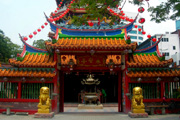
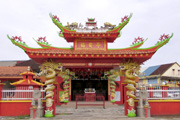
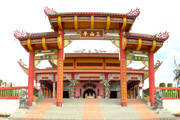
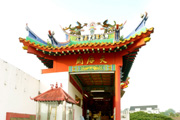
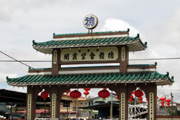
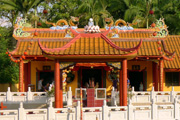
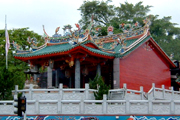
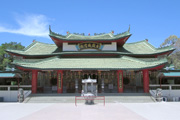
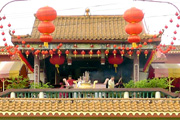
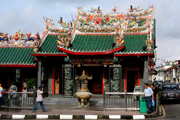
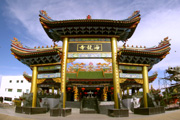
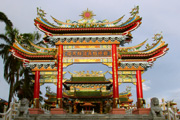
View from Ching San Yen Temple, Kuching 古晋青山巖
KUCHING CITY > TAOISM > Ching San Yen Temple 青山巖
| CHINESE VERSION | ENGLISH VERSION |
View from Ching San Yen Temple, Kuching 古晋青山巖

Ching San Yen Temple
古晋青山巖
This Buddhist temple is called Ching San Yen. It is situated on a 2.5-acre
site on a hill at 120ft above sea level at the left hank of the estuary of
Sarawak River. This temple is about 15 nautical miles from the barrage of
Sarawak River and 30 kilometres from Kuching city centre.
This temple in Kampung Muara Tebas, is the biggest temple within the
jurisdiction of Kuching City North Council. Kampung Muara Tebas is a Malay
fishing village of racial harmony and religious tolerance.
A National Tabloid, The Star in its National Day special edition dated 31st
August 1995 listed Kampung Muara Tehas as a place that practices the most
religious tolerance in Malaysia. Meanwhile, "The Sarawak Book of Amazing Facts &
Records" published by the Ministry of Tourism of Sarawak in 2001 has described
Ching San Yen as the most decorative Buddhist temple in Sarawak.

古晋青山巖
Ching San Yen Temple
History:
According to oral history in Kampung Muara Tehas, Ching San Yen Temple existed on
this hill 200 years ago. At that lime, the temple was
small when Chinese and Malay traders carried out trading at the fishing village.
The origin old Ching San Yen has two versions.
The first version relates its origin as follows:- about 200 years ago, Chinese
immigrants, having safely arrived at the estuary of Sarawak River, built the
temple on the hill at the left bank of the estuary of Sarawak River based on the
best geomancy selection so as to thank the Buddha, Bodhisattvas & Macho (Goddess
of Sea) for their blessing of a safe journey. They would come to the temple to
worship from time to time to obtain blessing for good health and good business.
Thereafter. Chinese immigrants on reaching Sarawak River would pay homage to the
Buddha offering thanks giving for a save journey. Likewise, immigrants, before
set sail for their homeland would also visit the temple to pray blessing for a
save journey home. They would also drink water from a well below the hill on
which the temple is built for health.
The other version says that 200 years ago many Chinese came to Sarawak for
trading. They made a trade station along the sea side behind the hill of the
temple. They also selected the present site as a place of good geomancy to place
the statue of Buddha, other Bodhisattvas and Macho (Goddess of Sea) for
worshipping for good business and blessing. They needed fresh water. Following
the indication of Buddha, they found a well below the hill on which the present
temple is sited. The well provided adequate fresh water and Kampung Muara Tebas
then became a trading post.
This well is still in existence. It had been the source of fresh water until
1980 when water supply was extended to the village. According to historical
records Ching San Yen underwent a major renovation in 1903. It is generally
believed that the Ching San Yen began as a small temple and developed by stages
to become a big temple. Historical record shows that the temple was renovated in
1903; was managed by two monks whose names are inscribed on a piece of signboard
now hung at the main temple hall, all donors (or this renovation have their
names inscribed on a stone plague now cemented to the inner wall of the temple.
Development of Ching San Yen
In June 1979, a stall quarters was built mid in September of the same
year, the roof of the main temple was repaired.
On 1st May 1984, Kuching Hockien Association look over the administration of
(lie temple and carried out a survey on the temple. It was decided to carry out
a major renovation. On 24th January 1994, the earth breaking ceremony for the
renovation was officiated by the Minister in Chief Minister's office Datuk Dr.
George Chan Hong Nam. Renovation works was completed on 30th June 1996 with the
floor area of the temple extended from 5590sq ft to 9278sq It and two wings
added to the main temple. The original wooden structure and carving have been
re-conditioned and kept intact. All the roofs have been covered with yellow
gazed tiles with assorted porcelain artefacts such as dragons and fish etc. Many
Buddhist auspicious signs and artefacts were added to the building.
On 4lh August 1996, Deputy Chief Minister, Minister of Finance and Public
Utilities and Minister of Industry Development, YB Tan Sri Datuk Amar Dr. George
Chan Hong Nam officiated the completion ceremony of this renovation works which
marked a turning point of the history of Ching San Yen i.e. its transformation
from an old and dilapidated temple to a magnificent and decorative one.
The second phase of renovation works consisting of one vegetarian dining hall,
two public toilets and decorative fencing wall was completed in August 1998. The
third phase renovation works consisting of landscaping of the garden, one
fountain and one pail's of Buddha's foot print of 108 auspicious articles was
completed in October 2000.
| Lunar Month | Name of Festival | Celebration |
| 4th day
to 15th day of 1st moon |
Paying annual homage to Lord Buddha |
|
Buddha and Deities worshipped at Ching San Yen Temple :
At the forefront altar
The Heavenly King
Lao Tze (Founder of Taoism)
Deities of Sun & Moon
In front of the main altar
Macho (The Goddess of Sea) & her two aides
At the main altar
Lord Buddha, Amitaba, Buddha of Medicine
Right side of altar
Avolokitesva Guan Yin (for compassion)
Samantabhadra (for peace & happiness)
Manjusri (for wisdom)
Left side of altar
Ushnishavijaya (protector of life)
Ksitigardha (consoler of the dead)
Left wing of the temple
Deity Tua Pek Kong
Right wing of the temple
Deity Kong Teck Choon Ong
Deity Siang Tian Sian Ti
Deity Pau Kong
TAOISM in SARAWAK
砂勞越州道教廟堂
RELATED TOPICS
|
|
RELIGION |