Ficus racemosa (Cluster Fig)
聚果榕 - The cauliflorous keystone species of tropical Asia

Ficus racemosa tree with characteristic clustered fruits growing directly on the trunk (cauliflory)
Introduction
Ficus racemosa L., commonly known as the Cluster Fig or 聚果榕 in Chinese, is a medium-sized deciduous tree in the Moraceae family. This remarkable species is distinguished by its unique cauliflorous fruiting habit—producing dense clusters of figs directly on its trunk and main branches rather than on smaller twigs.
As a monoecious species (雌雄同株), it bears both male and female flowers within the same fig syconium. The tree serves as a vital keystone species in tropical ecosystems and holds significant cultural, medicinal, and ecological importance across South and Southeast Asia.
Botanical Description
Morphological Features
Height & Habit
Medium-sized deciduous tree, 15-18 m tall, with a spreading crown.
Leaves
Broad, ovate leaves with smooth margins, alternately arranged, 10-18 cm long.
Fruits (Figs)
Round syconia, 2-5 cm diameter, green when young ripening to reddish-orange; borne in dense clusters directly on trunk and branches (cauliflory).
Bark
Greyish, smooth bark with medicinal properties; contains latex.
Reproductive Biology
Monoecious: Both male and female flowers occur within the same fig syconium.
Pollination: Exclusively pollinated by the fig wasp Ceratosolen fusciceps in a highly specialized mutualistic relationship.
Fruiting Pattern: Produces multiple crops per year with peak fruiting during dry seasons. Fruits mature in about 2-3 months.
Unique Adaptation
Cauliflory
The adaptation of bearing flowers and fruits directly on the trunk makes them accessible to ground-dwelling and trunk-climbing animals, facilitating seed dispersal by a wider range of frugivores.
Image Gallery
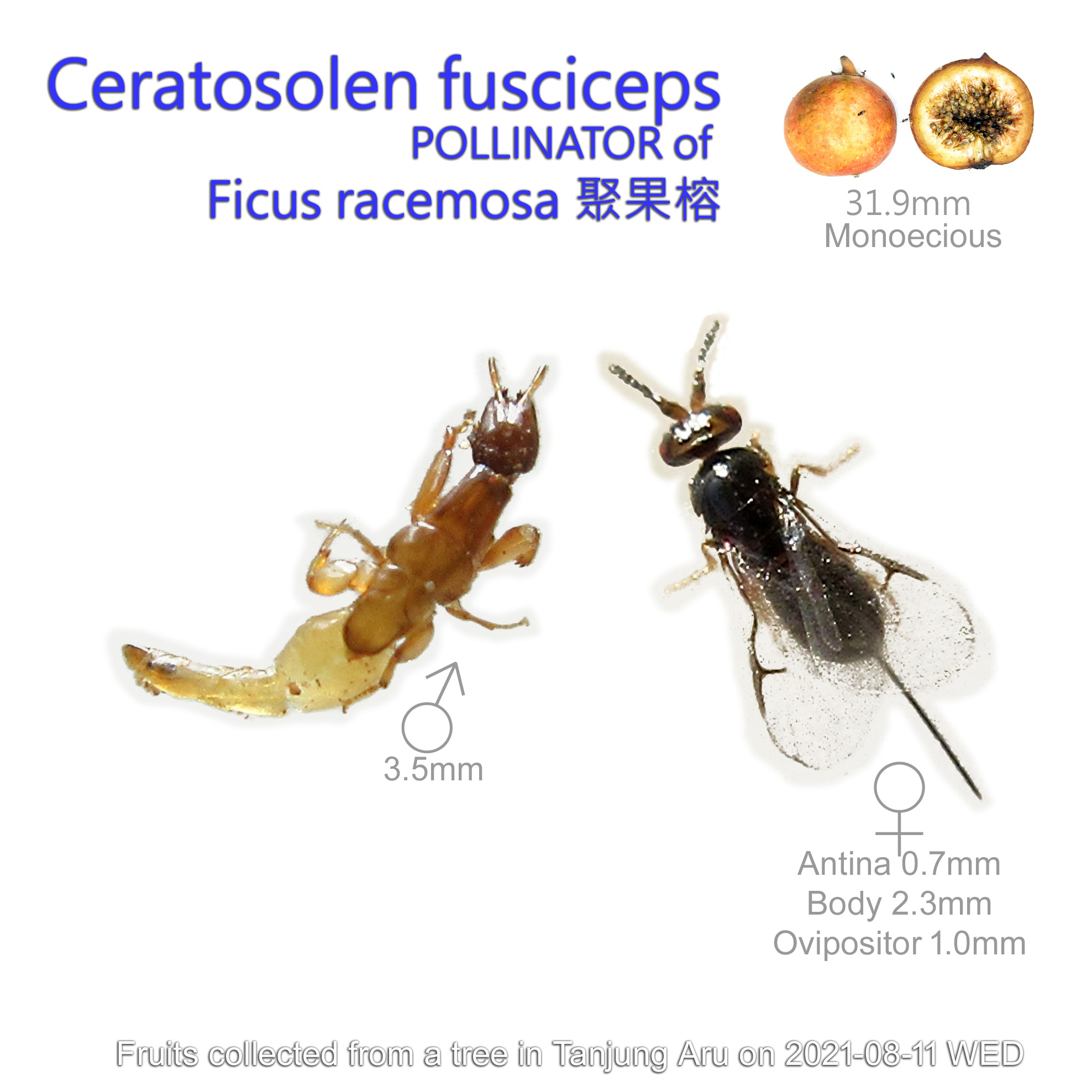
Specialized Pollination System
FIG WASPS that breed in fruits of Ficus racemosa
All wasp species in this chart were found from 20 fruits collected from a tree in Tanjung Aru on 2021-08-11

A - POLLINATOR
Ceratosolen fusciceps
Pollinator Wasp Details:
- Male (♂): 3.5 mm, wingless, lives inside fig
- Female (♀): 2.3 mm body + 1.0 mm ovipositor
- Antenna: 0.5 mm
Ficus racemosa is pollinated by a single population of a single agaonid wasp species all over continental South-East Asia.
Non-Pollinating Fig Wasps
Several non-pollinating wasp species also breed in the figs but play no role in pollination. These wasps lay eggs through the fig skin early in fruit development.
Distribution and Habitat
Ficus racemosa has a wide distribution across tropical Asia and Australasia, thriving in various habitats with sufficient moisture.
Geographic Range
- Indian subcontinent (India, Sri Lanka, Nepal, Bangladesh)
- Southeast Asia (Myanmar, Thailand, Vietnam, Cambodia, Laos)
- Malay Peninsula and Archipelago
- Borneo (throughout the island)
- Philippines
- Northern Australia (Queensland, Northern Territory)
Preferred Habitats
- Riverbanks and streamsides (riparian zones)
- Moist deciduous forests
- Village landscapes and temple grounds
- Forest edges and secondary growth areas
- Elevation: 0-1,800 meters above sea level
Historical & Cultural Significance
Ficus racemosa has been deeply integrated into the cultural and spiritual traditions of South and Southeast Asia for millennia.
Religious Significance
Revered in Hinduism and Buddhism; often planted near temples in India. Known as "Udumbara" in Sanskrit scriptures, mentioned in ancient Buddhist texts as a symbol of rarity and spiritual significance.
Cultural Symbolism
The Chinese name 聚果榕 ("cluster-fruit banyan") highlights its unique fruiting pattern. Symbolizes abundance, resilience, and community in many Asian cultures due to its prolific fruiting and ability to thrive in challenging conditions.
Historical Uses
Documented in Ayurvedic texts for over 3,000 years. Traditional communities have used various parts of the tree for food, medicine, and practical applications like natural dyes and fish poison.
Ethnobotanical Uses & Economic Importance
Medicinal Uses
Ayurveda & Traditional Medicine:
- Bark decoctions for diabetes, diarrhea, and inflammatory conditions
- Fruits aid digestion and support liver health
- Latex applied to skin ailments, warts, and wounds
- Root extracts for urinary disorders and menstrual problems
Phytochemical Composition
Contains flavonoids, tannins, saponins, sterols, and phenolic compounds with demonstrated antioxidant, antimicrobial, and anti-inflammatory properties.
Food & Other Uses
- Edible Fruits: Eaten raw, cooked, or pickled; used in chutneys and curries
- Fodder: Leaves used as fodder for livestock
- Timber: Lightweight wood used for making boxes, matches, and cheap furniture
- Ecological Services: Soil stabilization on riverbanks, shade tree in agroforestry systems
- Ornamental: Planted in parks and large gardens for its unique cauliflorous habit
Ecological Role
As a keystone species, Ficus racemosa plays a critical role in maintaining tropical ecosystem biodiversity.
Wildlife Support
- Frugivores: Provides year-round food for birds (hornbills, barbets, pigeons), bats, monkeys (macaques, langurs), and civets
- Pollinators: Supports specialized fig wasp populations
- Habitat: Offers nesting sites and shelter for various animals
- Critical Resource: Fruits during lean seasons when other food sources are scarce
Ecosystem Services
- Soil stabilization on riverbanks with extensive root system
- Carbon sequestration as a medium to large tree
- Water regulation in riparian ecosystems
- Supporting complex food webs through its year-round fruiting
Keystone Species Concept
The removal of keystone species like F. racemosa disproportionately affects ecosystem structure and function, leading to biodiversity loss.
Comparison with Related Ficus Species
Ficus racemosa belongs to the "Tree Trunk Figs" group (Section Sycomorus), which bear fruits directly on the trunk and main branches. Here's how it compares to related species in Borneo:
| Feature | Ficus racemosa | Ficus variegata | Ficus nota |
|---|---|---|---|
| Flower Sex | Monoecious | Dioecious | Dioecious |
| Fruit Position | On trunk & branches (cauliflorous) | On branches & trunk | In leaf axils |
| Fruit Color | Green → Reddish-orange | Green → Pink/Red | Green → Yellowish |
| Pollinator Wasp | Ceratosolen fusciceps | Ceratosolen appendiculatus | Unknown |
| Habitat Preference | Riverbanks, moist areas | Various forest types | Secondary forests |
Did You Know?
Ancient Species
Fig trees are among the oldest flowering plants, with fossil records dating back 80-90 million years. The fig-wasp mutualism is one of the most ancient plant-insect relationships.
Year-round Fruiting
Unlike most tropical trees that fruit seasonally, F. racemosa produces multiple crops per year, making it a critical "keystone resource" for wildlife during lean periods.
Medicinal Powerhouse
Nearly every part of the tree is used in traditional medicine systems across Asia. Modern research has confirmed antioxidant, antimicrobial, antidiabetic, and anti-inflammatory properties.
Single Pollinator
Ficus racemosa is pollinated by a single species of fig wasp (Ceratosolen fusciceps) throughout its entire range from India to Australia, demonstrating extreme specialization.
Educational Insights
Studying Ficus racemosa provides valuable lessons across multiple scientific disciplines:
Scientific Concepts Illustrated
- Botany: Plant morphology, taxonomy, and unique adaptations like cauliflory
- Ecology: Keystone species concept, mutualism, and ecological networks
- Ethnobotany: Traditional knowledge systems and medicinal plant use
- Evolutionary Biology: Co-evolution and specialized pollination systems
- Conservation Biology: Importance of protecting keystone species and their habitats
Field Identification Tips
- Look for dense clusters of round fruits on the trunk and main branches
- Note the smooth greyish bark and broad ovate leaves
- Check habitat preference for moist areas and riverbanks
- Observe the monoecious flowering system (both sexes in same fig)
- Compare with similar species using the comparison table above
Test Your Knowledge
Conservation Status
Least Concern (IUCN Red List)
Ficus racemosa is currently not considered threatened due to its wide distribution across tropical Asia and ability to grow in various habitats including disturbed areas. However, like many forest trees, it faces localized threats from habitat loss and over-exploitation.
Conservation Importance: As a keystone species, protecting F. racemosa is crucial for maintaining overall forest biodiversity. Conservation efforts should focus on preserving riparian habitats and maintaining populations of its specialized pollinator wasp.
Threats and Conservation Actions
Primary Threats
- Riparian habitat destruction for agriculture and development
- Over-harvesting of bark and fruits for medicinal use
- Habitat fragmentation affecting pollinator populations
- Climate change altering rainfall patterns in its habitat
- Competition from invasive plant species
Recommended Conservation Actions
- Protection of riverine ecosystems and riparian buffers
- Inclusion in reforestation and habitat restoration programs
- Sustainable harvesting guidelines for medicinal use
- Research on pollinator conservation and climate resilience
- Community education about keystone species importance
- Cultivation in botanical gardens and conservation areas